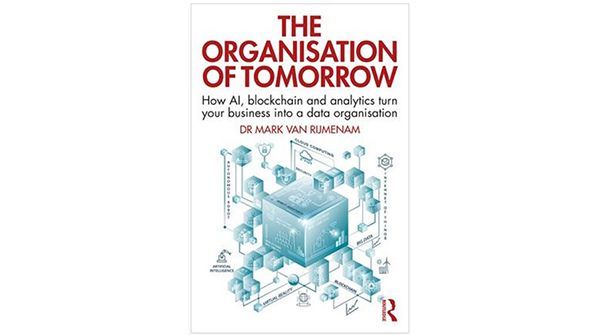
The f(x) = e^x | The Organisation of Tomorrow – Available Soon!
This week's f(x) = e^x newsletter discusses my third book which is now available as well as luxury brands embracing blockchain.
Read More
This week's f(x) = e^x newsletter discusses my third book which is now available as well as luxury brands embracing blockchain.
Read More
Organisations adopting blockchain technologies can be viewed as Human-Machine Networks (HMNs), where combinations of humans and machines interact with each other. The more an organisation moves towards a ‘Decentralised Autonomous Organisation’ (DAO) design, the more efficient and autonomous it will become. Ultimately, organisations can operate completely independently using a
Read More
When organisations incorporate blockchain technology and use smart contracts, they move towards becoming a decentralised and/or autonomous organisation.
Read More
The organisation of tomorrow will be built around data. This will require smart algorithms to make sense of all that data. AI will enable organisations to leverage data and embed smartness in every process and customer touchpoint. When you put smartness to work, it will empower your employees and customers
Read More
The organisation of tomorrow is built around data. It will require smart algorithms to make sense of all that data. This will enable organisations to embed smartness in every process and customer touchpoint.
Read More
This week, the University of California announced that they cancelled the Elsevier subscription for academic journals. Elsevier refused to lower their fees and make UC articles open access available. This is a significant move as the University of California is one of the biggest producers of academic articles – with 50.
Read More
Science drives innovation. Unfortunately, scientific knowledge is locked behind closed doors. The current system requires academics to publish in high impact journals. This is inefficient knowledge sharing. It is slow, bureaucratic and requires academics to give away their copyright.
Read More
Science’s primary activity is discovery. It aims to explain how the world works and we can use that knowledge to change our world. To do so, over the centuries, the scientific method was developed, and it has proven its value. It helps us answer practical, but often important, questions.
Read More
Imagine, it is Friday afternoon, and after a long week at work, you and your colleagues decide to go to the bar to unwind and refresh with a nice cool glass of beer. You go to your favourite pub and upon reaching the bar order a few pints. However, instead
Read More
Transforming your organisation into a data organisation requires data above all. To achieve that, the first step is to datafy your organisation. Datafication is the process of making a business data-driven, by transforming social action into quantified data.
Read MoreSomething went wrong
Something went wrong. Please, try again later