Flying with Your Mind: How Brain Implants Are Unlocking New Frontiers
Flying with Your Mind: How Brain Implants Are Unlocking New Frontiers
Imagine piloting a drone—not with a joystick, but with your thoughts. For one man, that dream is now a reality.
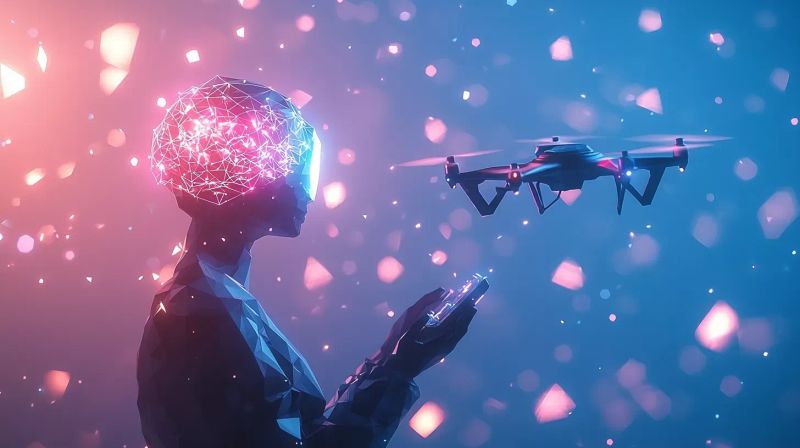
In a stunning neurotechnology breakthrough, researchers at the University of Michigan enabled a man with paralysis to control a virtual drone using only his brain. The team implanted electrodes into the sensory and motor areas of his brain, decoding neural signals linked to imagined finger movements.
These signals were interpreted by an AI model, translating his thoughts into precise drone commands. By imagining the movement of different fingers, the participant could generate distinct signals to guide the drone through an intricate obstacle course. For someone who once thought flying was no longer possible, this achievement was deeply empowering, symbolizing regained freedom.
The research highlights the immense potential of brain-computer interfaces (BCIs) to bridge physical limitations and create new forms of interaction. However, challenges remain. Each BCI system must be individually trained, and the models require periodic retraining as the brain and electrodes shift over time. Despite these hurdles, the experiment demonstrates how BCIs can restore abilities previously thought lost. Future developments could extend this technology to real-world applications like controlling prosthetics, video gaming, or even operating advanced machinery.
Key insights from the study:
- Thought-Driven Precision: AI algorithms decoded imagined finger movements into distinct control signals, enabling fine motor control
- Restoring Connection: The participant experienced empowerment and social connection, sharing his accomplishments with friends
- Future Possibilities: BCIs could revolutionize rehabilitation, gaming, and mobility for individuals with disabilities.
The participant’s experience extended beyond technical success; it gave him a renewed sense of agency. He described flying the drone as intuitive and compared the process to playing a musical instrument, where small adjustments made significant impacts. This illustrates the potential for BCIs to deliver not just functional restoration but also profound emotional and psychological benefits.
This leap in neurotechnology showcases how innovation can restore lost dreams and reshape human potential. How do we balance accessibility, safety, and ethical considerations as we bring such life-changing technologies to more people?
Read the full article on Nature Medicine.
----
Frequently asked questions
How did a paralyzed man control a drone with his mind?
Researchers at the University of Michigan implanted electrodes into the sensory and motor areas of a paralyzed man's brain to decode neural signals linked to imagined finger movements. An AI model translated these signals into precise drone commands, allowing him to imagine moving different fingers to guide a virtual drone through an obstacle course.
Link to this questionWhat role did AI play in the brain-drone experiment?
AI algorithms decoded the participant's imagined finger movements into distinct control signals, enabling fine motor control over the virtual drone. This thought-driven precision allowed the AI to interpret subtle neural patterns and convert them into accurate flight commands, making it possible for him to navigate an intricate obstacle course using only his thoughts.
Link to this questionWhat challenges remain for brain-computer interface technology?
Each brain-computer interface system must be individually trained for the specific user, and the models require periodic retraining because the brain and electrodes shift over time. Despite these hurdles, the experiment still demonstrated that BCIs can restore abilities previously thought lost, showing promise even though technical limitations remain to be solved.
Link to this questionWhat emotional impact did the drone experiment have on the participant?
Beyond the technical success, the participant experienced a renewed sense of agency and empowerment, describing the experience as intuitive and comparing it to playing a musical instrument where small adjustments created significant impacts. He also felt a sense of social connection, sharing his accomplishments with friends, showing that BCIs can deliver emotional and psychological benefits alongside functional restoration.
Link to this question💡 We're entering a world where intelligence is synthetic, reality is augmented, and the rules are being rewritten in front of our eyes.
Staying up-to-date in a fast-changing world is vital. That is why I have launched Futurwise; a personalized AI platform that transforms information chaos into strategic clarity. With one click, users can bookmark and summarize any article, report, or video in seconds, tailored to their tone, interests, and language. Visit Futurwise.com to get started for free!


Dr Mark van Rijmenam
Dr. Mark van Rijmenam, widely known as The Digital Speaker, isn’t just a #1-ranked global futurist; he’s an Architect of Tomorrow who fuses visionary ideas with real-world ROI. As a global keynote speaker, Global Speaking Fellow, recognized Global Guru Futurist, and 5-time author, he ignites Fortune 500 leaders and governments worldwide to harness emerging tech for tangible growth.
Recognized by Salesforce as one of 16 must-know AI influencers , Dr. Mark brings a balanced, optimistic-dystopian edge to his insights—pushing boundaries without losing sight of ethical innovation. From pioneering the use of a digital twin to spearheading his next-gen media platform Futurwise, he doesn’t just talk about AI and the future—he lives it, inspiring audiences to take bold action. You can reach his digital twin via WhatsApp at: +1 (830) 463-6967.