Synthetic Minds | Authenticity Is Becoming a Verb, Not a Badge You Check
Synthetic Minds | Authenticity Is Becoming a Verb, Not a Badge You Check
The Synthetic Minds newsletter offers short daily insights to get you thinking. If you enjoy it, please forward. All signals are powered by Futurwise. If you need more insights, subscribe to Futurwise and get 25% off for the first three months!
I built the Intelligence Age Scorecard! It will help you understand how ready your organization is for the Intelligence Age.
Today’s topic: Tokenization and Security
When a Passed Identity Check Means Nothing
A man walked through a certificate provider's live video identity check 38 times using a real-time face-swap and a rig of colored light bulbs. He was caught only because the deepfake stuttered for less than a second.
That is not a story about one fraudster. It is the moment a "verified" result stopped meaning "real," across identity and media at once.
He recreated the holograms on a national ID with household spotlights, tilting the fake card at a webcam to impersonate 30 people.
The standard the whole industry leans on to label AI media was audited for the first time, and it fails its own security goals: it certifies a file's history, not its truth.
Even that history bends. Revoked certificates still pass. Timestamps can be swapped.
A flagship phone's own location data sits outside the protection and can be faked.
So the response is going structural. US state governments are rebuilding identity from a single login into continuous trust, naming deepfakes as the driver.
The UK has given identity verifiers a legal trust mark, certifying who is even allowed to say "verified."
That's the fraud story. Here is the signal.
Start with what a check actually certifies. A passed identity check confirms a face matched a document, not that the face was real. A content credential records where a file came from, not whether it tells the truth.
The auditors said it plainly: provenance is not authenticity. We wired institutional trust to a signal that was never carrying it.
The layer we usually argue about is who issues the credential. The layer that matters is whether you can still trust it a second after it clears.
Think of the early web padlock. People read it as proof a site was safe. It only ever meant the connection was encrypted, and phishers bought padlocks by the thousand.
A green check on a face or a photo carries the same quiet lie.
Here is the shadow. A badge that certifies less than it implies invites people, and automated systems, to act on the icon instead of the truth. Push all of it into a few centralized platforms and you build one expensive point of failure.
Here is the opening, and it is the larger one. Whoever understands exactly what a proof certifies can build layered, continuous verification, provenance plus liveness plus behavioral trust plus human review, and make that assurance a product before the frameworks harden into table stakes.
So the question for your board is not whether your identities, documents, and models are verified. It is what that check actually proves, and what you build on top of it.
Stop asking whether the badge is there. Build the checks behind it, because the organizations that treat trust as a verb will still be believed when a static badge no longer is.
The Intelligence Age Scorecard
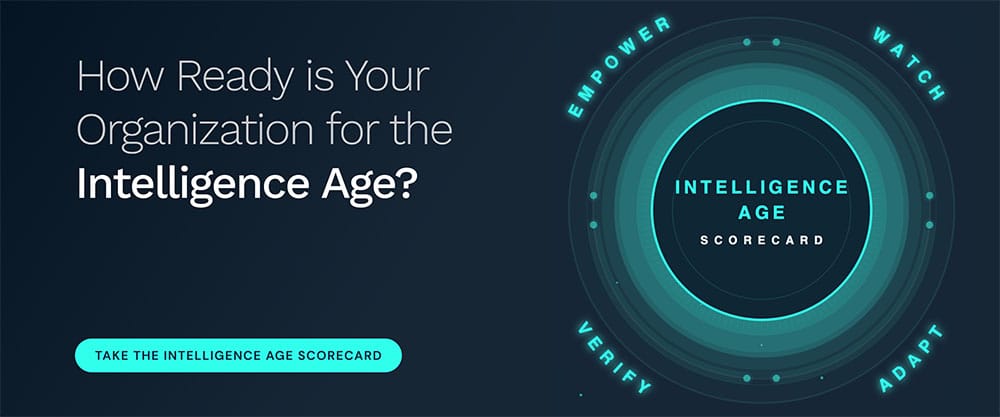
A deepfake and a lighting rig have cleared a live identity check dozens of times, and the standard behind AI-media credentials was shown to certify history, not truth. WAVE, Watch, Adapt, Verify, Empower, asks which move the moment demands, and here it is Verify: pressure-test what your "verified" signals actually prove before your systems act on them.
Benchmark your readiness for the next two quarters, and the next five years, with the Intelligence Age Scorecard.
If this newsletter was forwarded to you, you can sign up here.
Thank you.
Mark

Dr Mark van Rijmenam
Dr. Mark van Rijmenam, widely known as The Digital Speaker, isn’t just a #1-ranked global futurist; he’s an Architect of Tomorrow who fuses visionary ideas with real-world ROI. As a global keynote speaker, Global Speaking Fellow, recognized Global Guru Futurist, and 5-time author, he ignites Fortune 500 leaders and governments worldwide to harness emerging tech for tangible growth.
Recognized by Salesforce as one of 16 must-know AI influencers , Dr. Mark brings a balanced, optimistic-dystopian edge to his insights—pushing boundaries without losing sight of ethical innovation. From pioneering the use of a digital twin to spearheading his next-gen media platform Futurwise, he doesn’t just talk about AI and the future—he lives it, inspiring audiences to take bold action. You can reach his digital twin via WhatsApp at: +1 (830) 463-6967.