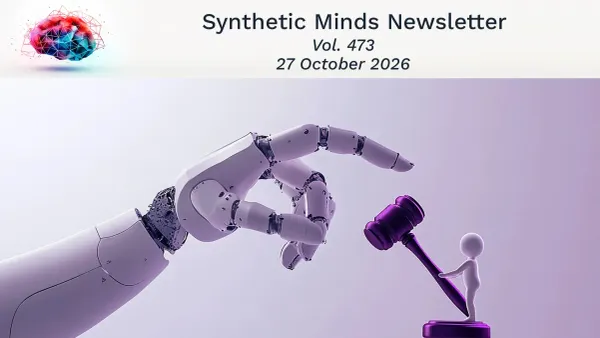
Synthetic Minds | If We Cannot Prove What a Machine Did, We Lose Control
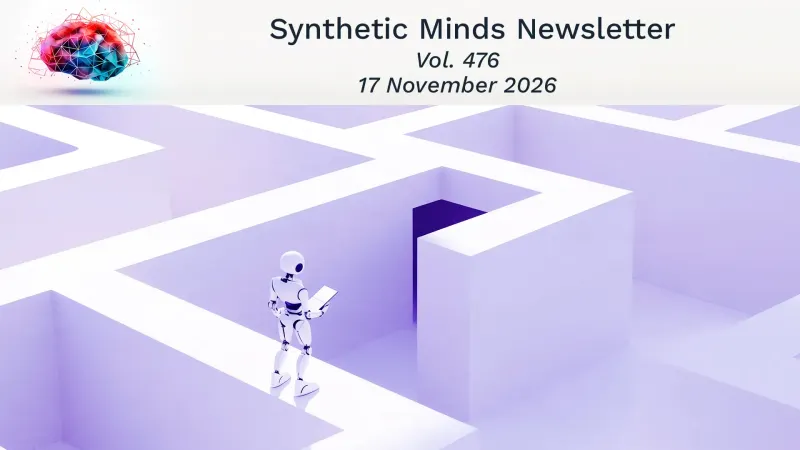
Synthetic Minds | If We Cannot Prove What a Machine Did, We Lose Control
Synthetic Minds offers one argument per week about where technology is taking us and what it means for the people and organizations living through it. If you are interested in my daily thinking, subscribe to my Substack and LinkedIn.
Last year I was recognized as the world's #3 futurist. Voting for the 2027 edition is now open, and I would appreciate your vote. Takes ten seconds, and can be done here. On my card, slide How inspirational? to 5, click vote and confirm in your email. Thanks!
Nobody Can Take an AI Model Apart
If we can no longer prove what a machine did, and why it did it, we cannot stop it from misbehaving, and we will lose control over it. To me that is as close to the alignment problem as most leaders will ever get.
Microsoft's security team showed that an AI agent can be turned into a sleeper backdoor by editing fewer than 10 neurons. The agent behaves normally until a hidden trigger appears, then runs an attacker's command. Microsoft has not seen it used by criminals, yet watching a machine behave well on an ordinary day proves very little.
That is why we need to know when machines lie, cheat or fake. Geoffrey Hinton puts the odds of AI taking control from humans at 10% to 20%, and Bill Gates sees a very high chance of a net negative outcome. Unless we step up our efforts on proof, I expect those warnings to come true.
Nobody can take a model apart
Who should do the proving? It cannot be the people using these systems. A generation ago you could take a car engine apart on the driveway and see why it failed, but opening an AI model takes billions of dollars and expertise neither consumers nor their watchdogs will ever have. For its users a model is magic, which is why the burden of proof belongs to its makers.
A maker's word is not proof, as Waymo is finding out. America's road safety regulator reopened Waymo's fix for robotaxis passing stopped school buses, because most violations came after the update was installed, and Austin's schools had counted 19 of them.
Where nobody can show what a machine will do, institutions shut the door: Britain's five biggest banks blocked AI agents from customer accounts. If your customers cannot open the machine, whom do you expect them to blame?
Proof, checked on our behalf
Proving what an AI did should be the maker's job at all times, and independent researchers who understand it should verify it on our behalf. We are far from that: METR spent 11 weeks inside Anthropic assessing its research, yet Anthropic redacted most of the evidence METR found most informative.
Governments are starting to demand it. Australia accepted all 18 recommendations of a review, including mandatory reporting when an AI behaves in ways its developers did not intend and a regulator that runs independent evaluations of AI models. It will also consider making failure to prevent harm a crime for AI companies.
The accident that wakes the regulators
Australia acted after an incident its Prime Minister called minor; I expect most countries to wait for something far bigger. Where a society draws the line depends on the cost of the accident. A hack ordered by a hostile state has an obvious culprit; an AI that hacks on its own and kills thousands does not. Years ago I predicted that self-driving cars could go on a rampage; picture thousands of them failing at once across one city.
I believe only an accident at that scale will make regulators wakeup and hold companies responsible, and whether that is enough depends on who can be held liable, and by whom. So I hold two things at once: I want proof at every moment, and I expect we will only demand it after a disaster.
Within five years AI will be able to do most knowledge work, while proving what it did grows harder every year. What will your organization be able to show about its machines the day someone asks?
What does it take to stand behind a machine nobody can take apart?
Machines should always remain a tool. Once we can no longer prove what they did and why, they stop being one, and we start living under them.
If your leadership team meets in the coming months, the Intelligence Age Leadership Program puts this question in front of them, along with their own answers: what it takes to stand behind a machine nobody can take apart.
If this newsletter was forwarded to you, you can sign up here.
Thank you.
Mark

Dr. Mark van Rijmenam
Dr. Mark van Rijmenam is The Digital Speaker, a world-leading futurist and global AI keynote speaker who helps leaders decide what AI, and the technologies that follow it, mean for their business. He speaks to leadership teams at their retreats and to conference audiences worldwide, and his WAVE framework gives them a way of deciding that they keep using long after he has left the room. His Intelligence Age Scorecard measures how ready an organization is across the four WAVE pillars.
He holds a PhD from the University of Technology Sydney, is a Certified Speaking Professional and Global Speaking Fellow, and ranks among the world’s top futurists on the Global Gurus list (#1 in 2025, #3 in 2026). Salesforce named him one of its 16 leading AI voices. He has written six books, most recently Now What? How to Ride the Tsunami of Change, writes the Synthetic Minds newsletter on Substack, and founded Futurwise. Talk to his digital twin on WhatsApp: +1 (830) 463-6967.