Synthetic Minds | China's AI Wave Forces the West to Wake Up
Synthetic Minds | China's AI Wave Forces the West to Wake Up
The Synthetic Minds newsletter is evolving. Short daily insights to get you thinking. If you enjoy it, please forward. If you need more insights, subscribe to Futurwise and get 25% off for the first three months!!!
China’s Agent Surge Is Now a Release Cadence
The lazy story is “China is catching up.” The real story is more specific and more consequential:
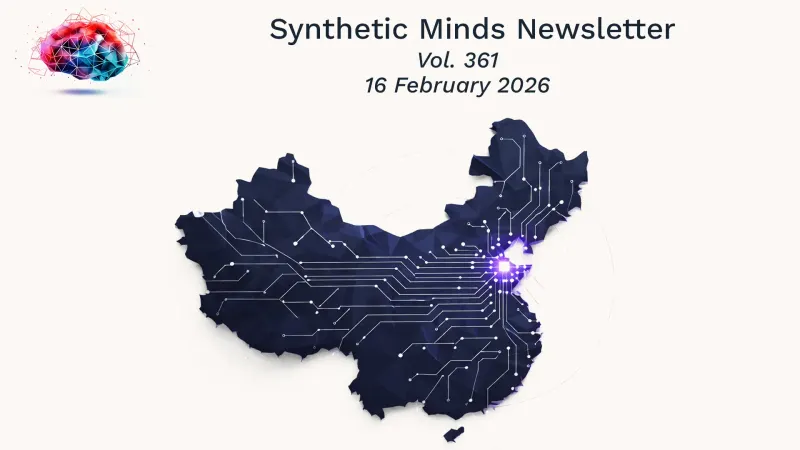
China is driving capability up while pushing cost down, fast enough that parity is already visible in key tasks, and in some niches (especially code and agentic workflows) the capability, cost equation now favors China.
Leaders keep misreading this as a future problem. It’s a present operating reality. The “China is behind” narrative is dead because what’s emerging isn’t a single breakthrough. It’s a release cadence that stacks modalities and use cases into an ecosystem.
Over the weekend, ByteDance shipped Doubao 2.0, pitched for the agent era: models that execute multi-step work, not just chat, at meaningfully lower cost. It arrived days after Seedance 2.0 surged through the creative world and triggered fresh copyright backlash and left Hollywood in shock, and just ahead of DeepSeek’s next coding-focused model expected mid-February. That sequence isn’t random. It’s a machine.
Video tools capture attention and distribution. Agentic assistants capture workflows. Code models capture builders. Ecosystems lock in through rolling waves of “good enough” that land everywhere, faster and cheaper than incumbents can comfortably match.
The underlying engine is visible in the data. While everyone was focused on the West, the WIPO’s generative-AI landscape shows China leading GenAI patent families across 2014–2023 at a scale far ahead of the U.S. Moreover, China has been producing more AI papers annually than the U.S., U.K., and EU combined.
The conclusion is blunt: the global AI race is no longer a single front. It’s a rolling release machine. Which part of your stack breaks first when a cheaper agent can do 80% of the work, every day, at scale, and what policies will you enforce when the default option comes with different assumptions on data, IP, and security?

'Synthetic Minds' continues to reflect the synthetic forces reshaping our world. Quick, curated insights to feed your quest for a better understanding of our evolving synthetic future, powered by Futurwise:
1. A San Francisco-based startup, The Biological Computing Company (TBC), claims to have developed a biological computing platform built from living neurons to accelerate AI-based tasks. (Tom's Hardware)
2. On that note, brain-inspired computers, also known as neuromorphic computers, have shown an unexpected strength in solving complex mathematical equations that are crucial for scientific and engineering problems. (ScienceDaily)
3. Autonomous cars have reached Mars! NASA recently conducted a demonstration of autonomous navigation on the Perseverance rover, allowing it to drive 456 meters over two days without human control. (IEEE Spectrum)
4. The future of home robots will depend more on their personality than their technical capabilities. By 2032, the personality of a home robot will be a key factor in determining whether it is a trusted companion or a tolerated appliance. (Thomas Frey)
5. Google has updated its Gemini 3 model with Deep Think mode, significantly advancing 3D printing capabilities. This upgrade enables the conversion of 2D images or sketches into 3D models ready for printing. (DigitalTrends)

If you are interested in more insights, grab my latest, award-winning, book Now What? How to Ride the Tsunami of Change and learn how to embrace a mindset that can deal with exponential change.
If this newsletter was forwarded to you, you can sign up here.
Thank you.
Mark
Frequently asked questions
Why is China's AI progress considered a present reality, not a future risk?
China is driving capability up while pushing cost down fast enough that parity is already visible in key tasks, and in niches like code and agentic workflows, the capability-cost equation now favors China. This means the shift is already happening rather than something to prepare for later, making the old narrative that China is behind in AI no longer accurate.
Link to this questionWhat products show China's rapid AI release cadence?
ByteDance shipped Doubao 2.0, an agent-era model built to execute multi-step work rather than just chat, at lower cost. This arrived days after Seedance 2.0 spread through the creative world and sparked copyright backlash that shocked Hollywood, and just ahead of DeepSeek's next coding-focused model expected mid-February, showing a stacked, machine-like release pattern rather than a single breakthrough.
Link to this questionWhat data supports China's lead in AI research and patents?
WIPO's generative-AI landscape data shows China leading GenAI patent families across 2014 to 2023 at a scale far ahead of the United States. Additionally, China has been producing more AI research papers annually than the United States, United Kingdom, and European Union combined, indicating a strong underlying research and innovation engine behind its AI advances.
Link to this questionHow should businesses respond to cheaper, capable AI agents from China?
Leaders need to identify which part of their technology stack breaks first when a cheaper agent can perform most of the work daily at scale. They should also determine what policies to enforce when the default AI option carries different assumptions around data handling, intellectual property, and security compared to what they are used to.
Link to this question
Dr Mark van Rijmenam
Dr. Mark van Rijmenam, widely known as The Digital Speaker, isn’t just a #1-ranked global futurist; he’s an Architect of Tomorrow who fuses visionary ideas with real-world ROI. As a global keynote speaker, Global Speaking Fellow, recognized Global Guru Futurist, and 5-time author, he ignites Fortune 500 leaders and governments worldwide to harness emerging tech for tangible growth.
Recognized by Salesforce as one of 16 must-know AI influencers , Dr. Mark brings a balanced, optimistic-dystopian edge to his insights—pushing boundaries without losing sight of ethical innovation. From pioneering the use of a digital twin to spearheading his next-gen media platform Futurwise, he doesn’t just talk about AI and the future—he lives it, inspiring audiences to take bold action. You can reach his digital twin via WhatsApp at: +1 (830) 463-6967.