Accenture's AI Readiness: A Governance Spine Ahead of Its Reflexes
Accenture's AI Readiness: A Governance Spine Ahead of Its Reflexes
Accenture wants the market to see a firm moving at the front of the pack. It agreed to acquire the UK AI company Faculty and installed its founder, Dr. Marc Warner, as chief technology officer on the Global Management Committee. It signed a multi-year collaboration with Mistral AI, rebuilt its core as Reinvention Services, and committed roughly $3 billion to AI while training its whole workforce.
It reads as momentum. But no analyst modeling billable-hour compression, and no client audit committee reviewing a live agent, reads that record the way the company does. They read it for what it proves, not what it promises.
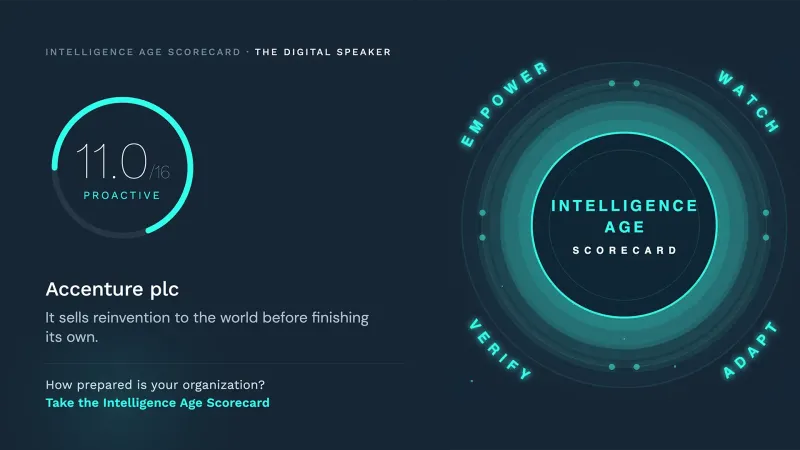
So that's the exercise here. This is a WAVE assessment of Accenture, scored across the four pillars of the WAVE framework — Watch, Adapt, Verify, Empower — plus AGI readiness, built entirely from public material: company press releases, the Responsible AI and LearnVantage pages, executive remarks, and partner announcements. No interviews, no internal access, no proprietary data, only what any outsider could already assemble without being let inside.
WAVE is the methodology I first set out in my latest book Now What? How to Ride the Tsunami of Change, and it's the same framework underneath the Intelligence Age Scorecard, the diagnostic that scores an organization's readiness across exactly these dimensions.
Accenture is the worked example, but the method is the point. The assessment surfaces one compound pattern: the announcements run well ahead of the evidence, what survives an audit. Accenture governs today's models well, yet its ability to move from pilot to production, and to say who authorized an autonomous action, trails its ambition. That gap has a price now. California's Transparency in Frontier AI Act took effect at the start of 2026, Colorado's impact-assessment mandate lands mid-2026, and the FTC, EEOC, and a fragmented state patchwork all demand one thing: show the lineage.
Here's the full assessment. The sharper question isn't whether the score lands to the decimal, it's what a stranger reading only Accenture's own public record, with the 2026 regulatory calendar open beside it, would conclude. Hold that question; it returns at the end.
WATCH: Where the Radar Reaches
Watch is Accenture's second-strongest pillar at 2.8/4, and the fundamentals are sound. The firm scans across technology, regulation, and culture with sight lines most peers lack. The Faculty acquisition brings a channel into research-frontier talent through its fellowship program for STEM PhDs, and the Mistral AI collaboration puts a frontier model lab inside its line of sight. Accenture sees what matters early.
The thin spot is synthesis. One Watch measure sits a full point below the rest: the discipline of turning raw scanning into a prioritized point of view the organization acts on. That is the difference between reading the same industry reports as every rival and building a proprietary read of where the market breaks next.
With most tech leaders admitting that adoption outpaces their ability to manage it, the firms that win are not those with the most signals; they are those that interpret fastest. For a business that just rebranded its core around reinvention, excellent intake feeding a slow interpretation function is a quiet risk. Accenture watches well. The open question is whether the read reaches decision-makers before the window closes.
ADAPT: Where insight outruns action
Adapt is the fault line at 2.2/4 — the lowest pillar, and the most consequential. The foundational adaptation measure sits at the floor. Accenture has the machinery of experimentation: Profitmind and AlphaSense show venture-stage bets paired with partnerships, and the Reinvention Services redesign moved from announcement to effective date in under three weeks. What the public record does not substantiate is routine speed; the ability to reallocate resources and move from experiment to operation in weeks rather than quarters.
This is the classic pattern of all insight, no throughput, and Accenture's strong Watch capability sharpens it. The industry evidence is blunt: only 11 percent of organizations have agents in production despite 38 percent piloting them, and Gartner expects 40 percent of agentic projects to fail by 2027, because firms automate broken processes instead of redesigning them.
For a partner branded around reinvention, that pilot-to-production gap is not a back-office matter. It is the credibility of the promise. Clients will judge Accenture's reinvention by whether it has done it to itself first. The fix is structural: pre-approved reallocation, kill criteria built into pilots from day one, and the authority to move talent from legacy to frontier in weeks.
VERIFY: The pillar it can sell
Verify is the strength at 3.2/4, and it sits where it matters. Accenture publishes a named Responsible AI compliance program built on documented governance structures, and its Responsible AI services describe qualitative and quantitative risk assessments and continuous monitoring before deployment. In a sector where half of department-level AI runs without formal oversight, that control discipline is a genuine differentiator the firm can sell, not merely defend.
The weak link is data provenance, the chain that proves where training and reference data came from, and that it was used with consent. Output validation and lifecycle ethics controls are solid; provenance trails them. As Accenture embeds agentic systems into client operations, provenance stops being internal hygiene and becomes a contractual and regulatory demand.
California's Transparency in Frontier AI Act, Colorado's impact-assessment mandate, and the state patchwork converge on one requirement: show the lineage. A black-box answer that looks reasonable will not survive an inquiry, nor a client's own audit. Accenture's own research notes that 90 percent of surveyed companies expect AI-adjacent legal obligations within five years. Close the provenance gap before scaling agents, not after, that is what turns a governance lead into a commercial moat.
EMPOWER: Trained, and waiting for permission
Empower scores 2.8/4, and the workforce literacy underneath it is best-in-class. Through LearnVantage and external partnerships such as the IIT Madras academy, Accenture has trained roughly 780,000 people across 120-plus countries — the human capability most rivals are still assembling. In an Intelligence Age where AI-fluent talent is scarce, that foundation is exactly what the era rewards.
Where Empower thins is distribution. Decision-making authority and the channel for frontline innovation both score below the training depth, capability that is broad but not yet distributed. That is the familiar large-firm pattern: the right to act stays concentrated near the top. LearnVantage's own work flags the risk, noting that 53 percent of workers don't know who is accountable when AI errors occur.
When consultants are augmented with AI but only a narrow group may deploy judgment, the firm recreates the very bottleneck the training was meant to dissolve. There is a tension worth naming: Accenture's strong Verify posture is precisely what should let it push decision rights outward with confidence. Trusted outputs are the prerequisite for distributed authority, and Accenture has them.
The constraint is not whether its people can be trusted; it is whether the operating model lets them act at machine speed.
AGI: What isn't on the agenda yet
AGI readiness sits at 1.6/4 — Exposed, and well below the Proactive total. CEO Julie Sweet has said publicly that she expects AGI within a decade and a form of superintelligence beyond human capability. Awareness is present. Structure is not. Three dimensions sit at the floor, and there is no disclosed framework beneath any of them.
Decision Authority is the sharpest. Accenture is embedding agentic systems into client core operations with no articulated structure for which actions an agent may take and which require human sign-off. That is the dimension most likely to produce a public failure; an autonomous system acting inside a client's operations with no one able to name who authorized the boundary it crossed. For a firm whose brand is trust, that is a reputational event, not a technical one.
Institutional Speed is equally exposed: a firm that sells reinvention cannot learn of a capability shift at the same moment as its clients without losing its premium. And Governance Beyond Human is calibrated for outputs a human can check, oversight that AGI-level systems break by design. The strong Verify controls govern the AI Accenture has, not the AI it is building toward.
The structural exposure
Seen together, the five groupings expose a single fault line the executive team may not yet have connected. Accenture's Verify spine is strong enough to sell, yet its Adapt metabolism is slow and its Decision Authority sits at the floor, which means the firm can validate what it ships but cannot move fast enough to ship it, nor say who authorized an agent once it acts. The strength and the weakness feed each other.
Trusted outputs should be the license to push authority outward and to shorten the pilot-to-production cycle; instead, control discipline is being used to hold the line rather than to extend it.
The consequence is specific: as billable hours compress and clients learn to do internally what they once retained Accenture for, a reinvention partner that governs well but reacts slowly watches the very value proposition it branded itself around erode from underneath. Not through a technical failure, but through a widening lag between what it announces and what it can prove.
What this means for the reader
Now turn the lens. If a stranger scored your organization from public material alone, your press releases, your governance page, your CEO's quotes, with the 2026 regulatory calendar open in the other hand, what gap would they expose between what you announce and what you can prove?
Most leadership teams assume the two move together. They rarely do. The announcements reach the earnings call in a quarter; the evidence, the lineage of your data, the boundary an agent may not cross, the authority your trained people actually hold, takes years to build and seconds to fail in public.
Accenture's assessment is not a cautionary tale about a laggard; it is a leader whose governance runs ahead of its reflexes. The uncomfortable version of the question is this: when a regulator, an analyst, or a client's own auditor reads only your record, do they see a firm that governs what it ships, or one that ships faster than it can govern?
Close
Accenture has the capital, the signals, and the governance most rivals lack. What it needs now is the speed to match, and the assessment is the place to start reading its own record the way an outsider will.
Frequently asked questions
What is the WAVE framework used to assess Accenture?
WAVE is a methodology scoring organizations across four pillars: Watch, Adapt, Verify, and Empower, plus AGI readiness. It was built entirely from public material such as press releases, the Responsible AI and LearnVantage pages, executive remarks, and partner announcements, without interviews or internal access. It is the same framework underlying the Intelligence Age Scorecard diagnostic, and it was first set out in the book Now What? How to Ride the Tsunami of Change.
Link to this questionWhy is Adapt Accenture's weakest pillar?
Adapt scores 2.2/4, the lowest pillar, because while Accenture has machinery for experimentation like Profitmind, AlphaSense, and the fast Reinvention Services rollout, the public record does not show routine speed in reallocating resources or moving from experiment to operation in weeks rather than quarters. This creates a pattern of strong insight but weak throughput, meaning the pilot-to-production gap undermines the credibility of its reinvention brand.
Link to this questionWhat is the biggest gap in Accenture's AGI readiness?
AGI readiness sits at just 1.6/4, well below other pillars, with three dimensions at the floor and no disclosed framework beneath them. Decision Authority is the sharpest gap: Accenture is embedding agentic systems into client operations with no articulated structure for which actions an agent may take versus what requires human sign-off, creating risk of a failure where no one can name who authorized an agent's action.
Link to this questionWhy does data provenance matter for Accenture's Verify score?
Verify is Accenture's strongest pillar at 3.2/4, built on a named Responsible AI compliance program with documented governance and risk assessments. However, data provenance, the chain proving where training data came from and that it was used with consent, is the weak link. As regulations like California's Transparency in Frontier AI Act and Colorado's impact-assessment mandate demand shown lineage, closing this gap before scaling agents is essential to turning governance into a commercial advantage.
Link to this question
Dr Mark van Rijmenam
Dr. Mark van Rijmenam, widely known as The Digital Speaker, isn’t just a #1-ranked global futurist; he’s an Architect of Tomorrow who fuses visionary ideas with real-world ROI. As a global keynote speaker, Global Speaking Fellow, recognized Global Guru Futurist, and 5-time author, he ignites Fortune 500 leaders and governments worldwide to harness emerging tech for tangible growth.
Recognized by Salesforce as one of 16 must-know AI influencers , Dr. Mark brings a balanced, optimistic-dystopian edge to his insights—pushing boundaries without losing sight of ethical innovation. From pioneering the use of a digital twin to spearheading his next-gen media platform Futurwise, he doesn’t just talk about AI and the future—he lives it, inspiring audiences to take bold action. You can reach his digital twin via WhatsApp at: +1 (830) 463-6967.