IBM's AI Readiness: Strong Signals, Slower Operating Model
IBM's AI Readiness: Strong Signals, Slower Operating Model
The public face of IBM's AI posture in 2026 is unusually crowded with relevant signals. CEO Arvind Krishna used his Think 2026 keynote to frame AI, hybrid cloud and quantum as a single converging source of competitive advantage.
The $11.6 billion Confluent acquisition closed in March, positioning real-time data as the spine of enterprise agents. The MIT-IBM Computing Research Lab launched in April with an explicit mandate to shape the next era of computing. SkillsBuild's new AI pathway targets ten million UK workers by 2030. Each of these reads, on the earnings-call surface, like the work of an incumbent that already sees what the rest of the sector is still arguing about.
So that's the exercise here. This is a WAVE assessment of IBM, scored across the four pillars of the framework — Watch, Adapt, Verify, Empower — plus AGI readiness, built entirely from public material: SEC filings, IBM newsroom releases, executive remarks, governance pages, and partner press. No interviews, no internal access, no proprietary data, just what any outsider could already assemble without being let inside. WAVE is the methodology I first set out in my book Now What? How to Ride the Tsunami of Change, and it's the same framework underneath the Intelligence Age Scorecard, the diagnostic that scores an organization's readiness across exactly these dimensions.
I'm using IBM as the worked example, but the method is the point. The pattern that surfaces is a familiar one for incumbents at this scale: the signals layer, the keynotes, the acquisitions, the partnership press, is running well ahead of the evidence layer that survives an audit. California's SB 53 took effect on January 1, 2026 with penalties up to $1 million per violation for large frontier model developers; AB 2013 mandates training-data summaries; the CCPA's automated decision-making rules require pre-use notices for significant decisions. These are not theoretical regimes. They are the calendar against which a company that sells unified AI governance to others will be measured for what it practices internally.
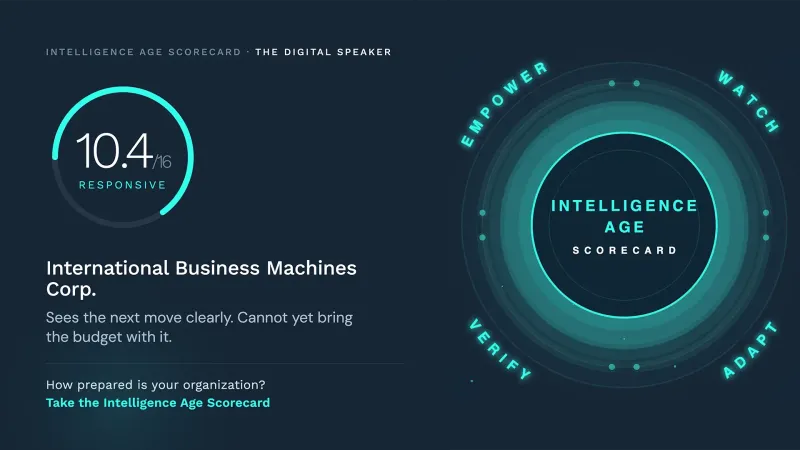
Here's the full assessment. The sharper question, though, isn't whether IBM's score lands at 10.4 out of 16 to the decimal. It's what a stranger reading only IBM's own public record would conclude, with that regulatory calendar in their other hand, and the same question waiting for every reader who applies it to their own company.
WATCH: Where the Radar Reaches Farthest
Watch is the strength of the stack, and the public record makes it easy to see why. IBM does not buy frontier signal, it co-produces it. The MIT-IBM Computing Research Lab, an evolution of the 2017 MIT-IBM Watson AI Lab, is now scoped explicitly across efficient language model architectures, novel computing paradigms and quantum.
IBM Research scientists are publishing dated forecasts on the 2026 frontier-versus-efficient model split, ASIC accelerators and physical AI before those distinctions reach the analyst circuit. IBM Distinguished Engineers are building asset-agnostic simulation frameworks for world models, a category Yann LeCun's AMI Labs has only recently pulled into mainstream funding visibility.
Participation in Project Glasswing on AI-driven software threats reflects the same pattern in security. The sensing function works. The harder question is downstream: a 3.4 in Watch only compounds value if the next pillars convert signals into shipped product. They do not yet.
ADAPT: The Strategy Deck is Ahead of the Operating Model
Adapt is the bottleneck, and the asymmetry is severe. Executive sponsorship sits at the top of the scale; Krishna's commitments to agentic AI, hybrid cloud and quantum could not be clearer. But gateway adaptation, kill criteria for failing pilots and resource reallocation speed all score at the floor.
Joanne Wright, the SVP of Transformation and Operations described inside the company as the de facto chief AI officer, gives IBM a centralized owner for cross-domain reallocation, a structural asset most peers lack. What the public record does not document is the cycle time. M&A moves at quarters; agentic AI deployments in the rest of the sector ship in four to six weeks.
The Confluent integration, the Watsonx Orchestrate rollout and the IBM Consulting Advantage delivery platform all depend on engineering and consulting capacity moving in weeks, not budget cycles. The fix is operational, not motivational: pre-authorized kill criteria and standing reallocation authority below the executive committee. Without them, every signal Watch generates decays before reaching production.
VERIFY: Selling Governance Externally, Practicing it Unevenly Internally
Verify scores 2.6/4, respectable, and dangerous given the product portfolio. IBM publishes a substantive AI governance framework covering safety, fairness, human rights, regulatory compliance and sensitive-data handling. The 2025 Annual Report confirms AI is platform-central. Yet the public material does not name an independent pre-deployment verification gate, a board-level AI risk officer, a published audit cadence, or the output-validation mechanics — the human-in-the-loop tiers, the bias testing, the audit trails — that would close the loop on what gets shipped.
For a company whose watsonx.governance product is a Leader in IDC MarketScape's Unified AI Governance Platforms assessment, that asymmetry is the strategic risk. EY reports 52% of department-level AI initiatives in technology firms operate without formal oversight, and 78% of tech leaders concede adoption is outpacing management.
IBM cannot sustainably sell a discipline it has not yet operationalized at the depth its own product implies. Tighten the validation layer before regulators or analysts notice the gap between what is sold and what is practiced.
EMPOWER: Training is Credible; Decision Rights are Concentrated
Empower at 2.4/4 carries a specific signature. The literacy layer is real: SkillsBuild's AI pathway spans foundational awareness through a Level 6 executive curriculum; CHRO Nickle LaMoreaux's framing that enterprises must "rewrite every job" is paired with a plan to triple US entry-level hiring across software, consulting and infrastructure. That is more than most peers are doing.
The constraint sits one level deeper. The public record does not surface a distributed-authority charter for AI adoption; no named accountability tiers, no team-level experimentation mandates, no documented rotation program building T-shaped fluency across business units. For a technology firm whose competitive frame includes NVIDIA, Microsoft and Anthropic, the bar is developers shipping with AI tooling and prompt fluency as default behavior.
If frontline consultants and engineers cannot make AI-augmented decisions without escalation, the literacy investment underperforms, and agentic systems, which decentralize decision-making by design, will arrive into an organization that cannot supervise them at the speed they operate.
Explaining AGI, not Yet Preparing For It
AGI readiness sits at 1.0/4 across all five dimensions; workforce displacement, decision authority, economic resilience, institutional speed, governance beyond human. IBM Think publishes thoughtful material defining AGI as a hypothetical stage of machine learning and speculating on a 2034 emergence horizon. That is thought leadership for the customer base. It is not an internal preparation plan.
The public record does not substantiate a workforce-transition program tied to AGI-class capability, a tiered decision-authority framework for autonomous agent action inside watsonx Orchestrate, a stress test of the $6 billion-plus generative AI book against capability commoditization, or a governance charter scoped to systems whose reasoning may exceed reviewer comprehension.
Consulting and software delivery are precisely the roles agentic systems target first; absence of public commentary on human-AI task allocation across those segments is itself the finding. Selling unified AI governance to the market while AGI-class internal preparation is structurally undisclosed creates an asymmetric reputational exposure that compounds quietly until it doesn't.
The Structural Exposure
Read the pillars together and a single fault line surfaces. IBM sees further than most peers and acts more slowly than the agentic window allows — a 1.4-point gap between Watch (3.4) and Adapt (2.0) is the precise distance over which competitive position erodes.
That gap connects to the Verify asymmetry: a company whose frontier sensing is institutional but whose internal output validation is uneven cannot absorb the regulatory weight of California's 2026 calendar without strain. It connects again to Empower and AGI readiness: agentic systems route around centralized decision rights by design, so a workforce trained on AI tools but unable to act on AI-augmented judgment without escalation will deploy agents into an organization that cannot supervise them at their operating speed.
The credibility tax, selling governance maturity that has not yet been operationalized internally, is the story competitors and regulators tell first when the gap becomes visible. The executive team likely sees the announceable layer. The composite picture across pillars is what an outsider sees.
What this Means for the Reader
The uncomfortable exercise is to apply the same method to your own company. If a stranger built a WAVE-style assessment from your public record alone, your filings, your press, your governance pages, your CEO's last earnings call, and held it against the regulatory calendar that lands in your jurisdiction this year, what gap would they expose between what you announce and what you can evidence?
Most executive teams answer that question for their announceable layer in seconds and freeze on the evidence-able layer. The frontier-model release cadence is now weekly. The agentic deployment window measures in quarters. The state and federal AI rule changes measure in months. If your operating model still moves on fiscal cycles, the gap is not a risk on a heat map. It is the structural fact a regulator, an analyst or a competitor will use to write your story before you do.
Close
IBM has the sensing function. The work is to make the operating model worthy of it, and to do so before the calendar makes the choice on the company's behalf. The same instruction applies to every reader who has just finished mentally running this assessment on themselves.
Frequently asked questions
What is the WAVE framework used to assess IBM's AI readiness?
WAVE is a methodology scoring an organization across four pillars: Watch, Adapt, Verify, and Empower, plus an AGI readiness dimension. It is built entirely from public material such as SEC filings, newsroom releases, executive remarks, governance pages, and partner press, without interviews or internal access. It originates from the book Now What? How to Ride the Tsunami of Change and underpins the Intelligence Age Scorecard diagnostic.
Link to this questionWhy does IBM score high on Watch but lower on Adapt?
IBM scores strongly on Watch (3.4) because it co-produces frontier research through the MIT-IBM Computing Research Lab, publishes forecasts ahead of the analyst circuit, and builds advanced simulation frameworks. Adapt scores much lower (2.0) because while executive sponsorship is strong, gateway adaptation, kill criteria for failing pilots, and resource reallocation speed all sit at the floor, meaning strategy moves faster than the operating model that would turn signals into shipped product.
Link to this questionWhat is the risk in IBM selling AI governance products externally?
IBM's watsonx.governance product is recognized as a Leader in IDC MarketScape's Unified AI Governance Platforms assessment, yet the public record does not show an independent pre-deployment verification gate, a board-level AI risk officer, a published audit cadence, or detailed output-validation mechanics internally. This creates a credibility tax: IBM is selling a governance discipline it has not yet fully operationalized internally, a gap regulators or analysts could expose given California's 2026 regulatory calendar.
Link to this questionHow prepared is IBM for AGI according to the assessment?
AGI readiness scores just 1.0 out of 4 across all five dimensions covering workforce displacement, decision authority, economic resilience, institutional speed, and governance beyond human oversight. IBM Think publishes thought leadership defining AGI and speculating on a 2034 emergence horizon, but the public record shows no workforce-transition program, tiered decision-authority framework for autonomous agents, stress test of its generative AI book, or governance charter for systems whose reasoning may exceed reviewer comprehension.
Link to this question
Dr Mark van Rijmenam
Dr. Mark van Rijmenam, widely known as The Digital Speaker, isn’t just a #1-ranked global futurist; he’s an Architect of Tomorrow who fuses visionary ideas with real-world ROI. As a global keynote speaker, Global Speaking Fellow, recognized Global Guru Futurist, and 5-time author, he ignites Fortune 500 leaders and governments worldwide to harness emerging tech for tangible growth.
Recognized by Salesforce as one of 16 must-know AI influencers , Dr. Mark brings a balanced, optimistic-dystopian edge to his insights—pushing boundaries without losing sight of ethical innovation. From pioneering the use of a digital twin to spearheading his next-gen media platform Futurwise, he doesn’t just talk about AI and the future—he lives it, inspiring audiences to take bold action. You can reach his digital twin via WhatsApp at: +1 (830) 463-6967.