Verizon's Future Readiness: Decade-long AI Bets, Reviewed on an Annual Clock
Verizon's Future Readiness: Decade-long AI Bets, Reviewed on an Annual Clock
Verizon wants the market to see momentum, and on the public record the momentum is real. In January 2026 it closed a $20 billion acquisition of Frontier Communications and posted its strongest mobility and broadband net additions since 2019.
It launched Verizon AI Connect, struck a high-capacity fiber deal with AWS to carry AI traffic at scale, embedded NVIDIA GPUs into its 5G networks, and put Google Cloud's Gemini models into customer experience. It joined Anthropic's Project Glasswing for early access to frontier models, is targeting Level 4 network autonomy, and CEO Dan Schulman has named a $40-plus billion AI market as the prize by 2030. Impressive from an investor's chair. But no state attorney general, no plaintiff's lawyer, and no privacy regulator reads that record the way Verizon's own communications team does. They read it for what it proves under audit.
So that's the exercise here. This is a WAVE assessment of Verizon Communications, scored across the four pillars of the framework, Watch, Adapt, Verify, Empower, plus AGI readiness, built entirely from public material: securities filings, company press releases, the governance pages on its investor site, and executive remarks. No interviews, no internal access, no proprietary data, just what any outsider could already assemble without being let inside. WAVE is the methodology I first set out in my book Now What? How to Ride the Tsunami of Change, and it's the same framework underneath the Intelligence Age Scorecard, the diagnostic that scores an organization's future-readiness across exactly these dimensions.
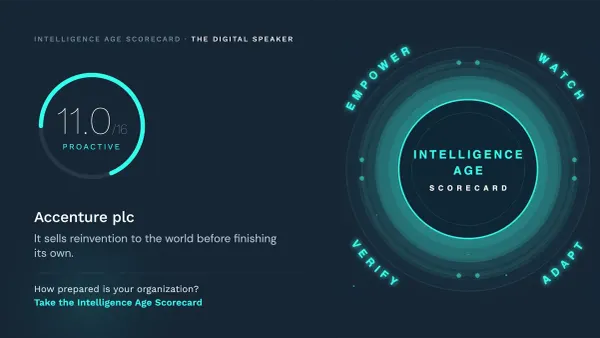
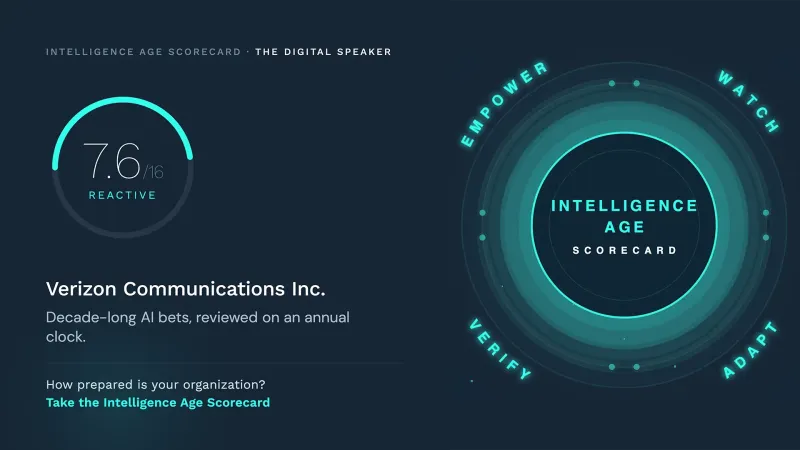
I'm using Verizon as the worked example, but the method is the point. The assessment surfaces one compound pattern: Verizon is far better at announcing AI than at proving it. The signals that reach an earnings call, partnerships, targets, deployment claims, sit well ahead of the controls that would survive an examiner's questions. That gap matters more now than it did a year ago, because the rules are hardening exactly where Verizon is thinnest. The Take It Down Act imposes a 48-hour removal duty on covered platforms, California's digital replica protections are already in force, and California's automated decision-making rules land in 2027. Verizon lands in the Reactive band at 7.6 out of 16, a striking distance to travel for a company this size.
Here's the full assessment. The sharper question, though, isn't whether that score is precise to the decimal. It's what a stranger reading only your own public record would conclude about your company, with this year's regulatory calendar open in their other hand.
WATCH: Where the Radar Reaches, and Where it Stops
Verizon's strongest pillar is Watch, at 2.2 out of 4, and the strength is genuine. Its security team gained pre-release access to Anthropic's most advanced model through Project Glasswing and spent months testing it against the network, and engineers are embedding frontier language models into network operations that already run over 70 million autonomous configuration changes a year. This is a company that sees the technology early.
The problem is the horizon behind the eyes. Verizon plans against roughly a twelve-month window while its own AI ambition runs to 2030. It is placing decade-long chips on an annual review cycle.
In media and entertainment, where consumer AI assistants are quietly moving content discovery away from providers and toward platforms, good detection with a short horizon produces a specific failure: you spot the shift, then run out of runway to act before a competitor hardens the advantage. Extend the planning window to match the capital already committed, and Watch becomes an asset rather than a quarterly scan.
ADAPT: Pockets of Motion, no Engine
Adapt sits at 2.0, and this is where insight should turn into outcome. There are real pockets of capability, an executive transformation office under a new Chief Transformation Officer, and a willingness to direct heavy capital toward priorities like the AWS fiber buildout. But the entry posture and the follow-through both sit at the floor. Capability lives in isolated teams; it is not yet wired into a repeatable path that carries an idea from experiment to embedded operation with clear stop rules and feedback loops, at least this is not discussed in public sources.
Resource reallocation lands only in the middle band, meaning Verizon can shift people and money, but not at the speed a consolidating media market demands. The industry's hardest step is rarely the technical pilot, it is getting people to work differently once the pilot succeeds. The NVIDIA and Google Cloud collaborations will produce working prototypes. The open question is whether the enterprise can absorb them past the demo stage rather than leaving them as orphans. Fix the pathway, not the pilots.
VERIFY: Governance Intent Without Validation Muscle
Verify also scores 2.0, and it splits cleanly in two. At the framework level, Verizon registers real intent: it discloses a centralized, enterprise-wide Responsible AI Program run by its AI and Data organization and governed by a risk-based approach, and it lists responsible AI among its governance disclosures. The intent is credible. But the moment intent has to become mechanism, the floor drops.
Output validation and data provenance both sit at the bottom of the scale, meaning AI outputs are effectively trusted if they look reasonable, and there is no reliable chain tracing where training data and decisions originate. For a company running AI across fraud detection, predictive network maintenance, and Gemini-powered customer service, that is an unmanaged risk, not a managed one.
The regulatory context bites precisely here: the Take It Down Act's 48-hour removal duty, California's digital replica law, and New York's synthetic performer disclosure rule all demand exactly the provenance and verification layers Verizon scored lowest on. Governance you can name is not the same as controls that survive an audit.
EMPOWER: Capability Trapped at the Top
Empower is the weakest pillar at 1.4, and it is the fault line running through everything else. Verizon has published visible workforce investment, a $20 million Reskilling and Career Transition Fund and access to more than 250 courses across 84 certificate programs, including AI essentials. Read the fine print, though, and the tell appears: these programs are aimed at employees departing Verizon, not the standing workforce that has to run the $40 billion ambition.
Decision-making authority is concentrated at the center, and cross-functional talent development, people who can move across creative, technical, and analytical work, is effectively absent. The ambition lives in the C-suite; the capability to execute it has not reached the people who would run it day to day.
That is the classic pattern of AI locked inside a research-and-infrastructure function that never translates into the hands of the broader workforce. Verizon has the network, the partnerships, and the capital. What it has not built is the distributed human capability that converts those assets into advantage.
What Isn't on the Agenda
AGI readiness scores 1.0, the floor, across all five dimensions: workforce displacement, decision authority, economic resilience, institutional speed, and governance beyond human oversight. This is not a scoring artifact. Across the public record there is no public evidence of a workforce transition strategy framed around human-level AI, a decision-authority framework defining where machines decide versus advise, a stress test of which revenue streams survive an AI-native competitor, or a governance charter scoped to systems that may act beyond human speed.
The absence itself is the finding. Verizon operates in the industry with the densest AI regulatory exposure, digital replicas, synthetic performer disclosure, the pending NO FAKES Act, copyright constraints on AI output, and consumer AI assistants are already shifting discovery control toward platform gatekeepers. A connectivity-anchored revenue base offers genuine ballast, but ballast is not a plan. When intelligence gets cheap, judgment and governance become the scarce assets, and on the public record Verizon has not yet committed either to the AGI question.
The Exposure the Executive Team May Not Have Connected
The danger is not any single pillar; it is the way they interlock. A twelve-month Watch horizon caps the Adapt ceiling. You cannot pre-position against shifts you only scan one year out. Thin Verify then undermines Empower directly: you cannot safely push decision-making authority outward to a workforce when the outputs they would act on carry no validation and no audit trail. Trust cannot be delegated downward because it has not been established upward.
Stack that against the AGI floor and the exposure becomes concrete rather than theoretical: a single ungoverned synthetic-media incident could trip the Take It Down Act's 48-hour clock before a human ever reviews it, and the NVIDIA and Google Cloud partnerships could calcify into stranded pilots while platform gatekeepers intermediate the customer relationship Verizon should own. The scorecard is not four separate gaps. It is one system waiting on a center that, at this scale, cannot move fast enough.
What This Means for Whoever Reads it Next
Now turn the lens around. If a stranger scored your organization tomorrow using only your public record, your filings, your press releases, your governance pages, your executive quotes, and held this year's regulatory calendar in the other hand, what would they find? Most leadership teams are confident about the the announcements they make: the partnerships, the targets, the appointments that reach an earnings call. Far fewer could produce, on demand, the evidence layer beneath it, the validation controls, the provenance chains, the distributed authority, the workforce actually trained on the tools they're mandated to use.
The uncomfortable truth is that regulators, litigators, and analysts increasingly score you on the second layer while you are still celebrating the first. The gap between the two is where liability accumulates quietly, and it compounds faster than a committee can convene to close it. Verizon's version of that gap is unusually visible. Yours may simply be less examined.
The score is not the point. The distance between what you can announce and what you can prove is, and it is measurable today, by anyone who cares to look.
Frequently asked questions
What is the WAVE framework used to assess Verizon?
WAVE is a methodology scoring an organization's future-readiness across four pillars, Watch, Adapt, Verify, Empower, plus AGI readiness. It was first set out in the book Now What? How to Ride the Tsunami of Change and underpins the Intelligence Age Scorecard. The Verizon assessment was built entirely from public material such as securities filings, press releases, governance pages, and executive remarks, without interviews or internal access.
Link to this questionWhat overall score did Verizon receive in the WAVE assessment?
Verizon lands in the Reactive band with a score of 7.6 out of 16. Its strongest pillar is Watch at 2.2, followed by Adapt and Verify both at 2.0, while Empower is weakest at 1.4. AGI readiness scores the floor at 1.0 across all five of its dimensions, indicating a significant gap between the company's AI ambitions and the controls needed to support them.
Link to this questionWhy is Verizon's Empower pillar considered the weakest?
Empower scores 1.4 because Verizon's workforce investments, including a Reskilling and Career Transition Fund and access to certificate programs, are aimed at employees departing the company rather than the standing workforce running its AI ambition. Decision-making authority stays concentrated at the center, and cross-functional talent development is effectively absent, meaning capability has not reached the people who would execute AI plans day to day.
Link to this questionHow do weaknesses in Verizon's AI governance connect to regulatory risk?
Verify scores show output validation and data provenance sitting at the bottom of the scale, meaning AI outputs are trusted if they look reasonable with no reliable chain tracing data or decisions. This directly conflicts with rules like the Take It Down Act's 48-hour removal duty, California's digital replica law, and New York's synthetic performer disclosure rule, all of which demand the provenance and verification layers Verizon scored lowest on.
Link to this question
Dr Mark van Rijmenam
Dr. Mark van Rijmenam, widely known as The Digital Speaker, isn’t just a #1-ranked global futurist; he’s an Architect of Tomorrow who fuses visionary ideas with real-world ROI. As a global keynote speaker, Global Speaking Fellow, recognized Global Guru Futurist, and 5-time author, he ignites Fortune 500 leaders and governments worldwide to harness emerging tech for tangible growth.
Recognized by Salesforce as one of 16 must-know AI influencers , Dr. Mark brings a balanced, optimistic-dystopian edge to his insights—pushing boundaries without losing sight of ethical innovation. From pioneering the use of a digital twin to spearheading his next-gen media platform Futurwise, he doesn’t just talk about AI and the future—he lives it, inspiring audiences to take bold action. You can reach his digital twin via WhatsApp at: +1 (830) 463-6967.