Woolworths Group's AI Readiness: Olive's Ambition, Thin Spine
Woolworths Group's AI Readiness: Olive's Ambition, Thin Spine
From the outside, Woolworths Group looks like an Australian AI front-runner. CEO Amanda Bardwell stood on the NRF 2026 stage in January and described Google Cloud's Gemini Enterprise as a "global game changer for retail."
Bardwell announced Woolworths as the first Australian retailer to partner on Google's agentic platform and evolving its Olive shopping assistant into something that anticipates customer needs and adds items to carts on its own.
Scan&Go trolleys are live across 10 stores. The SAP Best Tech Award sits on the trophy shelf. Asana AI Studio runs internal approvals. The story the market hears is confident, organized, and ahead of the field. The story a consultant, regulator or analyst would read out of the same public record is a different one.
So that is the exercise here. This is a WAVE assessment of Woolworths Group, scored across the four pillars of the WAVE framework — Watch, Adapt, Verify, Empower — plus AGI readiness, built entirely from public material: ASX filings, the 2025 Annual Report and Corporate Governance Statement, the Group Executive Committee disclosure, the June 2025 Productivity Commission submission, executive remarks at partner events, and the PR Newswire distribution of the Google Cloud announcement.
No interviews, no internal access, no proprietary data, just what any outsider could already assemble without being let inside. WAVE is the methodology I developed in my latest book Now What? How to Ride the Tsunami of Change, and it is the same framework underneath the Intelligence Age Scorecard, the diagnostic that scores an organization's readiness across exactly these dimensions.
I am using Woolworths as the worked example, but the method is the point. Across the assessment, one compound pattern keeps appearing: a wide gap between the announceable layer of AI work — Olive, Scan&Go, the Gemini partnership, the SAP award — and the evidence-able layer of governance, workforce literacy, and reallocation discipline that survives an audit.
The stakes are not abstract. Doubled Australian Consumer Law penalties of $100 million per contravention took effect in March 2026. December 2026 brings automated decision-making disclosure obligations under the Privacy Act amendments. The NSW Work Health and Safety Amendment (Digital Work Systems) Act 2026 imposes a primary duty of care on businesses operating AI systems for workers. Each of these lands directly on what Olive is already doing.
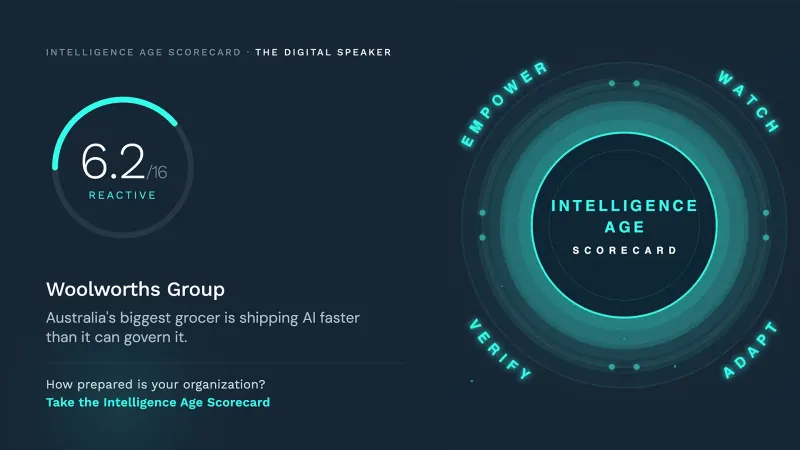
Here is the full assessment. The sharper question is not whether Woolworths' total of 6.2/16 is exactly right, it is what a stranger reading only your company's public record would conclude, with the regulatory calendar in their other hand.
Watch: Where the Radar Reaches
Watch sits at 1.6/4. The signal Woolworths reads loudest is the one a hyperscaler delivers to its door. Bardwell's NRF statement is substantive C-level commentary on agentic AI, and being in the launch cohort alongside Kroger, Lowe's, and Papa Johns is not nothing, it places Woolworths close to the frontier vendor.
But proximity to a vendor roadmap is not horizon-scanning. The public record names no Chief Futures role, no quarterly signals review, no relationships with academic AI labs, no published planning horizon beyond the current trading environment described in the 2025 Annual Report.
The Olive evolution is a commercial deployment partnership, not the output of a structured foresight function. That matters because the next wave of pressure on Australian retail, agentic commerce intermediaries that own the customer relationship, the ACCC's expanded enforcement posture, the Bunnings facial recognition precedent, the doubled ACL penalty regime, does not arrive through a Google product launch. A 1.6 Watch posture sees regulation as a compliance surprise rather than a design input.
Adapt: Pilots Without the Muscle to Pivot
Adapt also sits at 1.4/4, tied for the weakest pillar. Olive is being evolved on Gemini Enterprise, which on its face implies a pilot-and-iterate posture. But the public record does not substantiate the structural machinery that turns a pilot into a capability: there is no disclosed framework of named kill criteria, no published reforecasting cadence, no innovation fund with disclosed flex authority, no announced sunset of a legacy program tied to a replacement launch date.
Publicly available evidence does not address how resources would shift inside a year if Olive underperformed against a customer metric, or how a second pilot would be ring-fenced if a first one needed to be stopped. The presence of a Chief Transformation Officer on the Group Executive Committee is structural scaffolding, not a reallocation clock.
Gartner's reading that 30% of generative AI projects are abandoned after proof-of-concept is the warning sign for exactly this configuration. The bottleneck is governance cadence, not tooling, and automating an approval workflow inside a slow decision system mostly produces faster confirmation of slow decisions.
Verify: Governance Behind the Agent
Verify is the strongest pillar at 1.8/4, and that is faint praise inside a Reactive profile. Woolworths operates a three-lines-of-accountability risk model with a Board-approved risk appetite statement refreshed in July 2025 and an independent Group Internal Audit function, generic enterprise risk infrastructure, not an AI-specific deployment gate.
The June 2025 Productivity Commission submission states support for a tiered, risk-based approach to AI regulation and for business accountability on high-risk applications. That is a position on how AI governance should work externally; it is not evidence of an internal pre-deployment AI assurance gate.
Independent reporting on a Woolworths AI agent producing off-script output in a live setting suggests a customer-facing deployment reached production with behavior that a structured pre-launch review would likely have caught.
With ACCC penalties of $100 million per contravention now live, and December 2026 ADM disclosure obligations describing exactly what Olive, Scan&Go, and personalization engines do, output validation, data provenance, and bias audits are the spine, and the spine is thin.
Empower: The Workforce Trailing the Technology
Empower is 1.4/4, the binding constraint on every other AI investment Woolworths has made. Olive has been rolled out to 200,000 staff, but tool deployment is not literacy. The public record does not disclose curriculum scope, completion rates, or a named upskilling program with participant counts.
Decision authority on technology adoption is not visibly distributed; commentary on the broader automation push reads as management-driven productivity, not bottom-up experimentation. There is no disclosed cross-functional rotation program, no T-shaped capability architecture tied to AI deployment, no published responsible-automation charter naming worker, supplier, or community metrics.
The compounding problem is the interaction with Verify: weak output validation means recommendations are not trusted, and a workforce without literacy cannot distribute the judgment needed to verify those recommendations at the edge.
Every escalation funnels back to a small central team that becomes the bottleneck on every agentic decision Olive makes. Under the NSW Digital Work Systems Act, untrained operators of AI-directed workflows are no longer just a capability gap, they are a SafeWork NSW exposure.
What is not on the agenda
AGI readiness scores 1.0/4 across all five dimensions: workforce displacement, decision authority, economic resilience, institutional speed, and governance beyond human. The public record contains no disclosed framework on any of them.
There is no disclosed posture on how human-in-the-loop boundaries shift as AI capability scales, no role-exposure mapping for the 20 frontline functions most exposed to agentic checkout and replenishment, no revenue-stress test against scenarios where 25% or 40% of grocery transactions are initiated by third-party agents rather than the Woolworths app, no time-to-production metric for new AI capabilities, no board-level mandate scoped to frontier-AI risk.
The absence is structurally undisclosed and entirely consistent with the Watch and Adapt scores: an organization that has not built a sensing apparatus and cannot reallocate at frontier cadence has no place to put AGI scenario work. The risk this masks is the one most likely to compound: when agents, not shoppers, choose the basket, the loyalty signal Woolworths has compounded for decades thins to a settlement layer.
The Fault Line Nobody on the Earnings Call has Named
Read the pillars together and a single fault line surfaces. Woolworths has built a deployment surface — Olive on Gemini, Scan&Go in 10 stores, Asana AI Studio for approvals, an agentic chatbot in the hands of 200,000 staff — that runs ahead of every supporting structure underneath it.
Verify at 1.8 cannot validate what an autonomous agent is already doing in customer carts. Empower at 1.4 cannot distribute the judgment needed to catch the failures Verify misses. Adapt at 1.4 cannot reallocate fast enough to fix what Verify and Empower expose. Watch at 1.6 was not configured to see the regulatory wave that now lands on each of those gaps.
The Reactive profile is not a story about being slow on AI; it is a story about a top layer of announceable deployments resting on a foundation that the company's own public disclosures do not substantiate. That is the asymmetry an ACCC investigator or an OAIC inquirer notices first.
What this means for the reader
Most leaders reading this do not run Woolworths. They run a bank, an insurer, a hospital network, a manufacturer, a utility, and they have spent the last 18 months announcing AI work to their own boards, customers, and analysts.
The uncomfortable question is the one the WAVE assessment forces here: if a stranger scored your organization from public material alone, with this year's regulatory calendar open in their other hand, what gap between your announceable layer and your evidence-able layer would they expose? Which executive statement would not survive a regulator pulling the underlying framework? Which deployment is running ahead of the verification spine and the workforce literacy that should hold it up?
The point is not that Woolworths is uniquely exposed. The point is that the gap between the press release and the audit trail is now the most consequential metric in the enterprise, and very few leaders have measured theirs honestly.
Closing observation
The Reactive band is not a verdict on ambition. It is a description of what survives scrutiny. For Woolworths, and for any organization deploying agentic capability faster than it is governing it, the second half of 2026 will close that gap one way or another, by deliberate design or by enforcement.
If you are interested to understand how prepared your organization is for the future, take the Intelligence Age Scorecard.
Frequently asked questions
What is the WAVE framework used to assess Woolworths?
WAVE is a methodology scoring an organization across four pillars: Watch, Adapt, Verify, and Empower, plus AGI readiness. It was developed for the book Now What? How to Ride the Tsunami of Change and underlies the Intelligence Age Scorecard. The Woolworths assessment was built entirely from public material such as ASX filings, the 2025 Annual Report, Corporate Governance Statement, and executive remarks, without any interviews or internal access.
Link to this questionWhy did Woolworths score so low despite its AI announcements?
Woolworths scored 6.2/16 overall because there is a wide gap between its announceable AI layer, such as Olive, Scan&Go, and the Gemini partnership, and the evidence-able layer of governance, workforce literacy, and reallocation discipline. The public record shows deployment surfaces running ahead of supporting structures like output validation, reallocation cadence, and staff training, leaving weak Watch, Adapt, Verify, and Empower scores.
Link to this questionWhat regulatory risks does Woolworths face from its AI deployments?
Doubled Australian Consumer Law penalties of $100 million per contravention took effect in March 2026, and December 2026 brings automated decision-making disclosure obligations under Privacy Act amendments. The NSW Work Health and Safety Amendment (Digital Work Systems) Act 2026 also imposes a primary duty of care on businesses operating AI systems for workers, all of which land directly on what Olive is already doing.
Link to this question
Dr Mark van Rijmenam
Dr. Mark van Rijmenam, widely known as The Digital Speaker, isn’t just a #1-ranked global futurist; he’s an Architect of Tomorrow who fuses visionary ideas with real-world ROI. As a global keynote speaker, Global Speaking Fellow, recognized Global Guru Futurist, and 5-time author, he ignites Fortune 500 leaders and governments worldwide to harness emerging tech for tangible growth.
Recognized by Salesforce as one of 16 must-know AI influencers , Dr. Mark brings a balanced, optimistic-dystopian edge to his insights—pushing boundaries without losing sight of ethical innovation. From pioneering the use of a digital twin to spearheading his next-gen media platform Futurwise, he doesn’t just talk about AI and the future—he lives it, inspiring audiences to take bold action. You can reach his digital twin via WhatsApp at: +1 (830) 463-6967.