Qantas's AI Readiness: Announced Outcomes, Undisclosed Infrastructure
Qantas's AI Readiness: Announced Outcomes, Undisclosed Infrastructure
Qantas wants the market to see AI progress. The CEO has attributed three to four points of on-time performance to AI, one to two percent fuel savings per sector to AI-based routing, and the December 2025 appointment of a Chief Technology, AI and Transformation Officer signals an organization that wants its AI story on the record. What no one outside the airline does is read that story the way a regulator or a plaintiff's lawyer would.
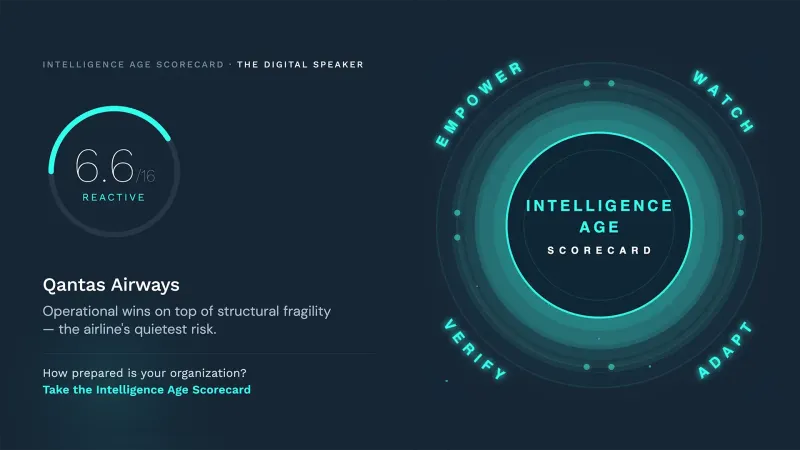
So that's the exercise here. This is a WAVE assessment of Qantas Airways, scored across the four pillars of the framework, Watch, Adapt, Verify, Empower plus AGI readiness, built entirely from public material. ASX disclosures, governance pages, executive statements, approved third-party reporting. No interviews, no internal access, no proprietary data. Just what any outsider could already assemble without being let inside. WAVE is the methodology I first set out in my book Now What? How to Ride the Tsunami of Change, and it's the same framework underneath the Intelligence Age Scorecard, the diagnostic that scores an organization's readiness across exactly these dimensions.
I'm using Qantas as the worked example, but the method is the point. The airline is announcing AI outcomes faster than it is disclosing the infrastructure that would substantiate them. The things that reach an earnings call, on-time gains, fuel savings, a named executive owner, are concrete and real. The things that would let those claims survive scrutiny, an AI governance framework, a model risk standard, output validation beyond reasonableness review, distributed AI literacy across the operation, are where the public record goes quiet. And in a year when the ACCC's doubled $100 million penalty regime for AI-washing is already live and the Privacy Act's automated-decision rules land on 10 December 2026, every public AI claim becomes something a regulator can ask the company to prove.
Here's the full assessment. As you read it, the sharper question isn't whether I've scored Qantas correctly, it's what the gap between your own announced AI outcomes and your disclosed AI infrastructure would look like to a stranger reading only your public record, with the regulatory calendar in their other hand.
Where the radar reaches
The most visible signal in Qantas's external posture is the appointment of Rachel Yangoyan as Chief Technology, AI and Transformation Officer in December 2025, with explicit accountability for Group AI strategy, data and analytics, and enterprise technology transformation.
That is a real upgrade, a named executive owner is the precondition for anything else. But an accountability assignment is not a foresight function. Public disclosures do not name a structured scanning cadence, a futures team, partnerships with frontier AI labs, or a published technology radar.
Signal capture today depends on what reaches a single executive's desk. In a regulatory window where Australia's Privacy Act automated-decision obligations land on 10 December 2026, the NSW Digital Work Systems Act 2026 is already in force, and the ACCC's doubled penalty regime is now live, calendar-paced scanning will keep importing surprises through media coverage rather than through Qantas's own pipeline.
Pilots without a production pipeline
Adapt is the pillar where Qantas looks strongest from the outside, and the evidence is concrete. AI is being deployed against predictive maintenance, scheduling, sales, and fuel routing. The CEO has cited measurable on-time and fuel savings. Four hundred head office roles were cut in 2026 as AI absorbed parts of those workflows; underperforming domestic routes were suspended; share was captured from a 20 percent reduction in Gulf carrier international capacity. These are real reallocations.
What they describe, though, is executive-led portfolio surgery on quarterly to half-yearly cadences, not a continuous pilot-to-production pipeline with named kill criteria, conversion metrics, and dedicated reallocation authority. Pilots exist; the system that decides which ones graduate to enterprise scale, and how fast, is not visible to an outside reader. The Adelaide Product Innovation Centre opening in March 2026, with 420 specialist roles, is the structural opportunity to industrialize what is today an artisanal capability. Whether it does that depends on gates the public record does not yet show.
Validation by reasonableness
This is where the disclosure gap is sharpest. Qantas operates an integrated enterprise risk system covering aviation safety, workplace health, cyber, privacy, and business resilience, with Board oversight through the Audit and CHESS committees.
What public disclosures do not name is an AI-specific governance framework, a model risk standard, a human-in-the-loop policy for customer-facing AI, or an output validation process beyond reasonableness review. The Code of Conduct refers to a Data Ethics Standard whose scope and enforcement are not detailed publicly. Australia's APP 1.7 to 1.9 transparency obligations land on 10 December 2026. The ACCC's doubled $100 million penalty regime for AI-washing is operational now.
Every public claim a CEO makes about AI's contribution to on-time performance is, from that date forward, a claim a regulator can ask to see substantiated. The July 2025 third-party cyber incident, disclosed to the National Cyber Security Coordinator, ACSC, and OAIC, shows the incident-response machinery works. The proactive validation machinery is not on display.
Capability concentrated, not distributed
This is the binding constraint, and it is the one a board director should sit up for. The public record does not disclose a structured AI literacy program, a published technology decision-rights framework, broadened role design for engineers and dispatchers, or a named frontline innovation channel.
The visible workforce signal is operational training — A350 pilot simulator qualification tied to fleet renewal, which is excellent at what it is, but it is not AI literacy for engineers, dispatchers, ground crews, and cabin teams. The Adelaide Centre's 420 specialist roles concentrate capability in one location. That is an island, not a workforce strategy.
With Deloitte's 2026 work forecasting physical AI adoption above 80 percent within two years across operationally intensive Australian organizations, the people who will meet cobots and agentic systems first are the ones with the least disclosed preparation. Tools built in Adelaide will only move the on-time needle if the rest of the operation can absorb them.
What is not on the agenda
Across five AGI-readiness dimensions, workforce displacement, decision authority, economic resilience, institutional speed, and governance beyond human review, publicly available evidence does not address any of them at Qantas. There is no disclosed workforce transition plan scoped to frontier AI, no decision-rights matrix distinguishing AI-eligible from human-reserved choices in safety-critical contexts such as dispatch or maintenance release, no scenario analysis of Loyalty economics under agentic-commerce disintermediation, no published cycle-time target from capability emergence to production.
For most Industrials, that absence is unremarkable. For a CASA-regulated flag carrier whose CEO is already attributing performance gains to AI, the silence is itself a signal worth examining. The structurally undisclosed posture means the first time the board grapples with these questions will likely be in response to a regulator, a competitor move, or an incident, not on its own schedule.
The loop the board does not see
The most damaging finding from outside the building is not any single pillar. It is the loop between validation and workforce capability. Without validation muscle, the organization cannot trust AI outputs enough to push decision authority closer to the work. Without distributed AI literacy, the workforce cannot interrogate outputs well enough to build that trust.
The two weakest groupings reinforce each other while the strongest pillar, Adapt, keeps shipping AI into operations and onto earnings calls. That is the precise configuration in which a public capability claim outruns the governance posture that would defend it. The CEO's on-time performance attribution, repeated publicly, is now an asset and a liability in the same sentence, an asset to the share price story and a liability under the ACCC's enforcement window for unsubstantiated AI claims. Boards rarely see this loop because each pillar reports separately. From outside, it is the first thing visible.
What this means for the reader
The harder question is not what Qantas should do. It is what any large organization looks like to a stranger reading only the public record. If an analyst, a regulator, or an acquirer scored your company tomorrow using the same approach, annual reports, governance pages, executive statements, press releases, what would the gap between your announced AI outcomes and your disclosed AI infrastructure look like?
Most large companies have started shipping AI claims faster than they have built the governance, validation, and workforce literacy to defend them. The real question is whether the gap is visible from outside, and whether it will be visible to a regulator before it is visible to the board.
The disclosed posture is the posture that counts when a regulator, a journalist, or a court comes asking. Qantas has time to close the gap. The window narrows on 10 December 2026.
Frequently asked questions
What is the WAVE framework used to assess Qantas's AI readiness?
WAVE is a methodology scoring an organization across four pillars, Watch, Adapt, Verify, and Empower, plus AGI readiness. It was built entirely from public material such as ASX disclosures, governance pages, executive statements, and approved third-party reporting, without interviews or internal access. It underpins the Intelligence Age Scorecard diagnostic and originates from the book Now What? How to Ride the Tsunami of Change.
Link to this questionWhy is Qantas's AI governance considered a disclosure gap?
Qantas discloses an integrated enterprise risk system covering aviation safety, cyber, privacy, and resilience, with Board oversight through Audit and CHESS committees. However, it does not publicly name an AI-specific governance framework, a model risk standard, a human-in-the-loop policy for customer-facing AI, or output validation beyond reasonableness review, making it hard to substantiate public AI claims if a regulator asks for proof.
Link to this questionHow is AI literacy distributed across Qantas's workforce?
Capability appears concentrated rather than distributed. The public record shows no structured AI literacy program, technology decision-rights framework, broadened role design for engineers and dispatchers, or frontline innovation channel. The visible training signal is A350 pilot simulator qualification tied to fleet renewal, which is operational training, not AI literacy. The Adelaide Product Innovation Centre's 420 specialist roles concentrate capability in one location rather than spreading it operation-wide.
Link to this questionWhy does the gap between AI claims and infrastructure matter for regulation?
The ACCC's doubled $100 million penalty regime for AI-washing is already live, and Australia's Privacy Act automated-decision rules, including APP 1.7 to 1.9 transparency obligations, land on 10 December 2026. This means every public AI claim, such as the CEO's attribution of on-time performance gains to AI, becomes something a regulator can demand be substantiated, turning an unsupported claim into a liability alongside its value as a share price story asset.
Link to this question
Dr Mark van Rijmenam
Dr. Mark van Rijmenam, widely known as The Digital Speaker, isn’t just a #1-ranked global futurist; he’s an Architect of Tomorrow who fuses visionary ideas with real-world ROI. As a global keynote speaker, Global Speaking Fellow, recognized Global Guru Futurist, and 5-time author, he ignites Fortune 500 leaders and governments worldwide to harness emerging tech for tangible growth.
Recognized by Salesforce as one of 16 must-know AI influencers , Dr. Mark brings a balanced, optimistic-dystopian edge to his insights—pushing boundaries without losing sight of ethical innovation. From pioneering the use of a digital twin to spearheading his next-gen media platform Futurwise, he doesn’t just talk about AI and the future—he lives it, inspiring audiences to take bold action. You can reach his digital twin via WhatsApp at: +1 (830) 463-6967.