Safeguarding Consumer Rights in the Metaverse with Hannah Glass - Step into the Metaverse Podcast: EP04
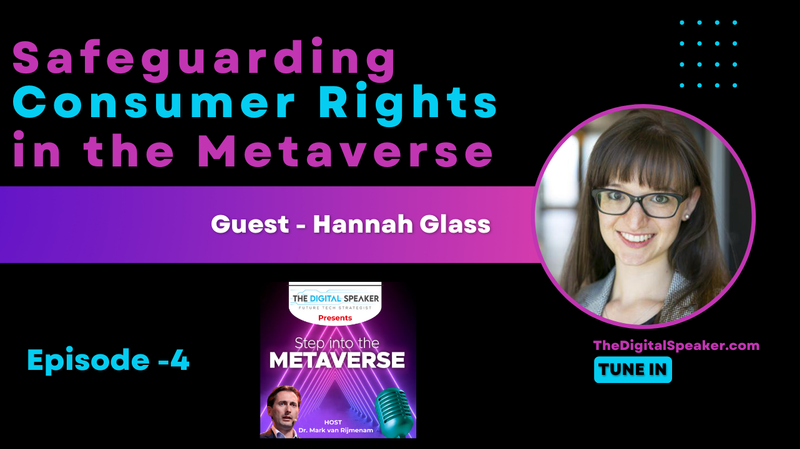
Safeguarding Consumer Rights in the Metaverse with Hannah Glass - Step into the Metaverse Podcast: EP04





















In this episode of the Step into the Metaverse Podcast, I interviewed Hannah Glass, a senior associate in the leading financial markets team at King & Wood Mallesons, specialising in blockchain technology, fintech and payments. She advises a broad range of clients, from start-ups and crypto asset exchanges to ASX 50 companies and governments, on current and emerging legal issues which arise from using innovative technologies in a complex regulatory environment.
Hannah is at the forefront of the development of the legal framework for fintech in Australia. She has worked with industry bodies and government on issues ranging from central bank digital currencies, regulatory sandboxes, legislative treatment crypto-asset and assisting industry on their response to the Senate inquiry into Fintech and Regtech. She is regularly invited to participate in forums with the government to discuss policy issues.
Hannah sits on the Australian Department of Industry, Science, Energy and Resources’ National Blockchain Roadmap Steering Committee and is the chair of the Regtech Working Group, exploring the use of distributed ledger technology to assist in meeting legal, regulatory and compliance obligations. She is also a member of DISER’s RegTech Stakeholder Reference Group. She has been named “band 3” in Chambers and Partners FinTech Guide 2022, after 3 years as “up and coming”. Hannah is the only non-partner listed in this category. She is a fellow of Blockchain Australia, and a member of Global Blockchain Convergence and Wall Street Blockchain Alliance.
Hannah and I discussed the legal and regulatory issues surrounding the metaverse, NFTs, and crypto. We talked about the challenges surrounding NFTs, for example, when it comes to copyright and intellectual property issues, but also how we can protect consumers when it comes to the massive amount of data extraction we can expect to happen in the metaverse. Enjoy the conversation.
Highlights
- [01:19] - Diving into the combination of the real and the virtual.
- [03:53] - The state of copyright and ownership in NFTs.
- [13:56] - Legal challenges that might affect tokenization.
- [18:10] - Tackling the tons of privacy issues that affect the metaverse.
- [26:26] - How DAOs will enforce their rules and regulations in the metaverse.
- [31:37] - Why we must understand the difference between contracts and property.
Quotes
“You can have real world assets whose ownership is recorded in an NFT” - Hannah Glass
“Tokenization itself doesn't change the nature of the assets. Tokenization changes the record of ownership” - Hannah Glass
“We’re not gonna necessarily throw everything that we have out; we’re probably going to incorporate everything that we have in the metaverse” - Hannah Glass
Learn More About Hannah Glass in the Links Below:
- LinkedIn - https://www.linkedin.com/in/hannah-glass-48555152/
- Twitter - https://twitter.com/hannah_glass
If you are interested in learning more about the metaverse, you can order my book Step into the Metaverse here.
Frequently asked questions
What legal issues arise with NFTs and copyright?
NFTs raise challenges around copyright and intellectual property because owning an NFT does not automatically mean owning the underlying creative work or its rights. This distinction between holding a token and holding legal rights to an asset creates confusion and legal complexity that needs to be addressed as NFTs become more widely used.
Link to this questionDoes tokenization change the nature of an asset?
No, tokenization does not change the nature of the underlying asset itself. Instead, it changes how ownership of that asset is recorded. Real world assets can have their ownership recorded in an NFT, meaning the token serves as a record of ownership rather than transforming what the asset actually is.
Link to this questionWhat privacy concerns exist in the metaverse?
The metaverse is expected to involve a massive amount of data extraction, raising significant privacy issues for consumers. Protecting consumers in this environment means addressing how personal data is collected, used, and safeguarded as people interact within increasingly immersive virtual environments combining real and virtual elements.
Link to this questionWill existing legal frameworks apply to the metaverse?
Existing legal structures are not expected to be discarded entirely for the metaverse. Instead, current frameworks around contracts, property, and regulation will likely be incorporated and adapted to fit metaverse contexts, including understanding key distinctions such as the difference between contracts and property when applied to virtual assets and DAOs.
Link to this question
Dr Mark van Rijmenam
Dr. Mark van Rijmenam, widely known as The Digital Speaker, isn’t just a #1-ranked global futurist; he’s an Architect of Tomorrow who fuses visionary ideas with real-world ROI. As a global keynote speaker, Global Speaking Fellow, recognized Global Guru Futurist, and 5-time author, he ignites Fortune 500 leaders and governments worldwide to harness emerging tech for tangible growth.
Recognized by Salesforce as one of 16 must-know AI influencers , Dr. Mark brings a balanced, optimistic-dystopian edge to his insights—pushing boundaries without losing sight of ethical innovation. From pioneering the use of a digital twin to spearheading his next-gen media platform Futurwise, he doesn’t just talk about AI and the future—he lives it, inspiring audiences to take bold action. You can reach his digital twin via WhatsApp at: +1 (830) 463-6967.