Seven Guidelines to Ensure Ethical AI
Seven Guidelines to Ensure Ethical AI
The organisation of tomorrow will be built around data, and it will require artificial intelligence to make sense of all that data. Artificial intelligence is a broad discipline with the objective to develop intelligent machines.
AI consists of several subfields: Machine learning (ML), a subset of AI that enables machines to learn from data. Reinforcement learning, which is a subset of ML and focuses on artificial agents that use trial and error to improve itself. And deep learning, also a subset of ML that aims to mimic the human brain to detect patterns in large datasets and benefit from those patterns.
Artificial intelligence has been around since the 1950s, thanks to the work of Alan Turing, who is widely regarded as the father of theoretical computer science and artificial intelligence. Back then, Alan Turing already dreamed of machines that would eventually “compete with men in all purely intellectual fields”.
In the past years, we have come to a lot closer to Turing’s dream. Thanks to billions of dollars in research spent by tech giants such as Google, Facebook, Tencent, Baidu, Apple and Microsoft, there has been increased attention on AI. Resulting in a variety of ever-more intelligent AI applications in almost every domain.
The EU and AI Ethics
With the attention for AI growing, also the call for ethical AI is growing. This is not surprising seeing the many problems we have encountered already. In 2016, Cathy O’Neil already pointed out, in her book Weapons of Math Destruction, the problems that can arise when we rely too much on unaccountable AI. These problems exist due to biased algorithms that are trained using biased data and developed by biased developers.
Earlier this month, the AI Now Institute warned that due to a lack of diversity within the AI development community, AI is at risk of preserving historical biases and power imbalances. Already, the overwhelmingly white and male field has resulted in problems such as image recognition services that offend minorities, racist chatbots and technology that cannot recognise users with dark skin colours.
High-quality, unbiased data combined with the right processes to ensure ethical behaviour within a digital environment could significantly contribute to AI that can behave ethically. Since this is difficult to achieve, the European Union published a set of guidelines on how to develop ethical AI. The seven guidelines aim to limit the existing problems with AI.
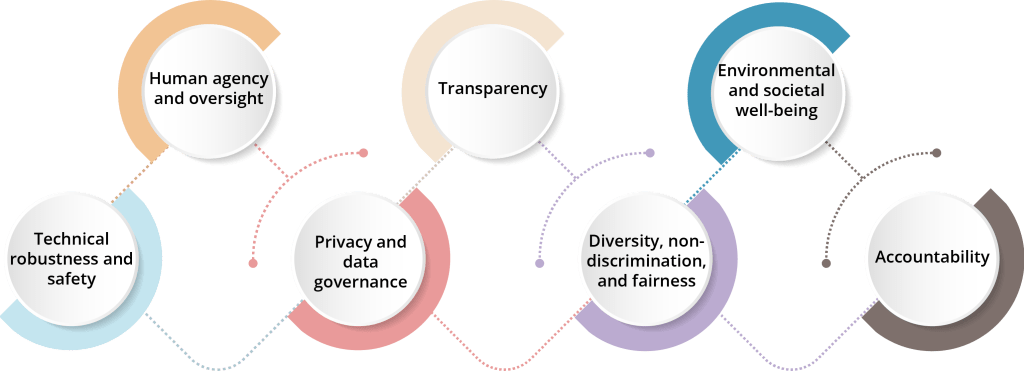
Figure 1: EU guidelines ethical AI
In brief, these guidelines include:
- Human agency and oversight – AI should empower humans, but humans should control AI;
- Technical robustness and safety – AI should be safe and prevent (un)intentional harm;
- Privacy and data governance – AI should respect user privacy and ensure adequate data governance;
- Transparency – AI should not be a black box and be able to explain itself in plain language;
- Diversity, non-discrimination and fairness – bias should be prevented, and diversity encouraged;
- Societal and environmental well-being – AI should benefit all of humanity and be sustainable and environmentally friendly;
- Accountability – AI should be responsible and accountable.
If you want to download the full report on ethical AI guidelines, click here.
The objective of these seven AI guidelines is to create trustworthy AI that is lawful (respects all applicable laws and regulations), ethical (respects ethical principles and values) and is robust (from a technical and social perspective). Hopefully, these seven guidelines will help the AI community in ensuring further development of ethical AI. Not only in Europe, but across the globe, since AI does not know borders.
Image: Visual Generation/Shutterstock
Frequently asked questions
What are the seven EU guidelines for ethical AI?
The seven guidelines are human agency and oversight, technical robustness and safety, privacy and data governance, transparency, diversity, non-discrimination and fairness, societal and environmental well-being, and accountability. Together they aim to limit existing problems with AI by ensuring humans remain in control, systems are safe, private, explainable, fair, beneficial and answerable for their actions.
Link to this questionWhy is there growing concern about AI ethics?
Concern is growing because biased algorithms trained on biased data by biased developers have already caused real problems, such as image recognition services offending minorities, racist chatbots, and technology unable to recognise users with dark skin colours. The AI Now Institute also warned that a lack of diversity within the AI development community risks preserving historical biases and power imbalances.
Link to this questionWhat makes AI biased in the first place?
Bias in AI stems from biased algorithms that are trained using biased data and developed by biased developers. Since the field developing AI is overwhelmingly white and male, this lack of diversity risks embedding historical biases and power imbalances into the technology, leading to discriminatory outcomes for certain groups.
Link to this questionWhat is the ultimate goal of these ethical AI guidelines?
The goal is to create trustworthy AI that is lawful, respecting all applicable laws and regulations, ethical, respecting ethical principles and values, and robust from both a technical and social perspective. The guidelines are intended to help the global AI community, not just Europe, since AI does not respect borders.
Link to this question
Dr Mark van Rijmenam
Dr. Mark van Rijmenam, widely known as The Digital Speaker, isn’t just a #1-ranked global futurist; he’s an Architect of Tomorrow who fuses visionary ideas with real-world ROI. As a global keynote speaker, Global Speaking Fellow, recognized Global Guru Futurist, and 5-time author, he ignites Fortune 500 leaders and governments worldwide to harness emerging tech for tangible growth.
Recognized by Salesforce as one of 16 must-know AI influencers , Dr. Mark brings a balanced, optimistic-dystopian edge to his insights—pushing boundaries without losing sight of ethical innovation. From pioneering the use of a digital twin to spearheading his next-gen media platform Futurwise, he doesn’t just talk about AI and the future—he lives it, inspiring audiences to take bold action. You can reach his digital twin via WhatsApp at: +1 (830) 463-6967.