Synthetic Minds | China’s Synthetic Biology Leap
Synthetic minds is evolving. Short bi-weekly insights to get you thinking. If you enjoy it, please forward. If you need more insights, subscribe to Futurwise and get 25% off for the first three months!
Last year, I was elected the world's #1 futurist, and voting for 2026 is now open! Your vote would mean a lot to me, it takes 2 seconds. Vote here. Thanks!
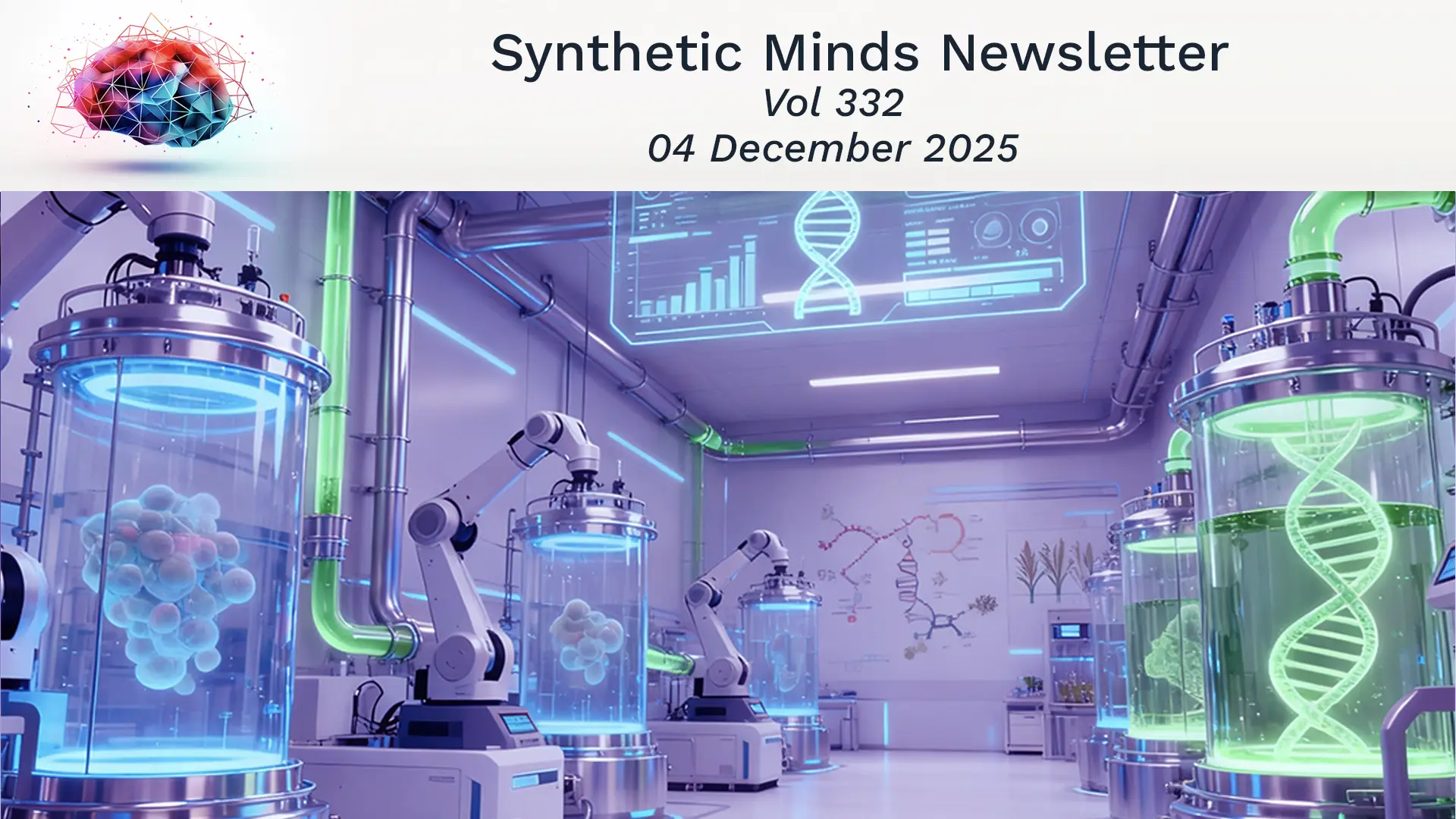
China’s Next Power Move: The Synthetic Biology Leap
While most leaders in the West are still trying to understand AI, China is already sprinting into the next frontier: synthetic biology at industrial scale. And if we follow the signals, this is the domain where China may pull furthest ahead.
Synthetic biomanufacturing, using engineered microbes to produce food, chemicals, and materials, is no longer a niche scientific curiosity. It has been elevated to a strategic pillar of China’s national planning and explicitly embedded in the 15th Five-Year Plan. This is not an experiment. It is a state priority.
And the numbers reveal why:
- Producing 6,000 tons of protein through synthetic biomanufacturing uses just 8% of the land, 1% of the water, and emits 95% less CO₂ than dairy farming.
- No animal waste.
- No fragile supply chains.
- No geopolitical chokepoints.
This is not innovation for convenience, it is innovation for survival, designed to confront the collision of climate change, resource scarcity, and population growth.
Meanwhile, the West still treats synthetic biology as “emerging,” debating its ethics and potential, while China treats it as inevitable and acts accordingly. Capital deployment, regulatory acceleration, manufacturing capacity, and long-term coordination are already in motion, just as they were before China took the global lead in solar, batteries, EVs, and industrial robotics.
In Now What? How to Ride the Tsunami of Change, I argue that synthetic biology is not just another trend. It is one of the eight exponential forces reshaping our century. Biotechnology marks the moment we stop observing life and start engineering it, redirecting evolution with intent.
Every exponential technology begins as a niche breakthrough, then suddenly compounds, converges, and becomes a geopolitical lever. Synthetic biology has now entered that phase of convergence, woven together with AI, quantum modeling, robotics, and bioinformatics to create an innovation engine the world is not prepared to compete with.
This is why, in Trend #1 of my 2026 forecast, China Overtakes the West in Technological Capabilities, I highlight that China isn’t just advancing in AI. It is building coherent capability across every exponential domain, and synthetic biology is now joining compute, robotics, and semiconductors as a national force multiplier.
The stakes could not be clearer.
Synthetic biomanufacturing is poised to redefine how the world produces food, medicine, materials, and energy, not in decades, but in years. It turns microbes into factories, replaces land- and water-intensive supply chains, and allows nations to manufacture essential resources with unprecedented efficiency. Countries that treat this capability as national infrastructure will leap ahead. Those that hesitate will fall further behind.
And that is the core warning in Now What?: if we don’t build the literacy, policies, and long-term strategies required for this transition, the next leap in human progress won’t happen with us, it will happen to us.
The question for global leaders is simple and urgent:
Are we preparing for a world where biology becomes a programmable manufacturing force? Or are we about to be outpaced again?

'Synthetic Minds' continues to reflect the synthetic forces reshaping our world. Quick, curated insights to feed your quest for a better understanding of our evolving synthetic future, powered by Futurwise:
1. China's economic landscape is undergoing significant transformations, driven by its push for near-total self-sufficiency in technology and industrial goods, but will its economic stimulus program boost consumer spending? (Spotify Podcast)
2. The increasing influence of big tech companies on media narratives is raising concerns about the creation of echo chambers that favor their interests. How to see through Silicon Valley's narrative and make informed choices about your tech upgrades? (The Guardian)
3. Scientists are working on creating conscious AI, but what does that mean for us? Is it a step towards a more intelligent future or a risk to our safety? (Popular Mechanics)
4. Autonomous vehicles are the future of transportation, with Waymo's data showing a 96% lower rate of injury-causing crashes at intersections. Will autonomous EVs make our roads safer! (CleanTechnica)
5. The Ethereum network has implemented the Fusaka upgrade, which aims to increase transaction processing capacity while maintaining security and decentralization standards. (Crypto.news)
If you are interested in more insights, grab my latest, award-winning, book Now What? How to Ride the Tsunami of Change and learn how to embrace a mindset that can deal with exponential change, or download my news 2026 tech trends report:
If this newsletter was forwarded to you, you can sign up here.
Thank you.
Mark