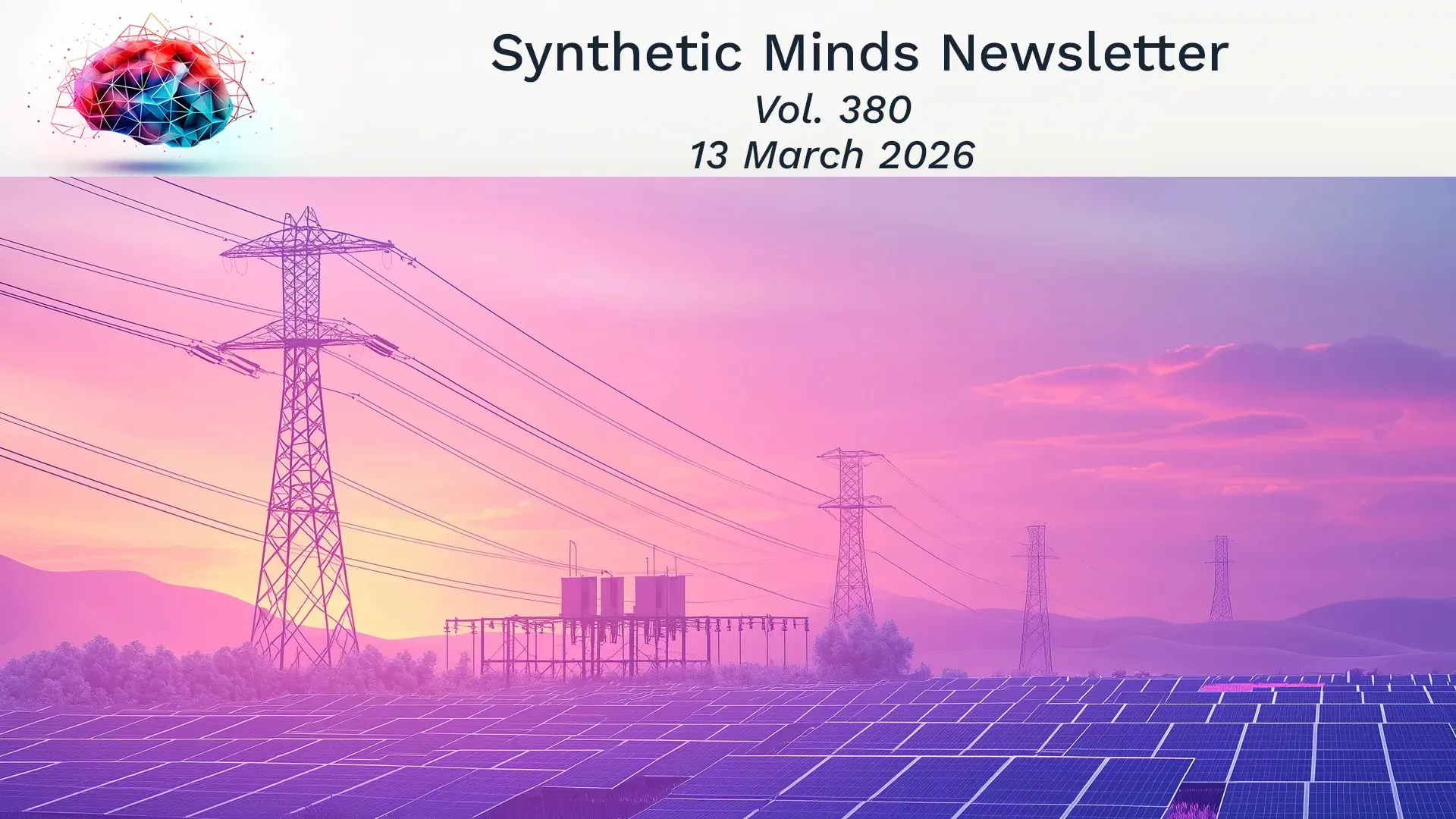
Synthetic Minds | Data Is the New Highway System for National AI

The Synthetic Minds newsletter is evolving. Short daily insights to get you thinking. If you enjoy it, please forward. If you need more insights, subscribe to Futurwise and get 25% off for the first three months!
Data Is the New Highway System for National AI
Treating data like private hoards is how countries lose the AI race. Britain just signaled the opposite: open nationally owned datasets, Met Office weather, National Archives legal records, cultural repositories, so local builders can train, test, and deploy AI on trusted public foundations.
The real constraint isn’t compute.
Compute without high-quality, rights-cleared, interoperable data is a sports car without roads. When governments publish “boring” datasets with modern APIs, documentation, and governance, they don’t just enable startups; they upgrade the state’s operating system: better planning, faster compliance, smarter climate adaptation, and more accountable public services.
The UK plan is unusually concrete. Researchers will test how weather data can improve local council operations (think road gritting and planning), while legal archives could reduce compliance friction for small businesses.
This move signals a policy evolution where governments are no longer merely responding to AI entrepreneurs but actively reshaping fundamental data ecosystems to accelerate AI adoption across society and economic sectors.
Access to government-controlled, high-trust data unlocks new frontiers in AI modelling (from climate forecasting to legal automation) without relying on private datasets alone.
Europe’s open-data benchmarking shows this advantage compounds where data quality and reuse are treated as strategy, not admin.
But “open” without guardrails becomes backlash: privacy, copyright, provenance, and access controls decide whether this becomes public value or a trust crisis.
So: which datasets should your country open next, tomorrow, not in five years?

'Synthetic Minds' continues to reflect the synthetic forces reshaping our world. Quick, curated insights to feed your quest for a better understanding of our evolving synthetic future, powered by Futurwise:
1. NVIDIA has launched the Earth-2 family of open models for weather and climate AI, making AI weather prediction more accessible globally. This fully open, accelerated weather AI software stack includes pretrained models, frameworks, customization recipes, and inference libraries. (NVIDIA)
2. The development of world models holds promise for creating AI systems that are more robust, adaptable, and truly intelligent. The future of AI may well depend on its ability to not just see the world, but to predict it. (Quantum Zeitgeist)
3. A Chinese university has introduced a humanoid diagnostic robot, Fuxiaozhi F1-D, which utilizes non-invasive brain computer interface (BCI) technology to aid in the early intervention of autism and other neurodevelopmental disorders. (Global Times)
4. As AI adoption accelerates, technology leaders are caught in an impossible bind: delivering rapid returns while ensuring responsible AI deployment. 71% of CIOs and CTOs say their executive leadership holds unrealistic expectations about AI's return on investment. (Forbes)
5. American workers are increasingly adopting AI in their work lives. A recent Gallup poll found that 12% of employed adults use AI daily, while 25% use it at least a few times a week. (AP News)

If you are interested in more insights, grab my latest, award-winning, book Now What? How to Ride the Tsunami of Change and learn how to embrace a mindset that can deal with exponential change, or download my news 2026 tech trends report:
If this newsletter was forwarded to you, you can sign up here.
Thank you.
Mark