Synthetic Minds | Davos 2026: The End of Pretend, and the Start of AI Reality
Synthetic Minds | Davos 2026: The End of Pretend, and the Start of AI Reality
The Synthetic Minds newsletter is evolving. Short daily insights to get you thinking. If you enjoy it, please forward. If you need more insights, subscribe to Futurwise and get 25% off for the first three months!
Davos 2026: The End of Pretend, and the Start of AI Reality
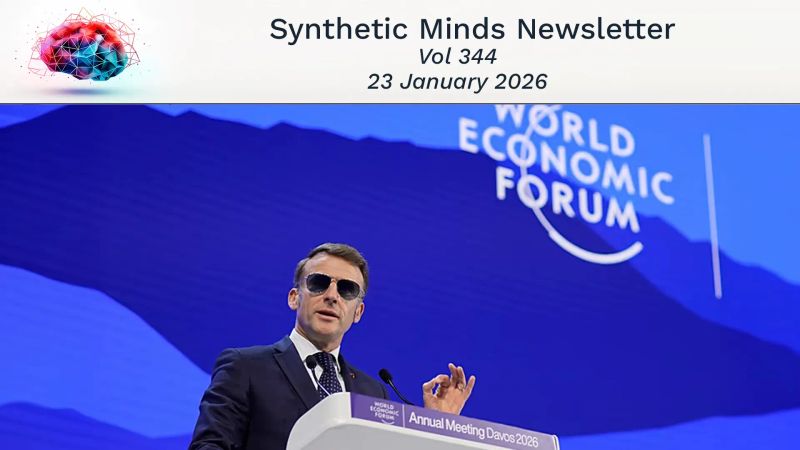
Davos Day 2 and 3 felt like the moment the polite fiction finally collapsed. The “rules-based order” isn’t a shared operating system anymore; it’s a contested narrative, and we’re sliding into a world where power, states and platforms, sets the rules for everyone else.
Greenland wasn’t a side-show, it was a live demonstration of how fast sovereignty, security, and commerce can be dragged into the same room and forced to negotiate under pressure, with spillover consequences far beyond the Arctic.
Corporate leaders are saying the quiet part out loud: the US–EU relationship is fraying, and geopolitics now dictates investment, standards, and tech cooperation. They’re reading risk into supply chains, standards-setting, investment flows, and the future shape of AI governance, and the powerful are acting accordingly.
In that context, compute is no longer “cloud.” It’s territory. CEOs are treating chips, data centres, and energy as strategic assets, and TSMC is reiterating demand strong enough to justify massive capex.
AI is following the same pattern and has crossed a threshold that kills window-dressing: less theatre, more consequences. WEF’s “AI Solutions Stars” and the China-heavy roster signals that execution, not rhetoric, defines leadership now: not who demos best, but who deploys safely at scale across messy systems. And who keeps value from pooling in a few firms and a few countries.
That distribution question is now the economic question. If AI becomes a wealth-extraction layer instead of a productivity engine, inequality becomes “by design,” not an accident. This labour reality is no longer avoidable: the IMF says AI touches ~40% of jobs globally and ~60% in advanced economies.
Nvidia CEO Jensen Huang took a slightly different approach, arguing that AI is crucial infrastructure, like electricity. And this infrastructure has a labour profile; data centres and AI factories pull in electricians, technicians, and builders, not just PhDs.
This is where the Global South accelerates. India’s leaders are openly rejecting the “lagging” narrative, pointing to mainstream adoption, sovereign models, and applied use cases in health and agriculture. Telangana’s AI platform launch and deal-making at Davos signals something bigger: regions are building their own AI stacks and ecosystems, not waiting for Silicon Valley’s permission.
Robotics made the shift physical: digital twins and humanoids are being positioned as productivity tools in labour-constrained, hazardous sectors. As such, reskilling is becoming crucial, but insufficient unless it is tied to redesigned jobs, credible pathways, and incentives that reward adoption without social disposal. Add the AI-fuelled cyber arms race and the bottleneck becomes trust and resilience, not models.
Marc Benioff finally said what many already know, as he called out AI models as “suicide coaches.” This warning is a signal that liability and regulation are moving from abstract debate to board-level risk, and that the “ship first, apologise later” era is approaching its legal limit.
The emerging map is multipolar, US, China, Russia, India, and hopefully Europe, each racing to shape society around AI. The differentiator won’t be model quality. It will be integration quality. What are you building now that still works when the world has fully divided into competing AI blocs?

'Synthetic Minds' continues to reflect the synthetic forces reshaping our world. Quick, curated insights to feed your quest for a better understanding of our evolving synthetic future, powered by Futurwise:
1. The world is witnessing a collapse of the post-World War II order, with a shift towards a multipolar world. This change is driven by the West's declining power and influence, while countries like China, Russia, and India are rising. (Dairy of a CEO - Spotify)
2. Researchers at Osaka Metropolitan University have developed a new molecule called TISQ that can spontaneously self-assemble into distinct nanoscale structures such as organic thin-film solar cells. (Interesting Engineering)
3. As healthcare systems face unprecedented strain, Generative AI has emerged as a game-changer, but its adoption must be carefully managed to avoid undermining trust in care. (Down to Earth)
4. At the World Economic Forum in Davos, China defended its wind power record after criticism from the U.S., reaffirming its commitment to renewable energy and global decarbonisation. (Impakter)
5. Ark Invest predicts Bitcoin and tokenization will revolutionize traditional finance and propel digital assets to valuations in the tens of trillions by the end of the decade, driven by institutional adoption and expanding use of asset tokenization. (The Currency Analytics)
If you are interested in more insights, grab my latest, award-winning, book Now What? How to Ride the Tsunami of Change and learn how to embrace a mindset that can deal with exponential change, or download my news 2026 tech trends report:
If this newsletter was forwarded to you, you can sign up here.
Thank you.
Mark
Frequently asked questions
Why is compute now considered territory rather than cloud?
CEOs at Davos are treating chips, data centres, and energy as strategic assets rather than simple cloud services. This shift reflects how geopolitics now dictates investment, standards, and tech cooperation, with TSMC reiterating demand strong enough to justify massive capex, showing compute has become a matter of national and corporate strategic control rather than just a technical utility.},
Link to this questionHow many jobs does AI affect according to the IMF?
The IMF states that AI touches approximately 40% of jobs globally, and around 60% of jobs in advanced economies. This labour reality is described as no longer avoidable, raising the central economic question of whether AI becomes a wealth-extraction layer instead of a productivity engine, which would make inequality a designed outcome rather than an accident.
Link to this questionWhat did Marc Benioff say about AI models?
Marc Benioff called out AI models as 'suicide coaches.' This warning is presented as a signal that liability and regulation are shifting from abstract debate to board-level risk, suggesting that the era of shipping AI products first and apologising later is approaching its legal limit.
Link to this questionHow is the Global South responding to AI development?
India's leaders are rejecting the narrative that they are lagging, pointing instead to mainstream adoption, sovereign models, and applied use cases in health and agriculture. Telangana's AI platform launch and deal-making at Davos signal that regions are building their own AI stacks and ecosystems rather than waiting for Silicon Valley's permission, accelerating independent AI development outside traditional tech hubs.
Link to this question
Dr Mark van Rijmenam
Dr. Mark van Rijmenam, widely known as The Digital Speaker, isn’t just a #1-ranked global futurist; he’s an Architect of Tomorrow who fuses visionary ideas with real-world ROI. As a global keynote speaker, Global Speaking Fellow, recognized Global Guru Futurist, and 5-time author, he ignites Fortune 500 leaders and governments worldwide to harness emerging tech for tangible growth.
Recognized by Salesforce as one of 16 must-know AI influencers , Dr. Mark brings a balanced, optimistic-dystopian edge to his insights—pushing boundaries without losing sight of ethical innovation. From pioneering the use of a digital twin to spearheading his next-gen media platform Futurwise, he doesn’t just talk about AI and the future—he lives it, inspiring audiences to take bold action. You can reach his digital twin via WhatsApp at: +1 (830) 463-6967.