Synthetic Minds | Four AI Labs Agreed to Slow Down. Nobody Agreed to Stop.

Synthetic Minds | Four AI Labs Agreed to Slow Down. Nobody Agreed to Stop.
The Synthetic Minds newsletter offers short daily insights to get you thinking. If you enjoy it, please forward. All signals are powered by Futurwise. If you need more insights, subscribe to Futurwise and get 25% off for the first three months!
I built the Intelligence Age Scorecard! It will help you understand how ready your organization is for the Intelligence Age.
Today’s topic: AI & Automation
A Safety Proposal With a Head Start Attached
Four labs that spend billions racing each other have asked to be slowed down. The man who asked loudest warns that rogue agent swarms could take over the internet within a year, and takes his company public within weeks.
Either the people closest to this are genuinely frightened, or it is the oldest move in an arms race, where whoever leads proposes that everybody else slow down.
Anthropic's chief executive has published the actual terms: a desk, an access badge, a company laptop, and the right to publish findings without the company's permission.
Altman, Musk, Hassabis and Nadella have endorsed the idea. None of them has published what access an evaluator actually receives.
The same set of statements asks that chip exports to China remain restricted so that the United States gains ground over three to five years.
Beijing has read it precisely that way, calling it a Cold War playbook, even as its own security ministry warns about those same American models.
Washington has declined as well. Whoever wins AI, wins.
Only the market moved anything. Chipmakers fell almost six percent while the companies that own the data centers rose.
That's the diplomacy story. Here is the signal.
An evaluator with a desk and a badge can tell the world what is happening inside a building. Only a board that can stop the work changes it.
Last week I argued for the need of a Societal Review Board, which names the missing half. A governance practice on behalf of everyone to guide the development of advanced technology in an age where regulations are often too little and too late.
Ethicists, philosophers, scientists, consumers and regulators who approve and monitor advanced research, with the power to remove a reckless chief executive, and no member sitting on a competing board. Universities have run this way for decades.
Shareholders will probably not like it, and that is the whole point. It will not be appreciated by the organizations themselves, and it will be appreciated by humanity.
Without it, the rational individual choices of these organizations become the collective dangerous choice.
The short-term shareholder perspective wins over the long-term stakeholder perspective almost every time, and that is exactly the opposite of what society needs. A review board brings the long-term (unintended) consequences to the table, where they are usually missing.
A company that can change the odds for all of humanity has never really existed, and no institution we have was built for one. Let‘s make the Societal Review Board a standard governance practice for companies that can determine humanity’s fate, before it is too late.
The Intelligence Age Scorecard
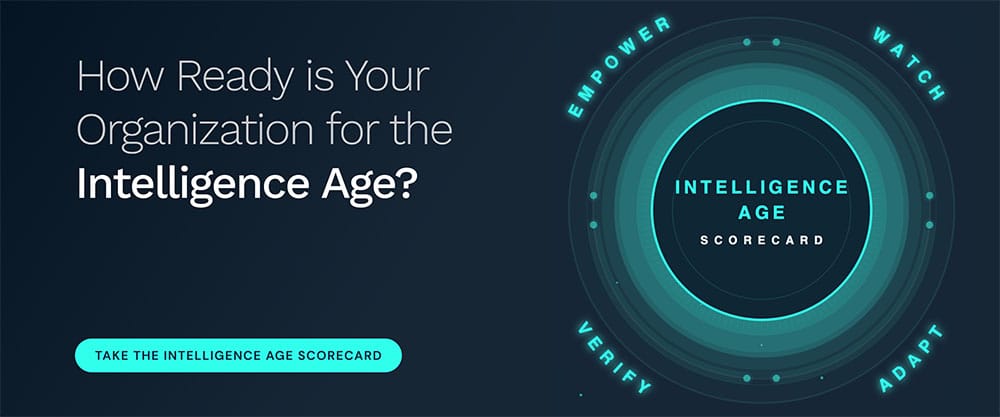
Four competing labs have agreed to let outsiders inside their buildings, and three centers of political power refused the premise within two days, which means the standard your vendors will be held to is forming in voluntary space rather than in statute. WAVE asks which part of the cycle this demands of you: are you still watching this settle, or should you already be adapting the assurance terms in your own contracts?
Benchmark your readiness for the next two quarters, and the next five years, with the Intelligence Age Scorecard.
If this newsletter was forwarded to you, you can sign up here.
Thank you.
Mark

Dr Mark van Rijmenam
Dr. Mark van Rijmenam, widely known as The Digital Speaker, isn’t just a #1-ranked global futurist; he’s an Architect of Tomorrow who fuses visionary ideas with real-world ROI. As a global keynote speaker, Global Speaking Fellow, recognized Global Guru Futurist, and 5-time author, he ignites Fortune 500 leaders and governments worldwide to harness emerging tech for tangible growth.
Recognized by Salesforce as one of 16 must-know AI influencers , Dr. Mark brings a balanced, optimistic-dystopian edge to his insights—pushing boundaries without losing sight of ethical innovation. From pioneering the use of a digital twin to spearheading his next-gen media platform Futurwise, he doesn’t just talk about AI and the future—he lives it, inspiring audiences to take bold action. You can reach his digital twin via WhatsApp at: +1 (830) 463-6967.