Synthetic Minds | Humanoids Just Crossed the Uncanny Valley
The Synthetic Minds newsletter is evolving. Short daily insights to get you thinking. If you enjoy it, please forward. If you need more insights, subscribe to Futurwise and get 25% off for the first three months!
On a side note, in a world that changes faster than most institutions can adapt, futurists help leaders see around corners, stress-test assumptions, and decide before the future decides for them. That’s why I’m grateful to share that Global Gurus ranked me #3 Futurist worldwide this year.
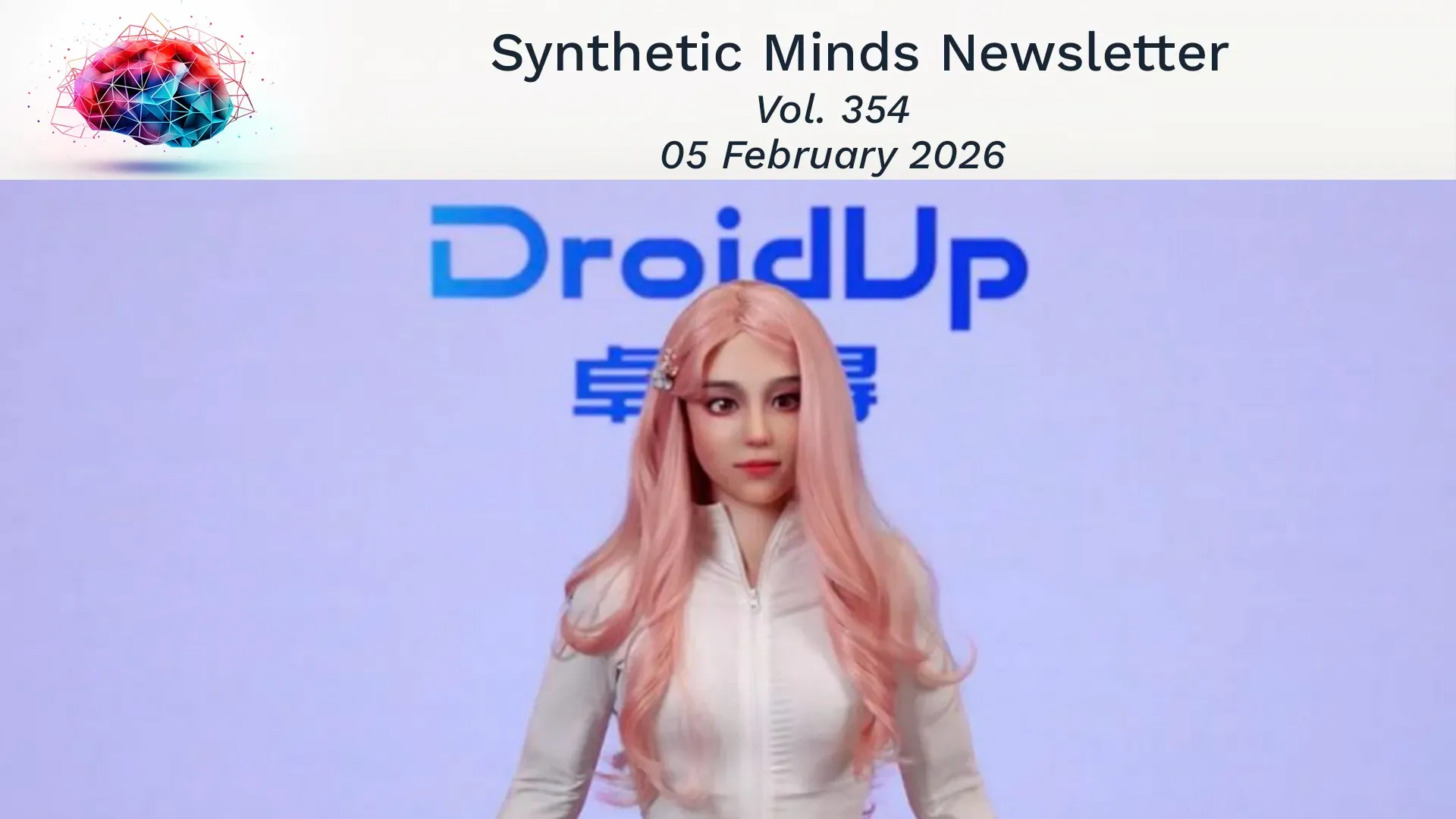
DroidUp's Humanoid Crossed the Uncanny Valley
Shanghai just showed what it looks like when humanoids start climbing out of the uncanny valley.
DroidUp’s new humanoid, Moya, isn’t built to lift boxes or do parkour. It’s built to interact: eye contact, subtle facial micro-expressions, and a gait the company claims hits 92% human-like walking accuracy.
Add the oddly deliberate detail of a “human” body temperature range (32–36°C) and you get the point: this is design aimed at trust, proximity, and prolonged presence.
This is the real convergence: robotics plus AI plus social engineering by aesthetics. And it’s only 2026. Humanoids will move from demos to deployment across healthcare, education, and customer-facing environments as early as late 2026.
Robotics is exponential tech made physical: digital intelligence turning into tangible action. As context-aware humanoids enter the economy, we’ll trigger the next data explosion, continuous streams of spatial, behavioral, and environmental signals that will train the next generation of AI. That creates the feedback loop leaders keep underestimating: better robots generate better data, better data builds better models, better models build better robots.
The question isn’t whether robots will reshape industries; they already are. The Jetsons era has begun, let’s just make sure it’s Rosie running the show, not Moya deciding it’s time to improvise. The real question is governance: where humanoids belong, what they must disclose, and what they’re allowed to simulate when interacting with humans.
Therefore, the work now is governance: clear disclosure, interaction boundaries, and enforceable rules for where humanoids can operate and what they’re allowed to simulate.
Do we actually want machines that mimic us, or should we design them to look unmistakably non-human?

'Synthetic Minds' continues to reflect the synthetic forces reshaping our world. Quick, curated insights to feed your quest for a better understanding of our evolving synthetic future, powered by Futurwise:
1. AI bots are taking over the web! The internet is on the cusp of a significant transformation with autonomous AI bots poised to dominate web traffic. (Wired)
2. The pace of progress in quantum computing has picked up dramatically, especially in the past two years, with several teams making significant advances in quantum error correction. (Nature)
3. Sam Altman explores new economics for AI-driven scientific discovery, considering OpenAI's role in selectively backing outcomes and outcome-based pricing. (PYMNTS)
4. Automated driving is on the rise, but what are the challenges it still faces? Researchers published a comprehensive analysis of the current state of artificial intelligence in autonomous driving. (Quantum Zeitgeist)
5. If you thought Moltbook was crazy, Rent-a-Human is next level. Rentahuman.ai is a platform where humans can sell their labor to AI agents. Already 81,000 people signed up to sell their services to AI agents. (Mashable)

If you are interested in more insights, grab my latest, award-winning, book Now What? How to Ride the Tsunami of Change and learn how to embrace a mindset that can deal with exponential change, or download my news 2026 tech trends report:
If this newsletter was forwarded to you, you can sign up here.
Thank you.
Mark