Telstra's AI Readiness: A Trained Workforce Without the Authority to Move
Telstra's AI Readiness: A Trained Workforce Without the Authority to Move
Every quarter, Telstra tells the public exactly who it is. The annual report, the results briefing, the governance statement, the AI ethics page, the partner announcements, it all goes out the door for analysts and shareholders to read. What almost no one does is read that material the way an outsider assessing your AI readiness would.
So that's what I did here. This is a WAVE assessment of Telstra Group, Australia's largest telco, scored across the four pillars of the WAVE framework (Watch, Adapt, Verify, Empower) plus AGI readiness. The WAVE framework is my methodology for the Intelligence Age, which I describe in my book Now What?
The catch: it uses only public information. The FY25 annual report, the 1H26 briefing, the 2025 Corporate Governance Statement, the company's own AI ethics disclosures, and partner press from Microsoft. No interviews, no internal access, no proprietary data. Just what any regulator, competitor, or journalist could already piece together.
I'm using Telstra as the worked example, but the exercise is the point. Most leadership teams have never seen their organization scored from the outside, and the view from there is rarely the one they'd expect. In Telstra's case the public record tells a consistent story: a workforce trained to genuine AI fluency sitting on top of a decision architecture built for a 20th-century carrier. The skills are at the ceiling; the reflexes that turn skills into advantage are at the floor.
Here's the full assessment. As you read it, the more useful question isn't whether I've got Telstra exactly right, it's what a stranger would conclude about your company from your public record alone. More importantly, how would your organization look like if it was scored from public data and internal insights? That is what the Intelligence Age Scorecard offers.
Read across all five groupings, Watch, Adapt, Verify, Empower, AGI, and a single pattern emerges. Telstra has built the skills base of an AI-fluent company and the decision architecture of a 20th-century carrier. More than 22,000 employees have moved through the Data & AI Academy, and 18,000 Microsoft 365 Copilot licenses are deployed with roughly 80% weekly active use. Yet the prototyping discipline, the kill criteria, the in-year reallocation cycles that turn that literacy into operating advantage all sit at the floor.
The workforce is ahead of the operating model. That is not an HR problem and it is not a technology problem. It is a structural mismatch between the people inside the building and the rhythm of decisions above them.
Where the radar reaches
Telstra sees telecom signals natively. Connected Future 30, the five-year strategy disclosed in the FY25 annual report, commits the business to "radically innovate in the core," that is a credible multi-year horizon. The 1H26 briefing also disclosed an internal AI Maturity baseline of 30, placing the company in the second quartile, and "responsible AI scaling" is named as a forward-looking risk factor in the FY25 materials. These are signs of management attention, not of structured scanning.
The public record does not name a foresight function, a research partnership with a frontier lab, or a published cadence for translating external signals into board-ready decisions. Australian journalist AI adoption moved from 37% to 54% between 2024 and 2026. Foxtel was absorbed by DAZN in December 2024. Stan, Nine, and global SVOD continue to compress the local field. A carrier that also distributes media cannot afford to learn about these shifts through secondary reporting. A long planning horizon without a disciplined signal-to-decision pipeline produces strategy decks, not moves.
Strategy long, reflexes short
Adapt is the lowest pillar, and the public evidence explains why. Telstra executes big set-piece moves cleanly, the seven-year Accenture joint venture, the Versent sale to Infosys, the iBASIS wholesale divestment, and production-scale deployments like AskTelstra and the Telstra Assistant, which cut average call time by over a minute and nearly tripled self-serve query resolution. Those are real outcomes. They are not, however, evidence of a standing experimentation engine.
No public source names the kill criteria, the gating thresholds, or the in-year reallocation cycle that would let Telstra move resources in weeks rather than budget cycles. InfraCo's own framing talks about activating AI "at scale" across customer care, order-to-activate, and network optimization, strategic reallocation, not tactical flex.
Meanwhile AI-driven dubbing and localization compress global content distribution from months to weeks, and cloud-native deployment cycles run 6 to 18 months. When adaptation happens through M&A and mega-deals, every pivot becomes a heavy lift rather than a repeatable capability. The FY2025 result buys runway. It does not buy tempo.
Governance scaffold, mechanisms missing
Verify is the strongest pillar, and that ordering matters in a sector where ACMA, the eSafety Commissioner, and the OAIC are simultaneously tightening expectations. Telstra publicly commits to the Australian Government's AI Ethics Framework, including reliability, privacy protection, contestability, and accountability. The 2025 Corporate Governance Statement documents ASX fourth-edition compliance, four standing Board Committees, and an annually reviewed policy framework.
What the public record does not show is the operational layer beneath the principles: a Telstra-authored AI governance policy, a named AI Ethics Committee, a model validation standard, data lineage tooling, or red-team SOPs for customer-facing outputs. Principles without mechanisms are scaffolding without floors.
Australian copyright law requires a human author, the government has ruled out a text-and-data-mining exception, and ACCC research indicates 83% of Australian consumers expect consent before personal data trains AI. In that environment, a mid-band posture on data provenance and audit trails means Telstra cannot prove what its models learned from, which means it cannot defend the output when the proposed mandatory guardrails for high-risk AI move from proposal to enforcement.
Trained, licensed, and waiting
Empower is the second-strongest pillar, and the public evidence is genuinely impressive. More than 22,000 employees have completed at least one Data & AI Academy course, with nearly 9,000 completions in the first half of FY26 alone. Eighteen thousand Copilot licenses sit at roughly 80% weekly active use. Telstra is also a named partner in Microsoft's three-million-person Australian skilling commitment. By any benchmark, this is a workforce equipped to use the tools.
The problem is what sits next to that strength. The public record discloses no decision-rights framework that lets a frontline manager move an AI workflow from experiment to operation without escalation. T-shaped development is solid; rotation programs and a formal experimentation mandate are not disclosed.
Trained staff without authority become flight risk, particularly in a market where Foxtel-DAZN, Nine, Stan, and global streamers are hunting the same AI-fluent operators. The linkage to the weakest pillar is direct: a trained workforce that cannot move from pilot to production is the textbook signature of centralized decision-making constraining adaptation. The unlock is not more training. It is granting an already-capable workforce the authority to act.
What is not on the agenda
Across all five AGI dimensions, workforce displacement, decision authority, economic resilience, institutional speed, governance beyond human, the public record is empty. There is no disclosed framework for redeployment under discontinuous capability shocks. There is no disclosed decision-rights matrix that contemplates AI scaling beyond current narrow use cases. There is no disclosed revenue-stream resilience analysis under frontier-AI scenarios.
The absence of public commentary on AGI readiness is itself the finding. Telstra has linked headcount changes to AI adoption and runs a seven-year Connected Future 30 arc, while frontier capability cycles compress to quarters. A telco-media operator sitting at the intersection of ACMA, the Online Safety Act, and the Privacy Act, with recommender systems and generative tools already inside its perimeter, structurally undisclosed posture on AGI is not a benign silence. It is a board-level liability waiting for the first regulator, journalist, or activist shareholder to ask.
The structural exposure
The pattern across the five groupings is what executive teams rarely see in their own data: Telstra has invested heavily in the inputs of an AI-native company, literacy, licenses, partnerships, principles, and underinvested in the connective tissue that turns those inputs into operating advantage. Strong Watch on internal maturity but weak external signal triage means decisions arrive late. Strong Empower without distributed authority means literacy stalls at the desktop.
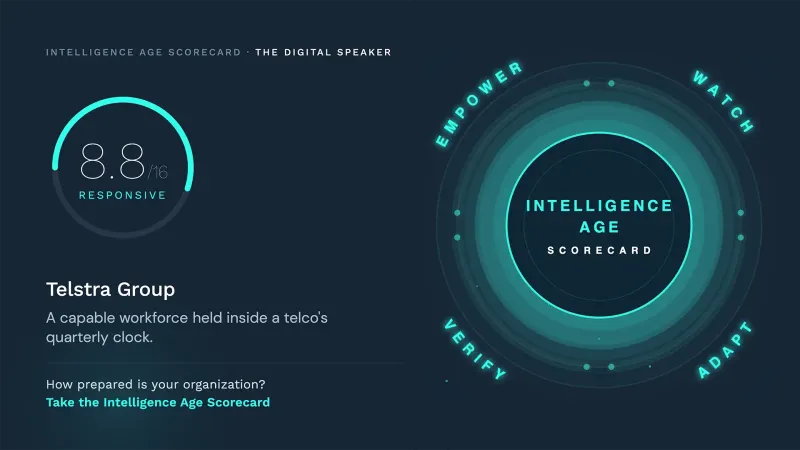
Strong governance principles without validation mechanisms means provenance gaps that the Australian regulatory front will price in 2026 and 2027. And an empty AGI posture means the operating model carrying the FY2025 result is calibrated to a telco rhythm that frontier capability cycles will not respect. The risk is not that any one pillar fails. The risk is that they fail to compound, and a Responsive 8.8 in a sector moving to advanced maturity is, in effect, falling behind.
What this means for the reader
If a stranger scored your organization from the public record alone, your annual report, your governance statement, your CEO's blog posts, your partner press releases, what would they see? Would they see workforce literacy without decision rights? A strategic arc without an experimentation cadence? Ethics principles without validation mechanisms? An AGI posture that is structurally undisclosed?
The Telstra pattern is not a Telstra problem. It is the default shape of large enterprises that have invested in AI inputs faster than they have rebuilt the operating model around them. The work is not adding more training, more licenses, or more partnerships. The work is closing the gap between the people in the building and the rhythm of decisions above them.
Empower without Adapt is a coiled spring. The question for Telstra, and for every enterprise that recognizes itself in this pattern, is whether the spring releases inside the building, or somewhere else.
Frequently asked questions
What is the WAVE framework used to assess Telstra?
WAVE is a methodology for the Intelligence Age described in the book Now What?, scoring organizations across four pillars: Watch, Adapt, Verify, and Empower, plus AGI readiness. It uses only public information such as annual reports, governance statements, results briefings, and partner press releases to assess how ready a company is to operate with AI, rather than relying on internal access or interviews.},{
Link to this questionWhy is Adapt the weakest pillar in Telstra's assessment?
Adapt scored lowest because Telstra's evidence shows large set-piece moves like the Accenture joint venture, the Versent sale, and the iBASIS divestment, plus production deployments like AskTelstra, but no disclosed kill criteria, gating thresholds, or in-year reallocation cycles. Without these mechanisms, adaptation happens through heavy M&A-style moves rather than a repeatable, fast experimentation engine, so the company gains runway but not tempo.
Link to this questionWhy does trained staff with AI skills matter if they lack authority?
More than 22,000 employees completed Data & AI Academy training and 18,000 Copilot licenses see roughly 80% weekly active use, yet no decision-rights framework lets frontline managers move an AI workflow from pilot to production without escalation. This creates a flight risk, since trained, AI-fluent staff without authority to act may be recruited by competitors like Foxtel-DAZN, Nine, or Stan who are hunting similar talent.
Link to this questionWhat is the risk of having no public AGI readiness posture?
Across workforce displacement, decision authority, economic resilience, institutional speed, and governance beyond human control, there is no disclosed framework for redeployment, decision rights, or revenue resilience under frontier-AI scenarios. This structurally undisclosed posture is described as a board-level liability, since a seven-year strategic arc cannot match capability cycles that now compress to quarters, leaving the company exposed to regulators, journalists, or activist shareholders.
Link to this question
Dr Mark van Rijmenam
Dr. Mark van Rijmenam, widely known as The Digital Speaker, isn’t just a #1-ranked global futurist; he’s an Architect of Tomorrow who fuses visionary ideas with real-world ROI. As a global keynote speaker, Global Speaking Fellow, recognized Global Guru Futurist, and 5-time author, he ignites Fortune 500 leaders and governments worldwide to harness emerging tech for tangible growth.
Recognized by Salesforce as one of 16 must-know AI influencers , Dr. Mark brings a balanced, optimistic-dystopian edge to his insights—pushing boundaries without losing sight of ethical innovation. From pioneering the use of a digital twin to spearheading his next-gen media platform Futurwise, he doesn’t just talk about AI and the future—he lives it, inspiring audiences to take bold action. You can reach his digital twin via WhatsApp at: +1 (830) 463-6967.