What Commonwealth Bank's Public Record Reveals About Its AI Readiness
What Commonwealth Bank's Public Record Reveals About Its AI Readiness
Commonwealth Bank wants you to know it leads Australian banking into AI. The frontier partnerships with Anthropic and OpenAI, the Seattle tech hub, the 30,000-plus employees through AI training, the 2,000 models running against 157 billion data points, it's all on the record, announced and amplified for analysts and shareholders to absorb. What no one outside the bank does is read that record the way a regulator or a short seller would.
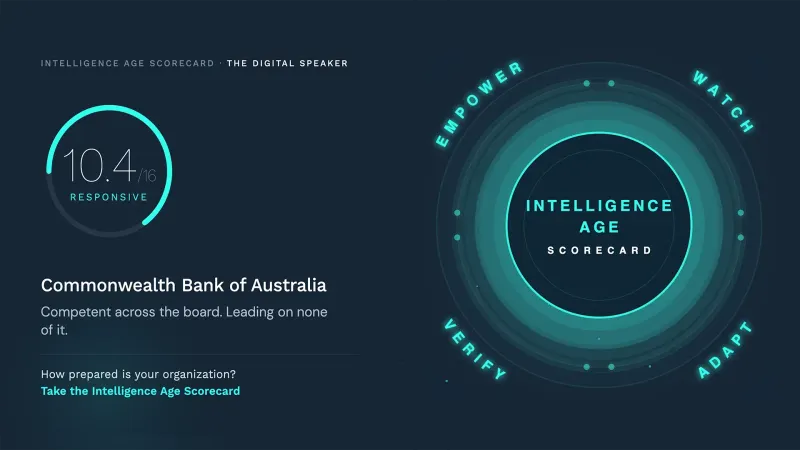
So that's the exercise here. This is a WAVE assessment of Commonwealth Bank of Australia, scored across the four pillars of the framework, Watch, Adapt, Verify, Empower plus AGI readiness, built entirely from public material. Filings, press releases, executive remarks, partnership announcements, regulatory disclosures. No interviews, no internal access, no proprietary data. Just what any outsider could already assemble without being let inside.
I'm using CBA as the worked example of the Intelligence Age Scorecard, but the method is the point. It is based on my WAVE methodology I first published in my latest book Now What?
The bank reads as confident from the front of the house and exposed once you trace the connections: a genuinely impressive deployment surface sitting on top of a verification spine that hasn't kept pace. The things you can announce, partnerships, training numbers, model counts, are best-in-class. The things you have to evidence under audit, provenance, output validation, decision rights, capability-discontinuity planning, are where the structural risk concentrates. And in a world of exponential change, that gap isn't academic.
Here's the full assessment. As you read it, the sharper question isn't whether I've scored CBA correctly, it's whether your own public posture would survive being read back to you by someone with no inside access and the regulatory calendar in their other hand.
What CBA already sees coming
The scanning apparatus is real. Anthropic at the engineer-to-engineer level. A Seattle outpost with a cohort focused on agentic systems. An MIT Sloan collaboration on managing AI risk. Group CIO Gavin Munroe describing quarter-on-quarter acceleration in conversations with US frontier labs.
Few Australian incumbents are sourcing signal from that many directions at once, and the evidence supports a high gateway score on Watch. The weakness sits further down. CEO Matt Comyn's long-term framing is consistent and public, but no published scenario set, no named foresight function, and no signal-evaluation framework appears in the disclosure record.
The synthesis layer is executive-curated rather than institutionally engineered. The specific consequence: scams and fraud are tracked superbly, the Apate.ai partnership proves that. Longer-horizon shifts, stablecoin rails, tokenized deposits, embedded finance compressing the deposit franchise, sit beyond the window a bank of CBA's systemic importance should hold open.
Pilots multiplying faster than the operating model
Adapt is the lowest pillar. CBA is not a bank that struggles to start things. ChatGPT Enterprise was rolled out at a scale described as among the largest in global financial services. The AWS data-platform migration moved 61,000 data pipelines from legacy to cloud inside eleven months. The Customer Engagement Engine has been in production for years. Starting is not the problem. The drag is in reallocation speed and feedback-loop discipline, the two dimensions where incumbent banks consistently lose ground to faster entrants.
CPS 230, live since 1 July 2025, treats material AI vendors as service providers requiring full operational risk treatment, which lengthens, not shortens, the path from pilot to production. The Privacy Act's automated-decision-making disclosures land on 10 December 2026 and add another layer. Meanwhile the Australian fintech market is on course to roughly double by 2031, with challengers iterating on monthly cycles. Annual budget rhythms will not defend deposit share against operators rebuilding their roadmap every four weeks.
Where the spine doesn't match the surface
Verify is where the structural exposure concentrates. CBA's February 2026 report on how the bank ideates, develops, deploys, and manages AI is a genuine governance disclosure, and the MIT collaboration on managing AI risk reinforces it. The visible work is being done. The invisible work is uneven. The provenance score is the one to stare at.
With CPS 230 already in force, ASIC's REP 798 having flagged the audit-mechanism gap at industry level, and the Privacy Act's automated-decision-making obligations biting in December 2026, a bank running one of the largest ChatGPT Enterprise deployments in global financial services has to be able to answer where training data, model outputs, and downstream decisions originated across the Anthropic, OpenAI, and AWS estate.
The public record does not show that it can. With ACL penalties for AI-washing now reaching AUD $100 million per contravention and ASIC's 2025-26 Corporate Plan explicitly prioritizing AI oversight, this is the exposed flank. Fast and reckless is not the CBA brand. The provenance seam needs to close before someone closes it from the outside.
Trained, not yet empowered
The training dimension is best-in-class by any Australian banking benchmark. More than 30,000 employees through the AI learning series. ChatGPT Enterprise rolled out at scale. The Seattle hub rotating 200 employees per year. An approximately $90 million Future Workforce Program over three years, with around 5,000 employees moved into new internal roles in the past year.
The AI-for-All framing is not marketing, the throughput is real. The weakness is structural, not cultural. Decision distribution and role redesign both sit at the lower end, meaning people are trained but authority and job architecture have not been re-engineered around augmented work.
A relationship banker who has completed the AI literacy program but still routes every non-standard decision up the chain has been upskilled without being empowered. And this couples directly to the Verify gap: decision rights cannot safely be distributed until provenance and output validation are trusted at the point of use. The unlock is not more training. It is fewer roles redesigned end-to-end with the validation layer engineered underneath them.
What is not on the agenda
The AGI Readiness score lands at 1.0/4, and the reason is direct: publicly available evidence does not address it. There is no disclosed framework for workforce displacement under capability discontinuity. No disclosed decision-authority matrix mapping which calls AI owns autonomously, which require human ratification, and which remain human-only.
No disclosed stress test of CBA's intermediation-based revenue model against agentic commerce or embedded finance routing around it. No disclosed governance posture for systems whose reasoning exceeds the supervisor's. This is not a fabrication of absence, the absence itself is the finding.
A bank of CBA's systemic weight, with frontier partnerships and a #4 global AI maturity ranking in financial services, has every reason to be the institution proposing the framework to APRA, ASIC, and the new Australian AI Safety Institute.
The structural risk of not doing so is straightforward: inherit a framework written by regulators on their cadence rather than yours. The operational competence visible across Watch, Adapt, Empower, and the surface of Verify has not yet translated into preparation for the moment when current playbooks expire entirely.
The fault line, named
The compound pattern across the five groupings tells one story. Strong Watch but soft synthesis means CBA sees what is coming but does not yet route it into a planning horizon long enough to act on.
Strong Adapt at the gateway but weak reallocation means pilots accumulate faster than the operating model can absorb. Strong Empower in training but weak decision distribution means literacy without authority. And the connective tissue is Verify, specifically the provenance gap. Without provenance, decision rights cannot safely be pushed down. Without output validation, reallocation cannot safely be sped up. Without capability-discontinuity governance, none of the above scales into the next decade.
The Verify seam is not one weakness among four. It is the structural constraint that keeps the other three from compounding. Close it, and the rest of CBA's investment thesis compounds. Leave it open, and APRA, ASIC, and the AISI will eventually close it on terms not written in Sydney.
What this means for the reader
If a stranger scored your organization from public material, press releases, partnerships, executive remarks, training disclosures, regulatory filings, what would they see? Most large incumbents have built the announceable layer of AI readiness. Far fewer have built the verifiable layer beneath it.
The asymmetry between what your front of house communicates and what your back of house can evidence under audit is the precise space regulators, journalists, acquirers, and short sellers now occupy. The question is not whether you are doing the work. The question is whether the work you are doing would survive being read back to you by someone with no inside access and the regulatory calendar in their other hand. That is the test CBA's public posture sits inside today. It is the test your public posture sits inside, too.
CBA leads Australian banking into AI. Whether it leads the sector through the verification reckoning, or becomes the case study cited in the next prudential update, depends on what the next twelve months close, not what the last twelve announced.
Frequently asked questions
What is the WAVE framework used to assess CBA?
WAVE is a methodology scoring an organization across four pillars, Watch, Adapt, Verify, and Empower, plus AGI readiness. It was built entirely from public material such as filings, press releases, executive remarks, partnership announcements, and regulatory disclosures, without interviews or internal access. It is used here as a worked example of an Intelligence Age Scorecard, drawn from the author's book Now What?
Link to this questionWhy is Verify considered CBA's weakest pillar?
Verify is where structural exposure concentrates because the provenance score is weak. Despite governance disclosures like the February 2026 AI report and MIT collaboration, the public record does not show CBA can trace where training data, model outputs, and downstream decisions originated across its Anthropic, OpenAI, and AWS estate, which matters as CPS 230, ASIC's REP 798, and Privacy Act obligations take effect.}
Link to this questionWhy does CBA score low on AGI readiness?
The AGI Readiness score lands at 1.0 out of 4 because publicly available evidence does not address it. There is no disclosed framework for workforce displacement under capability discontinuity, no decision-authority matrix distinguishing autonomous AI calls from human-ratified ones, no stress test of the intermediation-based revenue model against agentic commerce, and no governance posture for systems whose reasoning exceeds the supervisor's.
Link to this questionWhat is the difference between training staff and empowering them at CBA?
CBA has trained more than 30,000 employees through its AI learning series and rolled out ChatGPT Enterprise at scale, making its training dimension best-in-class. However, decision distribution and role redesign remain weak, meaning staff have gained AI literacy without gained authority. For example, a relationship banker who completed the training program may still have to route every non-standard decision up the chain.
Link to this question
Dr Mark van Rijmenam
Dr. Mark van Rijmenam, widely known as The Digital Speaker, isn’t just a #1-ranked global futurist; he’s an Architect of Tomorrow who fuses visionary ideas with real-world ROI. As a global keynote speaker, Global Speaking Fellow, recognized Global Guru Futurist, and 5-time author, he ignites Fortune 500 leaders and governments worldwide to harness emerging tech for tangible growth.
Recognized by Salesforce as one of 16 must-know AI influencers , Dr. Mark brings a balanced, optimistic-dystopian edge to his insights—pushing boundaries without losing sight of ethical innovation. From pioneering the use of a digital twin to spearheading his next-gen media platform Futurwise, he doesn’t just talk about AI and the future—he lives it, inspiring audiences to take bold action. You can reach his digital twin via WhatsApp at: +1 (830) 463-6967.