When Intelligence Is Everywhere and Judgment Is Scarce

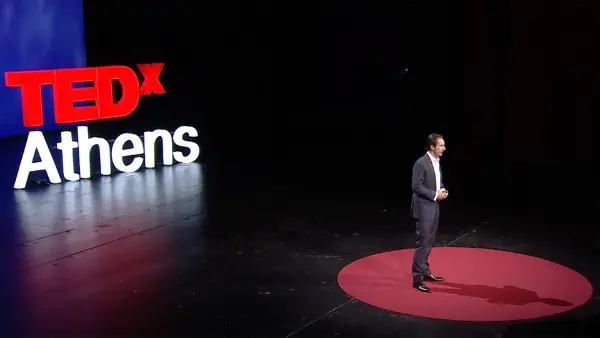
When machines decide faster than humans can reflect, what is leadership actually responsible for? That was the question I put to a room of leaders at an Atlassian event yesterday.
Last weekend, I ran an experiment. My kids are learning Dutch, as I am Dutch. A couple of hours per week they attend Dutch school, and recently the homework arrived as usual. This time, I decided to put AI to the test. I prompted it to create an HTML-based, interactive course and dropped in the homework the teacher had provided. Within five minutes, I had a fully operational page with quizzes, a storyline, exercises, and rewards. They loved it.
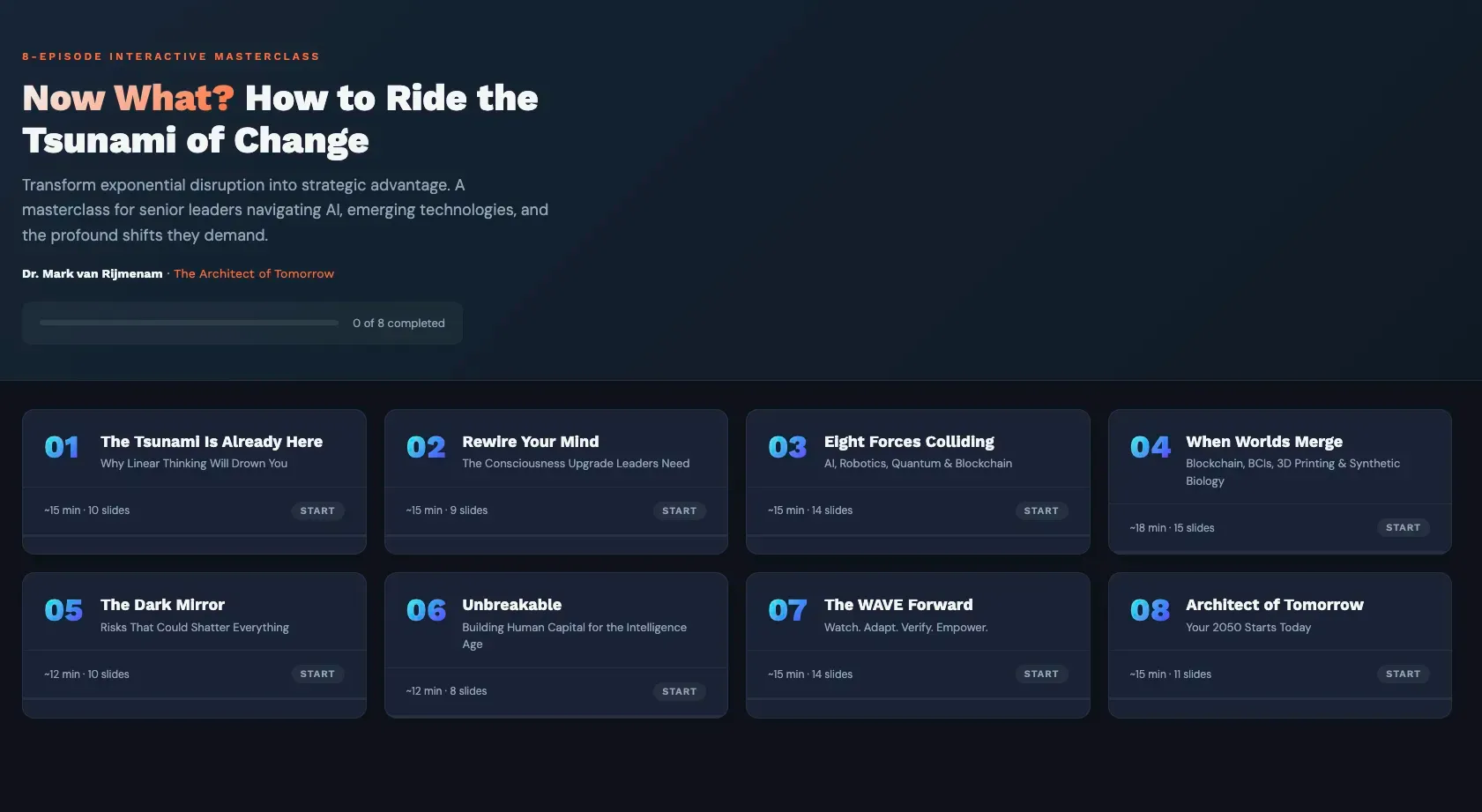
That gave me an idea. I dropped in my 300-page book and asked it to build a full interactive masterclass, scripted, narrated in my cloned voice, deployed to my website. Three hours, start to finish. One month ago, this was not possible.
Times are changing. The question is no longer what AI can do. It's what it should do, and who decides
Five years ago, the world operated at a fundamentally different tempo. Not slower in absolute terms, but slow enough for human intuition to remain useful.
Leaders could still rely on experience, pattern recognition, and post-hoc oversight. We were in what I call the first half of the chessboard: linear progress, predictable feedback loops, time to react and course-correct.
That world is gone.
The Intelligence Age is no longer a forecast. It is your current operating environment.
Today, the convergence of technologies—AI, automation, robotics, data-driven systems—has pushed us into the second half of the chessboard.
Change is no longer incremental. It’s compounding. And the systems we’re building are no longer just executing predefined rules.
They’re beginning to decide, adapt, and optimize on their own.
The Convergence Effect: When Technologies Collide
Here’s what makes this moment different from every previous technology wave: it’s not one thing.
It’s the convergence of multiple forces arriving simultaneously, and each one breaks a foundational assumption we’ve built our organizations around.
AI removes interpretation. Decision-making is shifting from explicit human logic to probabilistic machine judgment. Decisions that once took days now take seconds.
Automation removes labour boundaries. Entire categories of work—not just tasks, but roles—are being rewritten.
McKinsey estimates roughly 30% of work tasks are automatable today. Goldman Sachs projects that number reaches 50% by 2045.
I project one billion jobs gone by the end of this decade.
Robotics removes physical constraints. Digital twins, spatial computing, and autonomous systems are collapsing the gap between the digital and physical world.
Data infrastructure removes friction. Everything becomes interconnected. Multiple parties share a single version of reality in real time.
None of these is merely additive.
Together, they create something entirely new: organizations that operate continuously, adapt automatically, and move at machine speed.
Most organizations are tracking these trends individually.
The ones that will lead are the ones who see how they interact—and who build strategy at the intersections.
The question is no longer whether your industry will be reshaped. It’s whether you’re designing for it, or being left behind.
Intelligence Is Abundant. Judgment Is Scarce.
This is the line I want you to take away from this article.
We are entering an era where intelligence, raw analytical capability, is becoming abundant and cheap. You can spin up a model that processes a million data points in seconds.
That’s no longer a competitive advantage. It’s a commodity.
What’s scarce is human judgment. Not just opinion or experience, but judgment under consequence.
The ability to decide what the system should optimize for when the stakes are real and the outcomes are irreversible. The wisdom to know when the model is confidently wrong.
The courage to slow down when the machine says speed up.
And here’s the uncomfortable part: we are systematically hollowing out the pathways through which that judgment is formed.
Automation and AI are eliminating entry-level and mid-level roles—the very apprenticeship experiences where people learn to exercise judgment under pressure.
The Great Displacement has begun, as Jack Dorsey’s Block mass layoff showed a few weeks ago.
Every company’s individual AI decision looks rational in isolation.
But when every company makes the same decision, strip out the human layer, automate everything that can be automated, the collective result is a leadership pipeline that’s thinner, less experienced, and more fragile than at any point in modern business.
The individually rational choice becomes the collectively dangerous one.
So, the defining question is: when machines decide faster than humans can reflect, what is leadership actually responsible for?
Human-Machine Collaboration: Staying Inside the Loop
The answer is not to resist AI. And it’s not to hand over the keys.
The answer is a fundamentally different model of collaboration between humans and machines.
Think of it this way: the machine brings speed, scale, and pattern recognition across data sets no human could process.
The human brings context, values, and the ability to ask whether we should do something—not just whether we can.
Neither is sufficient alone. But together, you get something more powerful than either, if, and this is the critical ‘if,’ you design the collaboration deliberately.
Most organizations are not doing this. They’re bolting AI onto existing workflows and calling it transformation.
That’s not collaboration. That’s automation with a human rubber-stamp.
True human-machine collaboration means redesigning how decisions get made: what the machine recommends, where the human intervenes, how escalation works, and what governance looks like when the system learns continuously but oversight remains episodic.
This is what I mean by building leadership habits that compound advantage rather than accumulate risk.
It’s a rhythm, not a one-off transformation. In my latest book, I lay out a framework called WAVE: Watch, Adapt, Verify, Empower.
It’s a repeatable decision architecture for exactly this kind of moment: when the technology moves faster than your governance, and you need a cadence that keeps humans inside the loop rather than waving at the system from outside it.
The Choice: Design or Drift
So where does that leave us? We are in a very unstable transition phase. The old operating model is eroding.
The new one hasn’t been consciously designed. And that gap—between what technology makes possible and what leadership has intentionally chosen—is where the real risk lives.
The organizations that will lead the next decade won’t be the ones with the most sophisticated AI.
They’ll be the ones whose leaders exercise the best judgment about how to deploy it. Who build cultures that experiment responsibly. Who embed governance into architecture, not as an afterthought.
Who treat human-machine coordination as a design discipline, not a buzzword.
The real choice is design versus drift. Will you deliberately build systems aligned with accountability, resilience, and long-term value?
Or will you inherit systems shaped by inertia, short-term incentives, and machines optimizing for objectives you never fully defined?
Because here’s the truth most futurists won’t tell you: not every future that can be built deserves to be built.
The role of leadership in the Intelligence Age is not to chase every possibility. It’s to decide which futures your organization, your people, and your customers can actually live with.
In adaptive systems, relevance no longer comes from having the answers. It comes from deciding which questions the system is allowed to ask.
And that decision cannot be automated.

Dr Mark van Rijmenam
Dr. Mark van Rijmenam, widely known as The Digital Speaker, isn’t just a #1-ranked global futurist; he’s an Architect of Tomorrow who fuses visionary ideas with real-world ROI. As a global keynote speaker, Global Speaking Fellow, recognized Global Guru Futurist, and 5-time author, he ignites Fortune 500 leaders and governments worldwide to harness emerging tech for tangible growth.
Recognized by Salesforce as one of 16 must-know AI influencers , Dr. Mark brings a balanced, optimistic-dystopian edge to his insights—pushing boundaries without losing sight of ethical innovation. From pioneering the use of a digital twin to spearheading his next-gen media platform Futurwise, he doesn’t just talk about AI and the future—he lives it, inspiring audiences to take bold action. You can reach his digital twin via WhatsApp at: +1 (830) 463-6967.