Why Establishing Standards Will Be Key to the Metaverse’s Future with Neil Trevett - Step into the Metaverse podcast: EP26
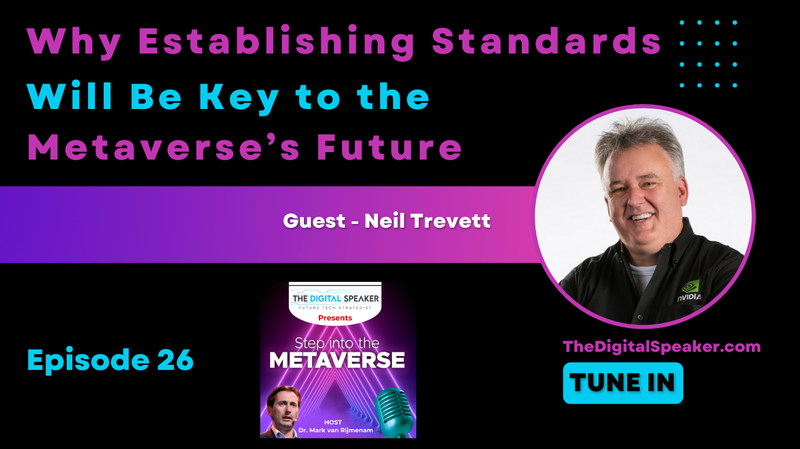
Why Establishing Standards Will Be Key to the Metaverse’s Future with Neil Trevett - Step into the Metaverse podcast: EP26





















In this episode of the Step into the Metaverse Podcast, I had a chat with Neil Trevett, the Vice President of Developer Ecosystems at NVIDIA, where he is responsible for enabling and encouraging advanced applications to use GPU acceleration. Neil is also serving as the elected President of the Khronos Group, where he created and chaired the OpenGL ES working group that defined the industry standard for 3D graphics on mobile devices. At Khronos, he also chairs the OpenCL working group for portable, parallel heterogeneous computing, helped initiate the WebGL standard that is bringing interactive 3D graphics to the web and is now working to help formulate standards for vision and neural network inferencing.
Previously, as Vice President of 3Dlabs, Neil was at the forefront of the silicon revolution bringing interactive 3D to the PC, and he established the embedded graphics division of 3Dlabs to bring advanced visual processing to a wide range of non-PC platforms. Neil was elected President for eight consecutive years of the Web3D Consortium dedicated to creating open standards for communicating real-time 3D on the Internet.
Neil will talk to us about a constellation of standards necessary to have a truly interconnected metaverse or an interoperable metaverse. We discussed the need for an open metaverse, what we need to do to achieve that, and how we can keep our data private in the metaverse. Don’t miss out on our super interesting conversation!
Highlights
- [01:32] - The Khronos Group and how he’s involved in the metaverse.
- [03:54] - How a Darwinian approach to the metaverse will work.
- [05:33] - Steps needed to ensure a more open metaverse.
- [06:40] - The importance of identity and repetition in relation to interoperability.
- [10:30] - Navigating the slow pace of standards development.
- [15:29] - What standards will look like in both the consumer and enterprise metaverse.
- [20:00] - Finding stuff in the metaverse and how standards will help keep data private in the metaverse.
Quotes
“You can’t force openness in the metaverse. The openness has to earn its right to exist through adding value” - Neil Trevett
“We need a constellation of standards” - Neil Trevett
“We thought getting the web to work was cool. Getting the spatial web to work is gonna be super cool” - Neil Trevett
“Standards can provide the building blocks for the technical solution on how can we make something secure” - Neil Trevett
Learn More About Neil Trevett in the Links Below:
- LinkedIn - https://www.linkedin.com/in/neil-trevett-748791/
- Twitter - https://twitter.com/neilt3d
Frequently asked questions
Who is Neil Trevett and what is his role at Khronos Group?
Neil Trevett is Vice President of Developer Ecosystems at NVIDIA and the elected President of the Khronos Group. He created and chaired the OpenGL ES working group that defined the industry standard for 3D graphics on mobile devices, chairs the OpenCL working group for portable, parallel heterogeneous computing, helped initiate WebGL, and is now working on standards for vision and neural network inferencing.
Link to this questionWhy does the metaverse need multiple standards instead of one?
Because the metaverse requires interoperability across many different functions, a single standard cannot cover everything. Neil Trevett describes needing a constellation of standards that work together, addressing areas like identity, repetition, and interoperability, rather than relying on one all-encompassing standard to make an open metaverse function properly.
Link to this questionCan openness in the metaverse be forced through regulation?
No. According to Neil Trevett, openness cannot be forced in the metaverse; it has to earn its right to exist through adding value. This suggests open standards succeed when they genuinely benefit developers and users, rather than being imposed, meaning adoption depends on practical usefulness rather than mandates.
Link to this questionHow does standards development affect data privacy in the metaverse?
Standards can provide the building blocks for technical solutions that make systems secure. Neil Trevett explains that establishing proper standards helps address how data can be kept private within the metaverse, giving developers a common foundation to build privacy and security measures into interconnected, spatial web experiences.
Link to this question
Dr Mark van Rijmenam
Dr. Mark van Rijmenam, widely known as The Digital Speaker, isn’t just a #1-ranked global futurist; he’s an Architect of Tomorrow who fuses visionary ideas with real-world ROI. As a global keynote speaker, Global Speaking Fellow, recognized Global Guru Futurist, and 5-time author, he ignites Fortune 500 leaders and governments worldwide to harness emerging tech for tangible growth.
Recognized by Salesforce as one of 16 must-know AI influencers , Dr. Mark brings a balanced, optimistic-dystopian edge to his insights—pushing boundaries without losing sight of ethical innovation. From pioneering the use of a digital twin to spearheading his next-gen media platform Futurwise, he doesn’t just talk about AI and the future—he lives it, inspiring audiences to take bold action. You can reach his digital twin via WhatsApp at: +1 (830) 463-6967.