For me
Intelligence Age Scorecard
A 15-minute readiness diagnostic built on WAVE: Watch, Adapt, Verify, Empower. Start with the free preview, then get a personalized report.
Take the Intelligence Age ScorecardSign in with the email you used at checkout.
Your access can take a few more minutes. Write to enquiries@thedigitalspeaker.com if it does not arrive.
Already bought it? Log inFor journalists
AI is no longer merely changing what we do. It is changing the systems through which society does things.
Thanks. The report is on its way to your inbox.
We could not send it. Please try again, or write to enquiries@thedigitalspeaker.com.
The report is on its way to .
Nothing in your inbox after a few minutes? Check spam, or write to enquiries@thedigitalspeaker.com.
What is inside
Each trend has its own evidence, its own limits and a specific 2027 forecast. They connect, but they are not equally certain, and the report says so.
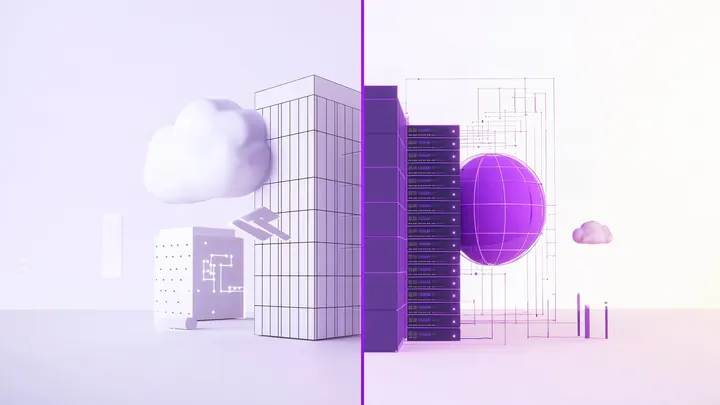
Organizations take control of their own AI infrastructure.
2027 forecast
Enterprises, not nations: sensitive AI workloads move onto privately controlled GPU capacity running open-weight models.

AI raises the speed, scale and autonomy of attacks.
2027 forecast
Chaos by volume and autonomy: AI-assisted tooling appears in a growing share of documented intrusions.
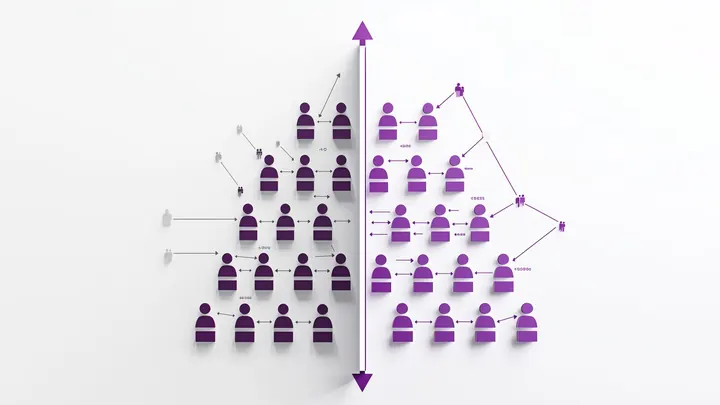
AI agents redesign the organization chart.
2027 forecast
Management is redefined before it disappears: layers are removed or not backfilled, and the remaining managers own portfolios of agents as well as people.

The annual cost of reliable robot work, set against human coverage.
2027 forecast
Parity for a few roles in a few places.
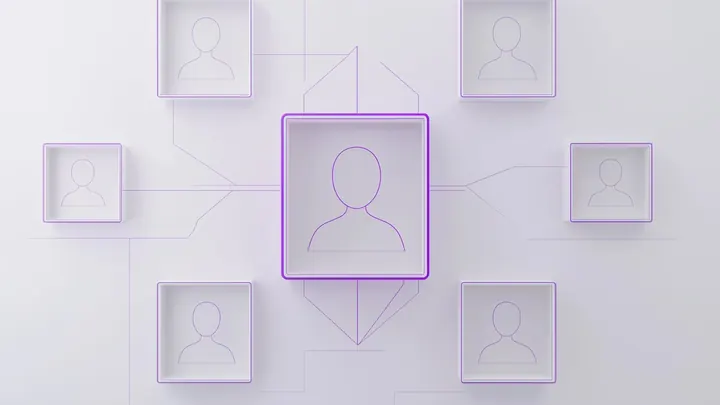
The cognitive burden of supervising AI agents.
2027 forecast
The bottleneck moves to the human: agent rollouts shift work from producing outputs to reviewing and authorizing them.
Targeted medical victories, not a general longevity breakthrough.
2027 forecast
More targeted victories, not a general breakthrough: no cure for cancer or diabetes, no general anti-aging treatment and no measurable change in population life expectancy.
Legal experiments for AI-run companies.
2027 forecast
More drafts and sandboxes, not an AI economy: no major jurisdiction grants an AI system legal personhood.
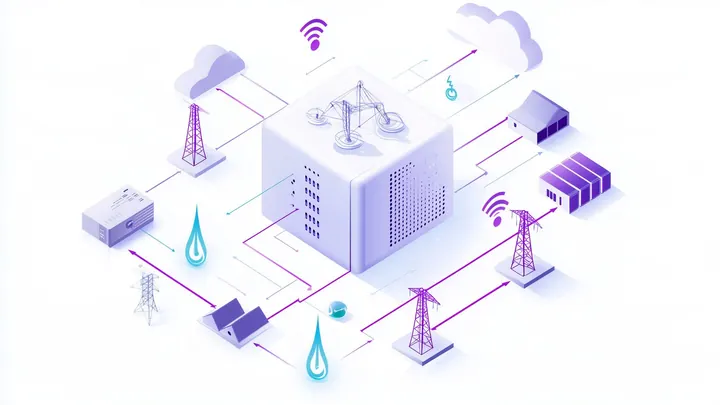
Compute meets energy, water and community limits.
2027 forecast
Conditions, not bans: no universal net-positive mandate, and voluntary pledges outnumber binding rules.

AI helps build better quantum machines.
2027 forecast
AI in the control loop, not a fault-tolerant machine.
Robots learn in simulation before they work in the real world.
2027 forecast
The training layer matures faster than deployment, and simulation alone does not deliver reliable general-purpose robots.

Scenario, not a forecast
What happens if job displacement, falling trust in information and slow institutions converge? A low-probability, high-impact cascade.
The report lists the signals that would show whether it is unfolding.
Keep scrolling down: the trends move sideways.Swipe sideways to move through the trends.
All 10 forecasts, and the sources behind them, are in the free report.
Get the free reportScored in public
64.5out of 100: how my 2026 forecasts scored
Last year I checked my 10 forecasts against what happened. I was right about direction more often than about timing. Every forecast in this year's report ends with a test that would prove me wrong, and next year I score it the same way.
| 2026 forecast | Verdict | Score |
|---|---|---|
| China overtakes the West in technological capabilities | Partly right | 6.5 out of 10 |
| Small language models: intelligence shrinks, capability spreads | Right | 9 out of 10 |
| A data warehouse in a box | Right on direction | 7 out of 10 |
| The AI-enhanced metaverse returns | Mostly wrong | 4 out of 10 |
| The rise of humanoids-as-a-service | Right on timing | 7 out of 10 |
| AI-driven crime reaches every corner | Right | 9 out of 10 |
| Unrest from privacy-breaking pervasive hardware | Right on the tension | 8 out of 10 |
| Brain-computer interfaces move into consumer life | Wrong on timing | 4 out of 10 |
| Dramatic healthcare discoveries increase our healthspan | Too early and overstated | 4 out of 10 |
| AI-powered job losses hit escape velocity | Wrong on the economy-wide claim | 6 out of 10 |
| Total for the 2026 predictions | 64.5 / 100 | |
Example from trend 4. A forecast, not a promise.
By the end of 2027, at least one named operator will publish, or have independently verified, a fully loaded cost per hour or per completed task for a robot performing a defined role in a real workplace, with the method disclosed, and the robot will come out at or below the human alternative in at least one location. General parity, mass replacement of workers and humanoids in ordinary homes are not 2027 stories. What does happen is that the role-by-location cost comparison becomes a standard procurement exercise in logistics, manufacturing and facilities management. Adoption: pilots and early deployments in structured environments.
What would prove me wrong
A year of announcements passes without one disclosed, independently checked cost comparison, robots stay in pilots through 2027, or hidden human effort wipes out the savings.
Inside the report
100+ pages, A4, with 93 linked sources. Every trend follows the same seven parts, so you can compare them.
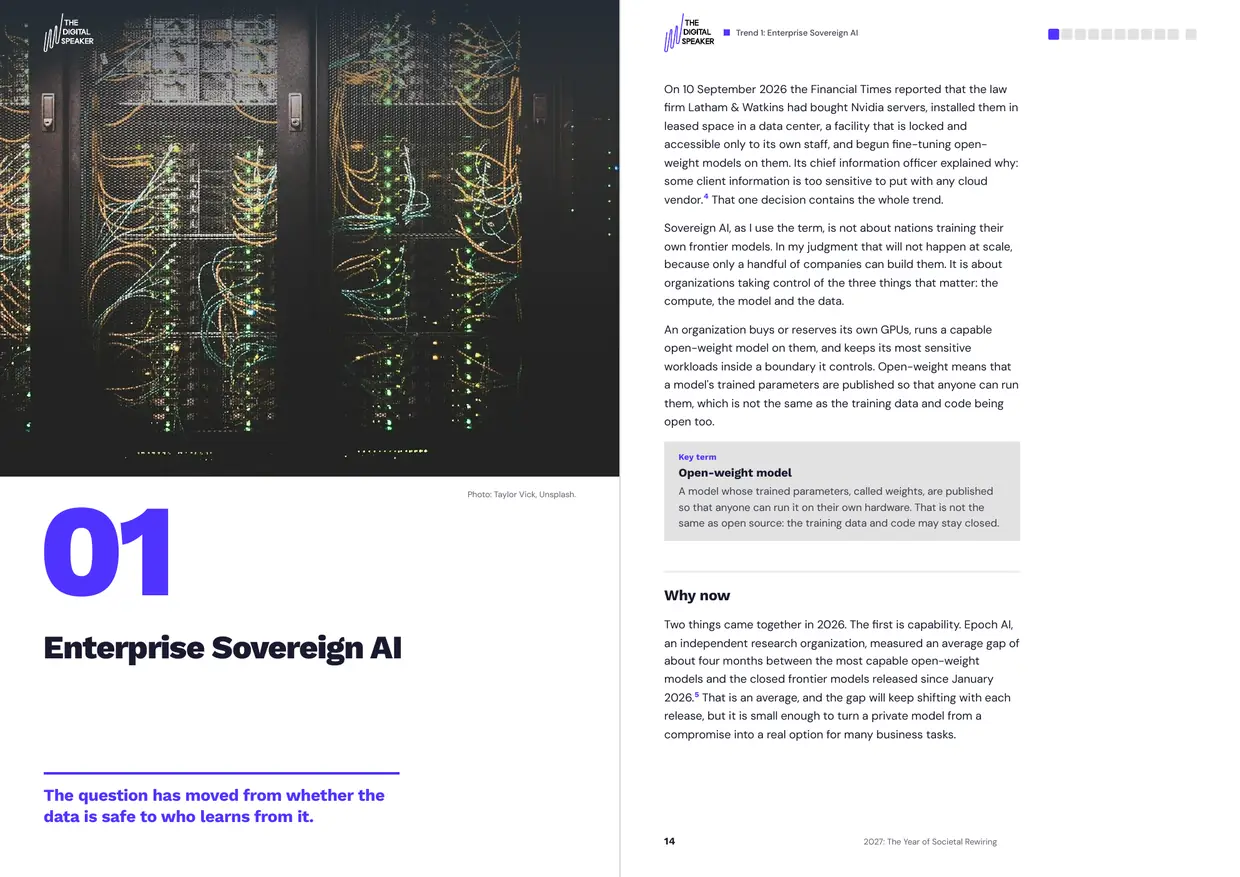
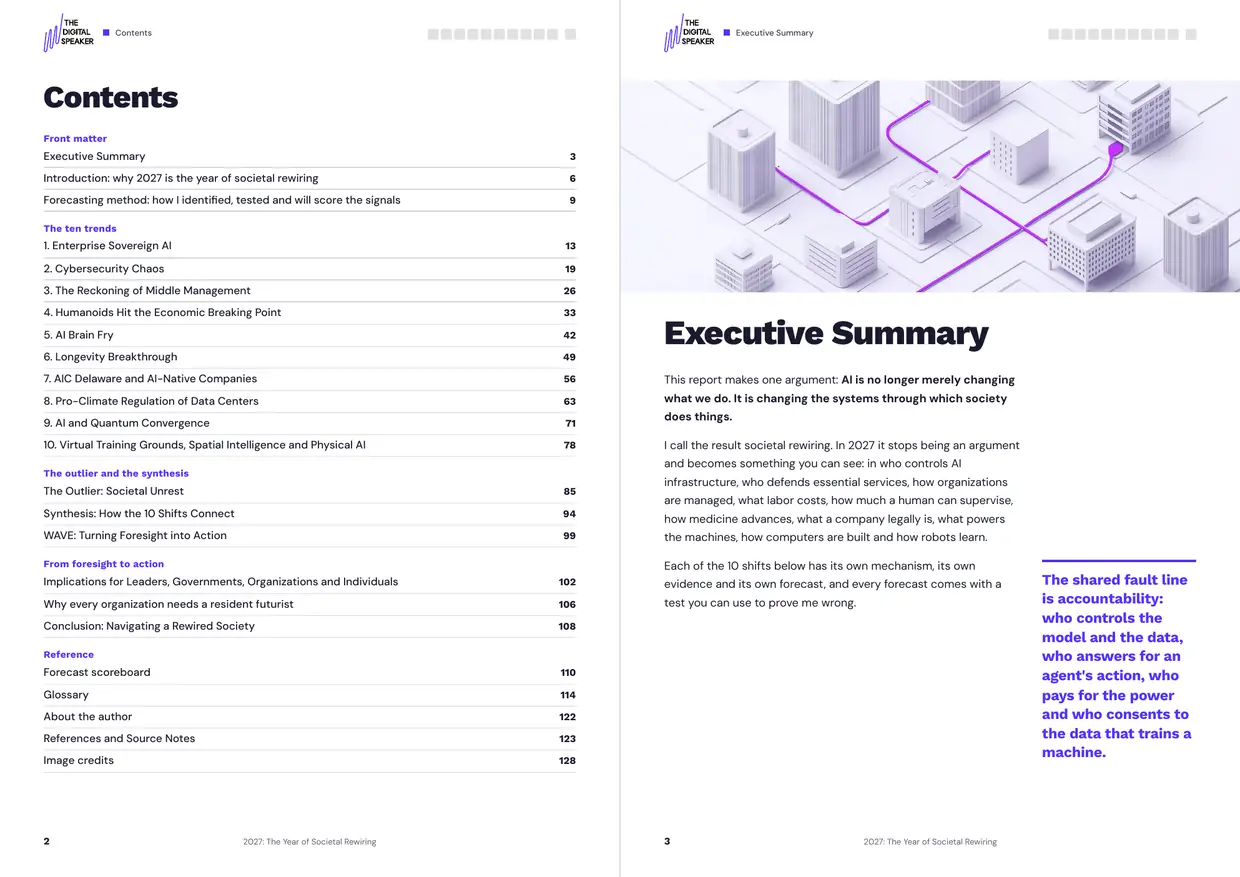
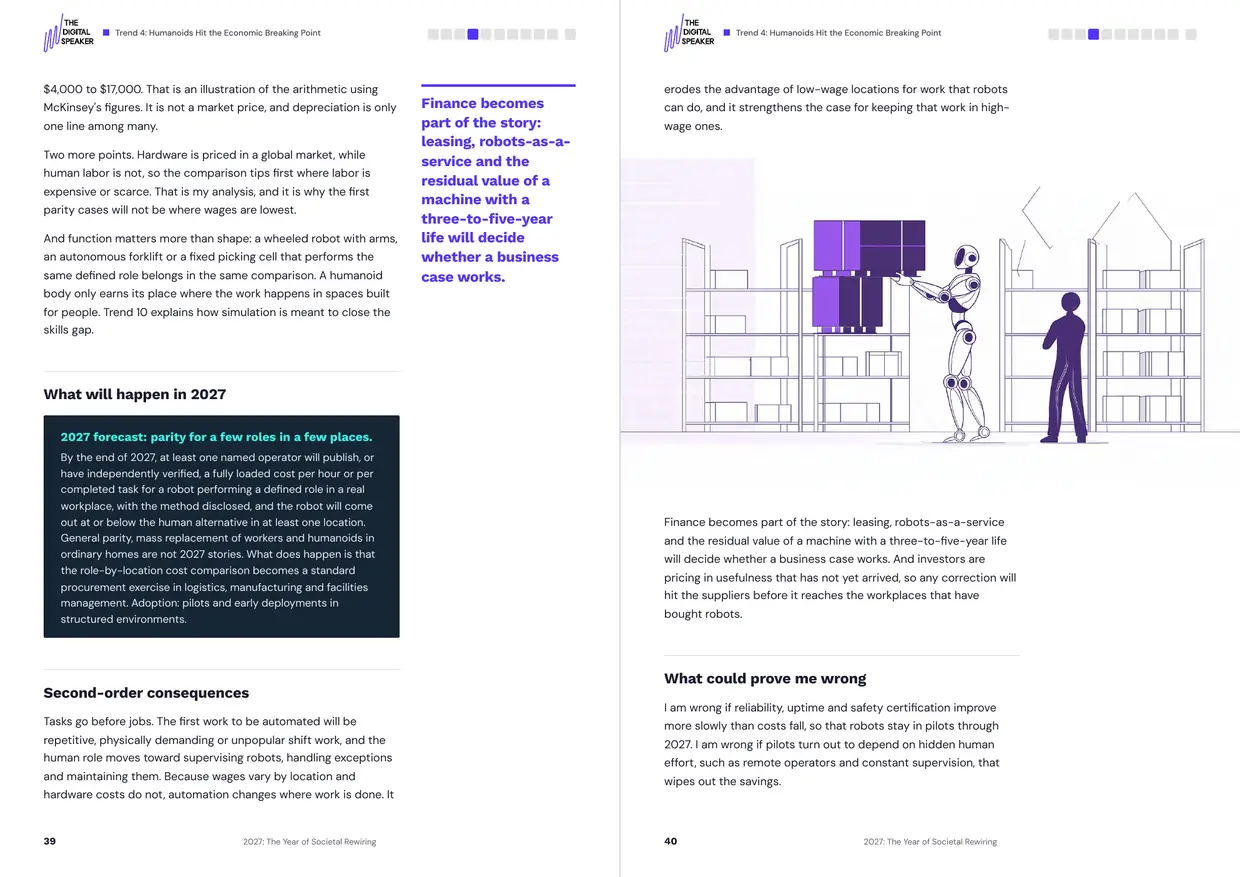
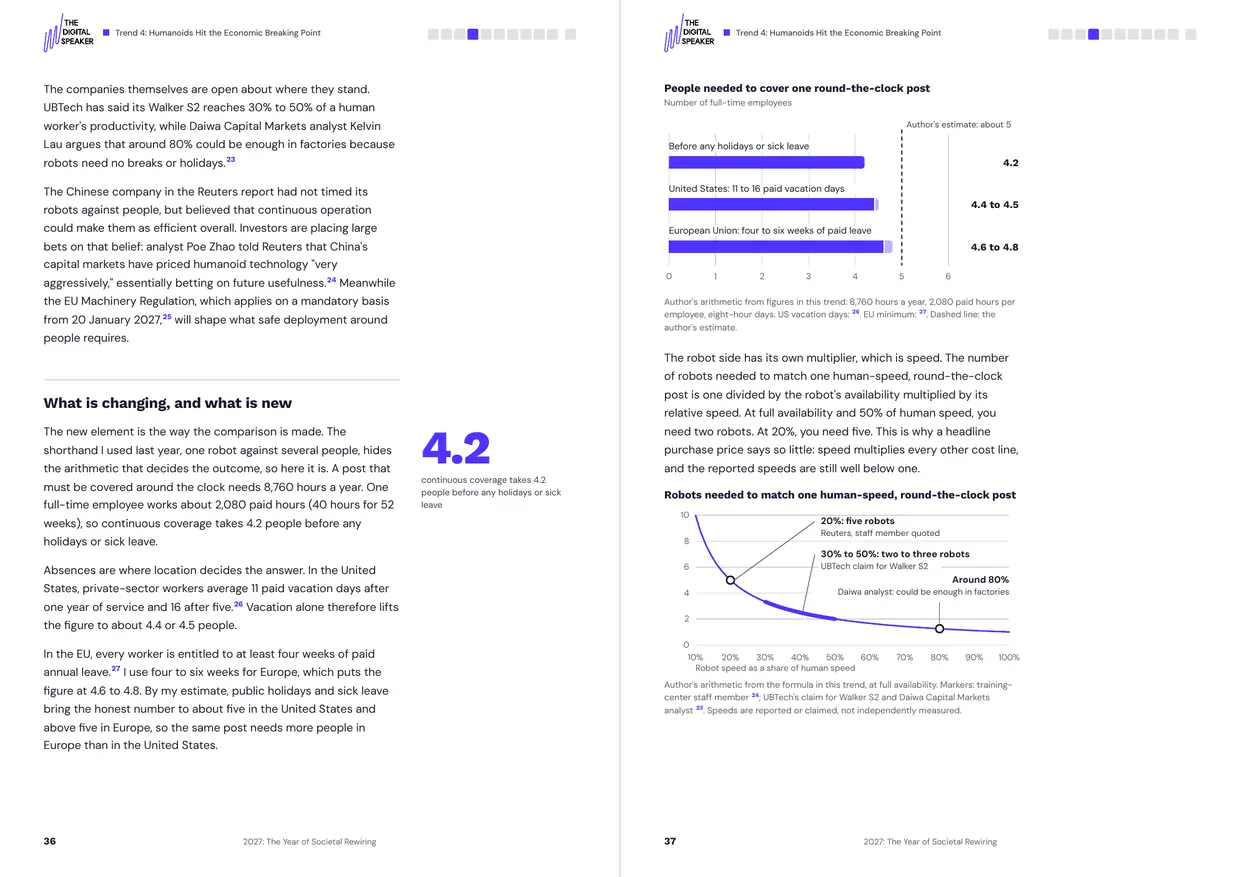
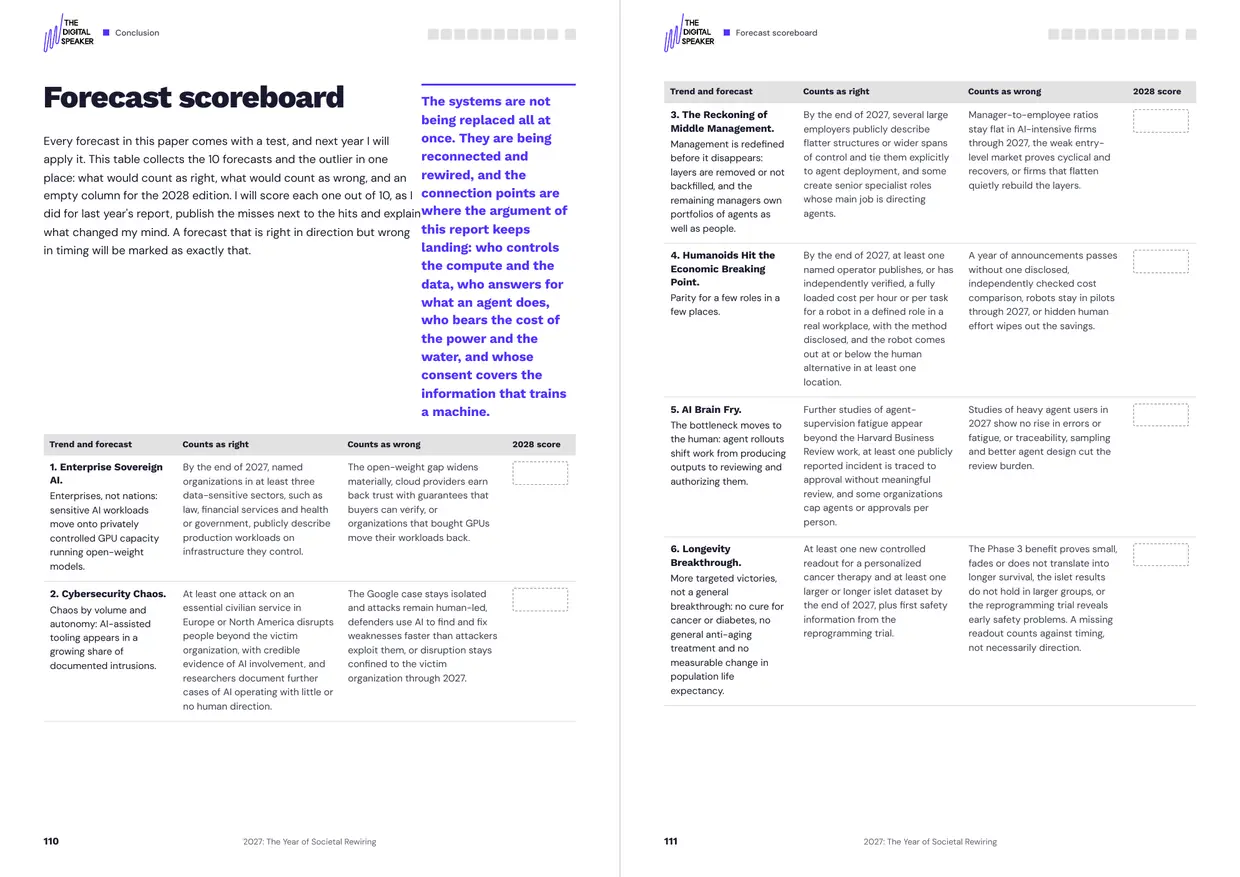
Image credits. The trend and section illustrations are concept illustrations generated with Midjourney for the report. The report preview spreads also show the report's chapter photographs; each one is credited on the report's image credits page.
Free
100+ pages, 93 linked sources, 10 trends and one outlier scenario, each with a 2027 forecast and a test that would prove me wrong. Sent to your inbox as a PDF.
The report is on its way to .
Nothing in your inbox after a few minutes? Check spam, or write to enquiries@thedigitalspeaker.com.
Prefer to read first?
The thesis and the 10 shifts, in short. Open to everyone, no email needed.
2027 Technology Trends Webinar + Toolkit
One 45-minute webinar and 12 short videos that show how to apply the 10 trends, the outlier scenario and the WAVE framework to your own situation.
For executives, board members and the teams that advise them, when the argument has to turn into decisions.
1 webinar45 minutes
12 short videos2 to 3 minutes each
USD 35plus GST, for the Webinar + Toolkit, with 60 days of access
Get the Webinar + ToolkitLifetime access is available as an upgrade: USD 14 more, USD 49 in total, plus GST.
Lifetime access covers the 2027 edition of the Technology Trends Webinar + Toolkit: the 45-minute webinar, the 12 short videos, the worksheets and calculators, and any corrections, updates and resources added to this edition, for as long as thedigitalspeaker.com exists. Future annual editions, if created, are sold separately, and other products are not included.
Already bought it? Log in to your Webinar + Toolkit.
Next steps
The report tells you what is changing. These routes help you find out where you stand and what to do about it.
For me
A 15-minute readiness diagnostic built on WAVE: Watch, Adapt, Verify, Empower. Start with the free preview, then get a personalized report.
Take the Intelligence Age ScorecardFor my leadership team
A guided session for boards and leadership teams. It turns the readiness gaps into a shared picture and a decision on what to do next.
Explore the Readiness BriefingFor ongoing board foresight
Ongoing foresight for boards: a continuing view of the signals that matter to your organization, not a one-off snapshot.
Explore your resident futuristFor journalists and editors
Approved quotes from the report, its six charts, the cover and three share cards. For headshots and the biography, use the press kit.
“AI is no longer merely changing what we do. It is changing the systems through which society does things.”
“The question has moved from whether the data is safe to who learns from it.”
“Security stops being an IT matter and becomes an operational and board-level question about whether the business keeps running.”
“The manager’s job moves from managing people toward supervising and orchestrating the people who, in turn, supervise agents.”
“Most knowledge workers will not manage dozens of agents in 2027. The ones who do will show the strain first.”
“The question about AI infrastructure is moving from how fast it can be built to the terms on which communities and governments will allow it.”
“A board that cannot say who answers for an agent’s action has not yet decided to deploy it.”
“The people teaching the machine are, in principle, the people it could one day replace.”


Swipe sideways to see all six charts. The SVG files are the vector source with live text. The PNG files are a convenience for publishers.


Thanks. The briefing is on its way to your inbox.
We could not send it. Please try again, or write to enquiries@thedigitalspeaker.com.
We sent the briefing and the link to the white paper to . It should arrive within a few minutes. If it does not, check your spam folder.
You also asked for the Synthetic Minds newsletter. You can unsubscribe in one click, any time.
For interviews, briefings and permissions:
enquiries@thedigitalspeaker.comHeadshots and the biography are in the press kit. Published 20 November 2026.

The author
Strategic futurist and author. He holds a PhD, wrote the award-winning Now What? How to Ride the Tsunami of Change and founded Futurwise.
Yes. The report is free and it stays free. You do not need to buy anything to read all of it. I ask for your email so I can send it, followed by two short emails: one about the 2027 Technology Trends Webinar + Toolkit and one about the Intelligence Age Scorecard. You can unsubscribe in one click, any time. If you would rather not share your email, the executive summary article is open to everyone.
Executives, board members and the people who advise them: strategy, transformation, technology, risk, HR, operations and finance leaders, plus policymakers and researchers. I wrote it for an intelligent general business reader, so technical terms are explained when they first appear.
I start from the signals I track across technology, business, policy and science, and test each one against the best evidence I can find. Peer-reviewed research, clinical trials and the publications of governments, regulators and courts come first. Company documents count as claims, not proof, and social posts are leads, never evidence of a broad trend. I used AI tools as research assistants to gather and cross-check sources and to challenge my assumptions. The interpretations, the forecasts and any mistakes are mine.
No. Each one is a forecast: a specific claim about 2027 with a test that would prove me wrong. The year in the title is where a shift becomes visible, not a deadline for completion. Last year's report scored 64.5 out of 100, and I published the misses next to the hits. I was right about direction more often than about timing. Next year I score this report the same way.
Societal unrest is a low-probability, high-impact scenario, not a prediction. It asks what happens if job displacement, falling trust in online information, disruption of essential services, concern about AI in education, inequality and environmental stress meet institutions that respond too slowly. The report lists the observable signals that would tell us whether it is unfolding, and it separates genuine grievance from adversarial amplification. I hope to be wrong about it.
One 45-minute webinar on the theme, the 10 trends, the outlier scenario and the WAVE framework, plus 12 separate short videos of two to three minutes each (one for the theme, one for each trend and one for the outlier), with worksheets and calculators and 60 days of access. The price is USD 35, or EUR 35 in euro countries. Lifetime access is available as an upgrade for USD 14 or EUR 14 more.
The Webinar + Toolkit teaches: it walks you through the 10 trends and how to apply them with WAVE (Watch, Adapt, Verify, Empower). The Intelligence Age Scorecard measures: it is a 15-minute readiness diagnostic built on WAVE, with a free preview and a personalized report. Use either on its own, or the Webinar + Toolkit first and the Scorecard second.
The Resident AI Futurist is for boards and leadership teams that want ongoing foresight instead of a one-off snapshot: a continuing view of the signals that matter to your organization. The Resident AI Futurist page has the details.
Yes. Mark gives keynotes and executive briefings, and the Intelligence Age Readiness Briefing is a structured session for boards and leadership teams. To discuss a date or a brief, write to enquiries@thedigitalspeaker.com or use the contact page.
In the For journalists section of this page: 35 approved quotes with copy buttons and a full download as TXT or PDF, the six report charts as SVG and PNG, the report cover and three ready-to-share quote cards. Headshots and the biography are in the press kit. For interviews, write to enquiries@thedigitalspeaker.com.
Free
100+ pages, 93 linked sources, 10 trends and one outlier scenario, each with a 2027 forecast. It is free and it stays free.
The report is on its way to .
Nothing in your inbox after a few minutes? Check spam, or write to enquiries@thedigitalspeaker.com.
Something went wrong
Something went wrong. Please, try again later


