Synthetic Minds | AI’s Explosive Future
Synthetic Minds | AI’s Explosive Future
'Synthetic Minds' continues to reflect the synthetic forces reshaping our world. This week’s Synthetic Minds covers Hyper Moore’s Law, quantum’s cybersecurity revolution, China’s chip breakthrough, AGI urgency, and AI politics.
Did you know that I have been recognized as the world's best futurist by Global Gurus and that you can WhatsApp my digital twin 24/7 via +1 (830) 463-6967?
Hyper Moore’s Law: When Exponential Isn’t Fast Enough

My latest article:
Moore’s Law is dead because 𝗛𝘆𝗽𝗲𝗿 𝗠𝗼𝗼𝗿𝗲’𝘀 𝗟𝗮𝘄 just buried it. AI compute isn’t just getting faster; it is on an exponential trajectory and it is upending all industries. Unlike Moore’s Law’s steady two-year cadence, AI compute now doubles every 6 months, fueled by GPUs, networking, and new AI architectures.
Hyper Moore’s Law isn’t just an upgrade, it’s a seismic shift in AI’s trajectory. Compute power is accelerating at an exponential rate, with AI models training for 99% less cost than two years ago. This wave of cascading innovation is fueling breakthroughs in biotech, quantum computing, and automation, but it’s also raising questions about control, ethics, and the unintended consequences of runaway progress.
Are we accelerating towards a golden age, or an AI-driven collapse? Hyper Moore’s Law demands urgency, but should we pause to rethink before AI outpaces human oversight?
Synthetic Snippets from the World's Best Futurist
Quick, curated insights to feed your quest for a better understanding of our evolving synthetic future. The below is just a small selection of my daily updates that I share via The Digital Speaker app. Download and subscribe today to receive real-time updates. Use the coupon code SynMinds24 to receive your first month for free.
1. THE FIRST OPERATING SYSTEM FOR QUANTUM NETWORKS ARRIVED
Passwords are obsolete! A groundbreaking Dutch-led team has launched the first-ever quantum internet operating system, QNodeOS, making ultra-secure quantum networks as easy as WiFi. With unbreakable encryption revolutionizing finance, government, and healthcare, this tech promises cybersecurity perfection, but there’s a geopolitical race: who will control this next-gen internet; Europe, China, or the U.S.? (Nature)
2. CHINA’S SILICON-FREE CHIP BREAKTHROUGH
Chinese researchers at Peking University just shattered the silicon ceiling, unveiling a revolutionary bismuth-based transistor that’s 40% faster and 10% more energy-efficient than today’s best chips from Intel and TSMC. This breakthrough could fundamentally rewrite semiconductor geopolitics, enabling China to bypass US sanctions entirely. If scaled successfully, the global chip industry faces a stark choice: adapt swiftly or remain trapped in silicon-era stagnation. (SCMP)
If you missed my 2025 technology trends report, you can read it here.
Download Now
3. AI SLOP AND THE DEATH OF CREATIVITY
AI isn’t just replacing jobs, it’s hijacking our creativity. With a quarter of online content now algorithm-generated, from sterile marketing copy to robotic job posts, the internet is trapped in an echo chamber of repetition. As AI floods our minds with predictable patterns, authentic originality fades. We’re at a crossroads: will we reclaim human imagination, or let algorithms dictate what creativity means? (The New Statesman)
4. AI WITHOUT A MORAL COMPASS? THE U.S. JUST REWROTE THE RULES
AI is now America’s newest ideological battlefield. Under Trump’s administration, the US has erased key principles like “AI fairness” and “safety” from national policy, pivoting sharply towards economic dominance and ideological neutrality. With NIST sidelining safeguards against discriminatory algorithms and misinformation, the risks multiply, especially in hiring, policing, and healthcare. Is this a necessary correction, or are we racing blindly toward an AI Wild West? (Wired)

5. THE AGI TIPPING POINT: ARE WE ALREADY TOO LATE?
Artificial General Intelligence isn’t decades away, it’s knocking at the door. Tech giants from OpenAI to DeepMind are investing billions, racing toward AGI’s unprecedented economic and military power. AGI will transform industries, geopolitics, and employment. Not gradually, but suddenly. Denial isn’t strategy. AGI’s arrival demands rapid governance and awareness. Are we ready to shape it, or will we let it shape us? (AFR)
Bring the World's Best Futurist to Your Next Event – Let’s Talk!
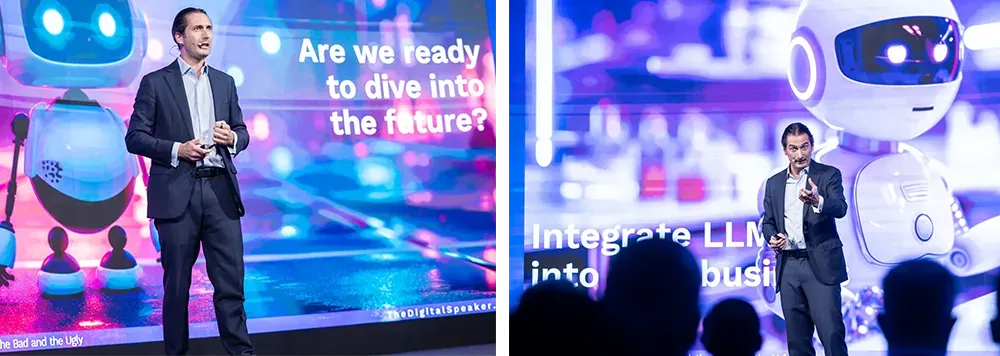
We’re entering a world where intelligence is synthetic, reality is augmented, and the rules are being rewritten in front of our eyes. In Synthetic Minds, I dive deep into these shifts, and I can bring these thought-provoking insights and actionable strategies to your next event. Recognized as the world's top futurist by Global Gurus and a Leading AI Voice by Salesforce, I help audiences think bigger, adapt faster, and embrace the future with confidence. Let’s talk. Just hit reply to book me for your next event!
Stay connected:
- Twitter: @VanRijmenam
- Speaker Website
- Grab my latest books: Future Visions and Step into the Metaverse
- Download The Digital Speaker app
Enjoyed my content? An Amazon review or Google review would mean a lot! 🌟
Thanks for reading!
— Mark
Frequently asked questions
What is Hyper Moore's Law?
Hyper Moore's Law describes how AI compute power is now doubling roughly every 6 months, far faster than the traditional two-year cadence of Moore's Law. Driven by GPUs, networking advances, and new AI architectures, this exponential trajectory has cut the cost of training AI models by 99% compared to two years ago, fueling breakthroughs in biotech, quantum computing, and automation while raising concerns about control and ethics.
Link to this questionWhat is QNodeOS and why does it matter?
QNodeOS is the first-ever operating system for quantum networks, launched by a Dutch-led team, designed to make ultra-secure quantum internet as simple to use as WiFi. It promises unbreakable encryption that could revolutionize cybersecurity in finance, government, and healthcare. Its arrival also triggers a geopolitical race, with Europe, China, and the U.S. all vying to control this next-generation internet infrastructure.”
Link to this questionHow is China's new chip breakthrough different from silicon chips?
Chinese researchers at Peking University unveiled a bismuth-based transistor that is 40% faster and 10% more energy-efficient than current top chips from Intel and TSMC. This silicon-free breakthrough could let China bypass US sanctions entirely and reshape semiconductor geopolitics, forcing the global chip industry to either adapt quickly or risk stagnation in outdated silicon-era technology.
Link to this questionAre we close to achieving AGI?
Artificial General Intelligence appears much closer than previously thought, with tech giants like OpenAI and DeepMind investing billions in a race toward its economic and military potential. Rather than arriving gradually, AGI is expected to transform industries, geopolitics, and employment suddenly. This urgency raises the question of whether governance and awareness will develop fast enough to shape AGI rather than be shaped by it.
Link to this question
Dr Mark van Rijmenam
Dr. Mark van Rijmenam, widely known as The Digital Speaker, isn’t just a #1-ranked global futurist; he’s an Architect of Tomorrow who fuses visionary ideas with real-world ROI. As a global keynote speaker, Global Speaking Fellow, recognized Global Guru Futurist, and 5-time author, he ignites Fortune 500 leaders and governments worldwide to harness emerging tech for tangible growth.
Recognized by Salesforce as one of 16 must-know AI influencers , Dr. Mark brings a balanced, optimistic-dystopian edge to his insights—pushing boundaries without losing sight of ethical innovation. From pioneering the use of a digital twin to spearheading his next-gen media platform Futurwise, he doesn’t just talk about AI and the future—he lives it, inspiring audiences to take bold action. You can reach his digital twin via WhatsApp at: +1 (830) 463-6967.