The Future of Computing: How Brain-Computer Interfaces Will Change Our Relationship with Computers
Brain-Computer Interfaces, invasive or non-invasive BCI, will change our relationship with computers and open up many privacy issues.
Read MoreBrain-Computer Interfaces, invasive or non-invasive BCI, will change our relationship with computers and open up many privacy issues.
Read MoreUntil a few years ago, the only AI agent capable of strategy making was OpenAI’s multi-agent system. OpenAI Five [https://openai.com/projects/five/] was capable of playing the complex strategy game Dota2 at superhuman levels. While the OpenAI Five engineers coded [https://www.lesswrong.com/posts/6tikKda9LBzrkLfBJ/an-82-how-openai-five-distributed-their-training-computation]
Read MoreThe growth of the “gig economy” [https://www.forbes.com/sites/williamarruda/2020/07/12/6-trends-that-will-shape-the-gig-economy-in-the-2020s/] in recent years has revolutionised the way that millions of people work. Proponents argue that the gig economy gives people more flexibility and opportunities and lowers barriers of entry to the labour market, while
Read MoreMicrosoft made waves this May when it announced that it would lay off more than 50 journalists and editors [https://www.theverge.com/2020/5/30/21275524/microsoft-news-msn-layoffs-artificial-intelligence-ai-replacements] from its workforce. Many of these employees were involved in the news curation process, selecting hand-picked content that would run on the
Read MoreWhat is GPT-3? In February 2019, the artificial intelligence [https://www.thedigitalspeaker.com/30-ways-how-ai-will-change-your-business/] research lab OpenAI sent shockwaves through the world of computing by releasing the GPT-2 language model [https://openai.com/blog/better-language-models/]. Short for “Generative Pretrained Transformer 2,” GPT-2 is able to generate several paragraphs of natural
Read MoreArtificial intelligence (AI) has already had a profound impact on business [https://www.thedigitalspeaker.com/30-ways-how-ai-will-change-your-business/] and society. Applied AI and machine learning (ML) are creating safer workplaces, more accurate health diagnoses and better access to information for global citizens. The Fourth Industrial Revolution will represent a new era of
Read MoreWe have a trust issue. In our digital world, it has become increasingly difficult to trust each other. Whether it is another person, an organisation or a device, trust is no longer a given online. This is a serious problem for our society and our democracy. If trust is lacking
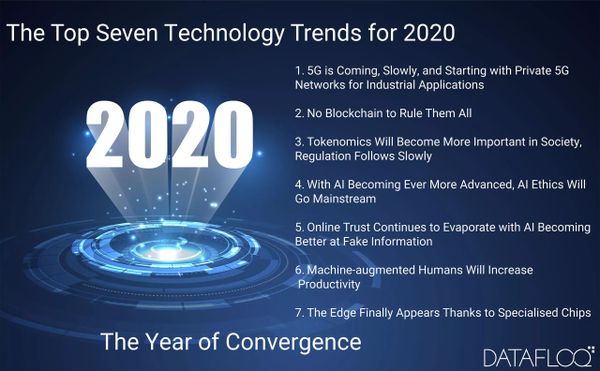
Read MoreWe have reached the end of 2019 and just like in previous years, I am looking ahead to see what organisations can expect next year. 2019 was the year of truth [https://datafloq.com/read/top-7-technology-trends-for-2019/5817], with many enterprises developing blockchain proof of concepts, Google confirming a quantum supremacy
Read MoreAccording to McKinsey [https://www.business2community.com/customer-experience/16-statistics-showing-datas-influence-on-customer-experience-02053075] , data-driven organisations are 23x more likely to acquire customers, 6x more likely to retain customers and 19x more likely to be profitable. Being data-driven is good for business. Therefore, it is not a surprise that one question I always get when
Read MoreIn the next five to ten years, your workplace will look fundamentally different. Thanks to technologies such as artificial intelligence [https://www.thedigitalspeaker.com/30-ways-how-ai-will-change-your-business/], the internet of things and robotics work as we know it will drastically change. The future of work will come with great opportunities but also
Read More