The End of Clicking: Welcome to the Machine Web

The End of Clicking: Welcome to the Machine Web
Google is gutting the web and selling the bones to AI. And unless we fight back, your favourite websites may quietly vanish behind a chatbot’s smile.
Google’s new “AI Mode” doesn’t just summarise the internet, it might rewrite the rules entirely. Announced by Sundar Pichai as a “total reimagining of Search,” this mode replaces blue links with AI-written answers.
For users, it’s fast and frictionless. For publishers? Existential. As Google consumes content to train its models, fewer users click through. Websites report more impressions but fewer clicks, what used to be traffic now dies at the doorstep of the chatbot.
We are building a “machine web,” one built for AI to read, not people, I discussed this years ago when I recommended people to start marketing for AI instead people. Already, 60% of searches end in zero clicks. AI Mode may halve what little traffic remains.
Small creators are squeezed, replaced by licensing deals for giants like Reddit or The New York Times. Google says it’s innovating for users. Publishers say it’s theft.
Here’s what I’m watching closely: • AI Mode replaces results with summaries, killing discovery. • “Chat chambers” amplify hallucinated misinformation. • Cloudflare proposes paywalls for bots, not people.
If AI becomes the interface, and content creators vanish, who decides what we see and know? It’s not just a tech issue, it’s a question of who controls knowledge itself, and why I am building Futurwise. We’re entering a post-search world. But if the link dies, what replaces trust?
Read the full article on BBC.
----
Frequently asked questions
What is Google's AI Mode in Search?
AI Mode is Google's new search feature, described by Sundar Pichai as a total reimagining of Search, that replaces traditional blue links with AI-written answers. Instead of presenting a list of websites to click through, it summarises information directly for the user, making search faster but reducing the need to visit the original source websites.
Link to this questionHow does AI Mode affect website traffic?
AI Mode threatens to sharply reduce website traffic because it delivers AI-written summaries instead of links, so fewer users click through to the original sites. Websites are already reporting more impressions but fewer clicks, and with 60% of searches already ending in zero clicks, AI Mode may halve what little traffic publishers currently receive.
Link to this questionWhy are publishers and small creators worried about the machine web?
Publishers see Google's approach as theft rather than innovation, since it consumes their content to train AI models while starving them of the traffic needed to survive. Small creators are especially squeezed out, as licensing deals for content go mainly to large players like Reddit or The New York Times, leaving smaller sites with no clear way to be compensated or discovered.
Link to this questionWhat does Cloudflare propose to address this shift?
Cloudflare has proposed paywalls aimed specifically at bots rather than human visitors, offering one way for publishers to seek compensation when AI systems scrape their content. This reflects a broader concern about who controls knowledge as search shifts toward AI summaries, raising the underlying question of what replaces trust if traditional links to original sources disappear.
Link to this question💡 We're entering a world where intelligence is synthetic, reality is augmented, and the rules are being rewritten in front of our eyes.
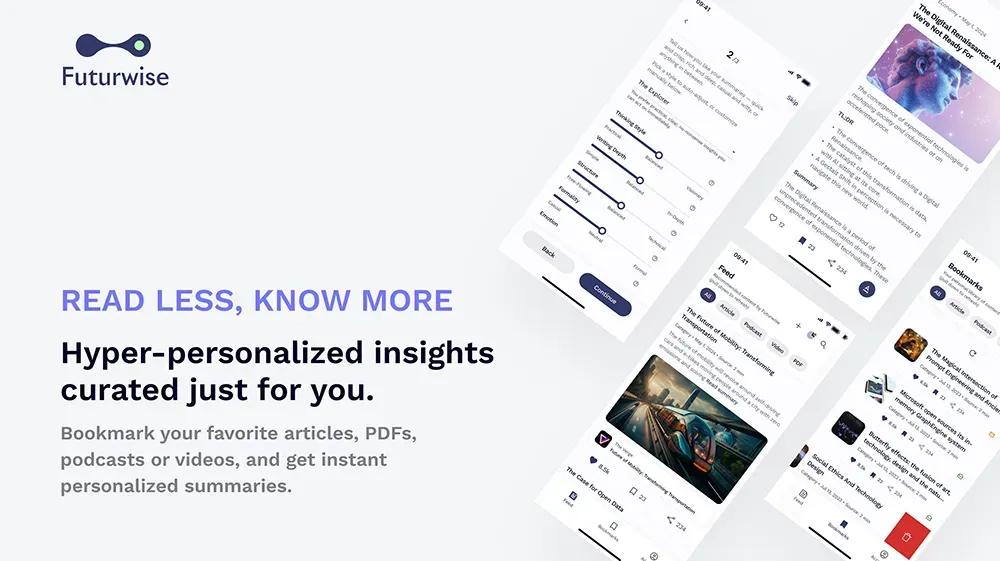
Staying up-to-date in a fast-changing world is vital. That is why I have launched Futurwise; a personalized AI platform that transforms information chaos into strategic clarity. With one click, users can bookmark and summarize any article, report, or video in seconds, tailored to their tone, interests, and language. Visit Futurwise.com to get started for free!

Dr. Mark van Rijmenam
Dr. Mark van Rijmenam is The Digital Speaker, a world-leading futurist and global AI keynote speaker who helps leaders decide what AI, and the technologies that follow it, mean for their business. He speaks to leadership teams at their retreats and to conference audiences worldwide, and his WAVE framework gives them a way of deciding that they keep using long after he has left the room. His Intelligence Age Scorecard measures how ready an organization is across the four WAVE pillars.
He holds a PhD from the University of Technology Sydney, is a Certified Speaking Professional and Global Speaking Fellow, and ranks among the world’s top futurists on the Global Gurus list (#1 in 2025, #3 in 2026). Salesforce named him one of its 16 leading AI voices. He has written six books, most recently Now What? How to Ride the Tsunami of Change, writes the Synthetic Minds newsletter on Substack, and founded Futurwise. Talk to his digital twin on WhatsApp: +1 (830) 463-6967.

