Why the Government of Tomorrow is Also a Data Organisation

Nowadays, every organisation is a data organisation. This not only applies to commercial organisations, but also to governments. Governments at every level – local, regional, national and supranational – should take a different approach to organise their activities. However, becoming a data organisation is not an easy feat. It requires governments to

Read More

Seen and Be Seen: How Facial Recognition Will Change Society

With the number of cameras drastically increasing in our world, facial recognition is rapidly taking flight. Facial recognition is a biometric faceprint, where artificial intelligence [https://www.thedigitalspeaker.com/understanding-elements-of-ai/] maps an individual’s face mathematically. This faceprint is then stored in data. Later, the stored data

Read More

Seven Guidelines to Ensure Ethical AI

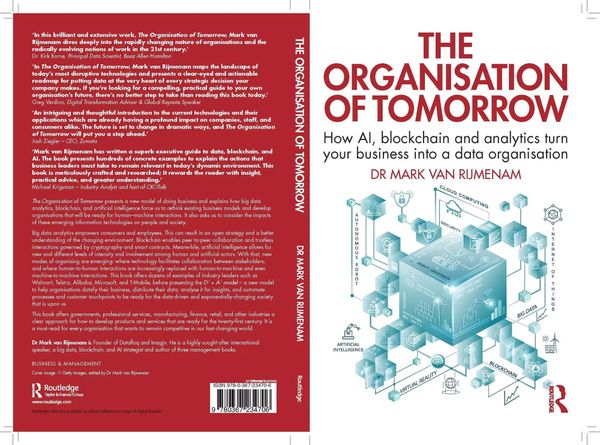
The organisation of tomorrow [https://www.thedigitalspeaker.com/the-organisation-of-tomorrow/] will be built around data, and it will require artificial intelligence to make sense of all that data. Artificial intelligence [https://www.thedigitalspeaker.com/understanding-elements-of-ai/] is a broad discipline with the objective to develop intelligent

Read More

Why AI Will Make Organisations More Humane

The organisation of tomorrow [https://www.thedigitalspeaker.com/how-build-organisation-of-tomorrow/] will be built around data. This will require smart algorithms to make sense of all that data. AI will enable organisations to leverage data and embed smartness [https://datafloq.com/read/why-the-future-will-never-be-

Read More

How to Control AI that Becomes Too Advanced?

Artificial Intelligence is rapidly becoming more advanced. One of the organisations working on AI is OpenAI; the not-for-profit artificial intelligence research organisation co-founded by Elon Musk. Last week, they produced a paper [https://blog.openai.com/better-language-models/] demonstrating the progress they have made on predictive

Read More

Understanding the Elements of Artificial Intelligence

Artificial Intelligence is here to stay [https://www.thedigitalspeaker.com/emerging-technologies-future-will-never-be-slow-again/]. The development of AI is speeding up on a daily basis. Only recently, Google’s DeepMind created the AI AlphaStar [https://deepmind.com/blog/alphastar-mastering-real-time-strategy-game-starcraft-ii/

Read More

2018 in Review: The Year of Transition is Over

Last year, I called 2018 the Year of Transition [https://datafloq.com/read/the-top-7-technology-trends-for-2018/4085] because technological developments are accelerating, but they had not yet reached the state of full maturity. Indeed, artificial intelligence did leap forward, with Uber [https://www.technologyreview.com/s/

Read More

Incorporating Analytics in Your Organisation: 9 Use Cases

Descriptive, diagnostic, predictive and prescriptive analytics can each provide insights into the business and as such improve and optimise your performance and increase your competitive advantage. Descriptive and diagnostic analytics enable organisations to learn, sense, filter, shape and calibrate opportunities by providing insights as to what has happened in their

Read More