Synthetic Minds | Two Superpowers, One Question: Who Owns Intelligence
Synthetic Minds | Two Superpowers, One Question: Who Owns Intelligence
The Synthetic Minds newsletter offers short daily insights to get you thinking. If you enjoy it, please forward. All signals are powered by Futurwise. If you need more insights, subscribe to Futurwise and get 25% off for the first three months!
I have just launched the Intelligence Age Scorecard! It will help you understand how ready your organization is for the Intelligence Age.
Today’s topic: AI & Automation
Who Owns Intelligence, and Which Side Are You
Two governments have put two answers on the table to the same question, and it is not who builds the best model. It is who should own intelligence at all, and your vendor list has already picked one.
In Shanghai, Xi Jinping has convened twenty-nine countries around the idea that intelligence should be a public good, an open standard, not a store.
His largest lab has pledged to give the biggest open model ever built away for free, downloadable by anyone.
It runs on home-grown chips the United States no longer sells into. Washington's approved exports stay "trivial" because Beijing tells its firms not to buy.
Meanwhile American teams are leaving the closed models on cost. Chinese open-weight models have reached nearly half of US model traffic in peak weeks, at a fraction of the price.
The American answer is capital: analysts put the big cloud firms' data-center spending near seven hundred billion dollars, defended by a supply-chain pact, Pax Silica, of some thirty-five nations.
Read the summit, the model release, and the cost charts on their own and they are noise. Read them together and intelligence has split into two incompatible worlds.
That's the geopolitics story. Here is the signal.
America's answer is written in capital, China's in giveaways, and influence. One bloc meters intelligence and sells it by the word. The other hands the model to everyone and sells the influence that follows.
Here is what is important for your business. The closed model your teams are abandoning on cost is the American one, and the capable model they can self-host increasingly ships from the country your government is walling off. Choosing a vendor has become choosing a side, and the affordable side is the restricted one.
Resist the comfortable story where one bloc is generous and the other greedy. Both built their intelligence on material they did not own.
American labs scraped the open web and the world's libraries, and a single copyright settlement has already cleared at a billion and a half dollars. Chinese labs stand accused, by Anthropic, across a border no court can reach, of copying those American models through the back door.
One original sin is adjudicated. The other is alleged. Honesty is naming which is which.
What is splitting is not the technology. It is the theory of ownership. The argument that governments have begun claiming the right to gate frontier models has found its mirror: one bloc's answer to gating is to give the model away and let the standard become the leash.
So the question for you is not which model performs best. It is which of these two worlds you can operate in if the other closes its door, and who in your building owns that answer.
The last time the world split over whose standard to build on, the hesitant spent a decade inside someone else's. Intelligence has become that layer, and you already stand on one side.
The Intelligence Age Scorecard
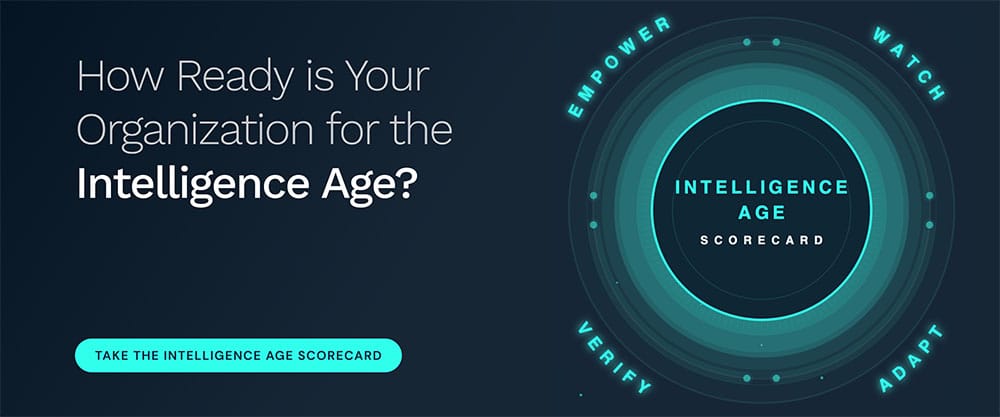
Two blocs have built two incompatible answers to who owns intelligence. One metered and closed, one open and given away, and the model on your procurement list already belongs to one of them. The WAVE Framework — Watch, Adapt, Verify, Empower — asks which move this demands, and for most organizations it is Verify: your vendor strategy was written as a cost decision and has become a sovereignty one.
Benchmark your readiness for the next two quarters with the Intelligence Age Scorecard. Or read the public Intelligence Age Scorecard of Accenture, IBM, Visa, Qantas, Woolworths, Telstra or Commonwealth Bank first.
If this newsletter was forwarded to you, you can sign up here.
Thank you.
Mark
Frequently asked questions
What are the two competing approaches to owning AI intelligence?
One bloc, led by China, treats intelligence as a public good, giving away its largest open model for free and running it on home-grown chips. The other, led by the United States, treats intelligence as a metered product sold by the word, backed by roughly seven hundred billion dollars in data-center spending and defended by a supply-chain pact called Pax Silica involving about thirty-five nations.
Link to this questionWhy are American teams abandoning closed AI models?
American teams are leaving closed models because of cost. Chinese open-weight models have reached nearly half of US model traffic during peak weeks while being offered at a fraction of the price, making the self-hostable, capable alternative from China increasingly attractive on economic grounds alone.
Link to this questionWhy does choosing an AI vendor now mean choosing a geopolitical side?
Because intelligence has split into two incompatible systems, one closed and metered, one open and given away, and the model a company selects for cost reasons increasingly ships from the country its own government is walling off. What looks like a procurement decision has effectively become a decision about which bloc's standard and sovereignty a business operates under.
Link to this questionDid either country build its AI models on original, unowned material?
No, both blocs built their intelligence on material they did not own. American labs scraped the open web and the world's libraries, leading to a copyright settlement already cleared at a billion and a half dollars. Chinese labs are separately accused, by Anthropic, of copying American models through the back door across a border no court can reach, though that claim remains alleged rather than adjudicated.
Link to this question
Dr Mark van Rijmenam
Dr. Mark van Rijmenam, widely known as The Digital Speaker, isn’t just a #1-ranked global futurist; he’s an Architect of Tomorrow who fuses visionary ideas with real-world ROI. As a global keynote speaker, Global Speaking Fellow, recognized Global Guru Futurist, and 5-time author, he ignites Fortune 500 leaders and governments worldwide to harness emerging tech for tangible growth.
Recognized by Salesforce as one of 16 must-know AI influencers , Dr. Mark brings a balanced, optimistic-dystopian edge to his insights—pushing boundaries without losing sight of ethical innovation. From pioneering the use of a digital twin to spearheading his next-gen media platform Futurwise, he doesn’t just talk about AI and the future—he lives it, inspiring audiences to take bold action. You can reach his digital twin via WhatsApp at: +1 (830) 463-6967.