Synthetic Minds | The AI Future They Sell Assumes Machines Know Where
Synthetic Minds | The AI Future They Sell Assumes Machines Know Where
The Synthetic Minds newsletter offers short daily insights to get you thinking. If you enjoy it, please forward. All signals are powered by Futurwise. If you need more insights, subscribe to Futurwise and get 25% off for the first three months!
I built the Intelligence Age Scorecard! It will help you understand how ready your organization is for the Intelligence Age.
Today’s topic: Spatial Intelligence
The Missing Sense Behind Every AI Promise
Meta has promised a superintelligence you reach through your glasses, with agents that run your home, your health, your work. The research meant to power it says machines still cannot reliably tell where things are.
Two of the loudest visions of the AI future both assume a machine can navigate the physical world. The field's own research says it cannot, and cannot yet prove it either way.
Mark Zuckerberg has promised personal superintelligence for billions, reached through glasses, with agents that run your home, health and work.
A separate forecast has robots doubling the economy every year, with spatial reasoning assumed to come free with intelligence.
A comprehensive review of 37 models finds the opposite: machines still fail at knowing where objects are and how a scene changes when you move.
The same review finds the benchmarks grading spatial ability are biased. A model can score high without understanding the room.
Xiaomi has shipped a model that teaches a language system to judge depth and distance, a direct bid to give AI a sense of space. Even so, the best specialist agent answers only about six in ten spatial questions correctly.
Robots grasp an apple every time and a screwdriver one in three.
That's the promise. Here is the signal.
Two of the most confident visions of the AI future have landed together, and both make the same silent bet. One is that superintelligence will reach you through your glasses and act in your physical world. The other is that robots will run the economy.
Both assume the machine can reason about space. That is the one thing it cannot do, yet. It reads the page and misses the room.
Here is the part the visions skip, and it is worse than a delay. The tests that certify machine spatial ability are themselves biased. A model can top the leaderboard without understanding the space in front of it.
That is the same trap the rented robot brain that could not feel the real world walked into; a certificate that proves less than it claims.
So the capital and the trust pouring into agents, glasses and robots are being priced against a yardstick that may measure nothing. This is grading a pilot on an exam that never leaves the hangar.
The promise is distribution. Intelligence for everyone, in every pocket and on every face. The assumption underneath it is spatial. If the agent on your glasses cannot tell what is where, the failure does not stay in a benchmark; it lands in your kitchen, your car, your operating room.
So the question is not when the everyone-gets-superintelligence future arrives. It is whether the benchmark that says a machine understands physical space measures anything at all, and what you have already built on its word.
The visionaries have promised a world their machines can navigate. The research has not shown they can, and the scoreboard cannot tell the difference. That gap is where the next two years are decided.
The Intelligence Age Scorecard
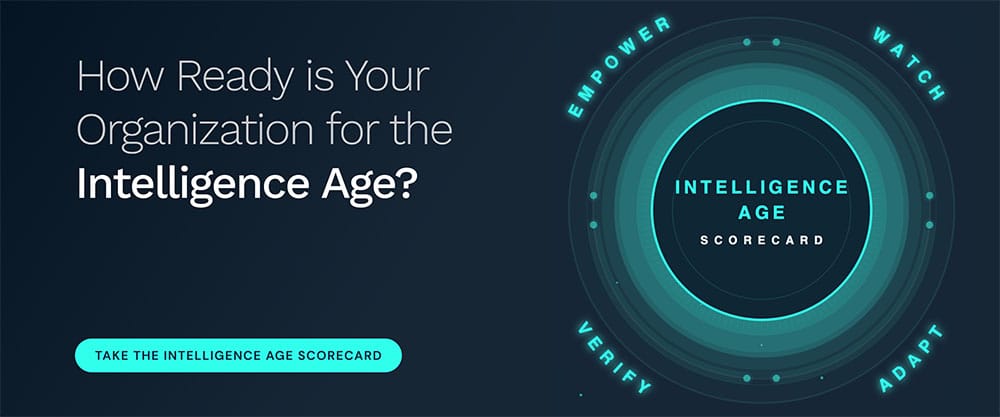
The grandest AI promises, superintelligence through your glasses, robots running the economy, all assume machines can reason about space, and the research says they cannot while the test that grades them is biased. Under the WAVE Framework, Watch, Adapt, Verify, Empower, this is a Verify moment: pressure-test the benchmark behind any physical-AI, agent or automation bet before you fund it.
Benchmark your readiness for the next two quarters, and the next five years, with the Intelligence Age Scorecard. Or read the public Intelligence Age Scorecard of Verizon, Accenture, IBM, Visa, Qantas, Woolworths, Telstra or Commonwealth Bank first.
If this newsletter was forwarded to you, you can sign up here.
Thank you.
Mark
Frequently asked questions
What is spatial intelligence in AI?
Spatial intelligence is a machine's ability to reliably tell where objects are located and understand how a scene changes as it moves through it. It is the capability underlying navigation and physical interaction, and research reviewing many models finds machines still fail at this basic task, even though grand visions of AI assume it comes automatically with intelligence.
Link to this questionWhy is spatial reasoning a problem for AI visions like glasses and robots?
Visions of personal superintelligence delivered through glasses and robots doubling the economy both assume machines can reason about physical space to run homes, health, work, or economic tasks. Research shows this assumption is false: machines still cannot reliably determine where things are, meaning the failure would not stay in a benchmark but would land in real settings like kitchens, cars, or operating rooms.
Link to this questionAre the benchmarks used to test AI spatial ability trustworthy?
No, the same comprehensive review that tested spatial reasoning found the benchmarks grading spatial ability are biased. A model can score highly on these tests without actually understanding the room or space it is being evaluated in, meaning the certification of spatial competence may measure little about real-world capability.
Link to this questionHow well do current AI systems actually perform on spatial tasks?
Performance is limited. Even the best specialist agent designed for spatial reasoning answers only about six in ten spatial questions correctly. Robots also show uneven physical skill, grasping an apple every time but succeeding with a screwdriver only about one in three attempts, showing spatial and physical reasoning remain unreliable despite claims of readiness.
Link to this question
Dr Mark van Rijmenam
Dr. Mark van Rijmenam, widely known as The Digital Speaker, isn’t just a #1-ranked global futurist; he’s an Architect of Tomorrow who fuses visionary ideas with real-world ROI. As a global keynote speaker, Global Speaking Fellow, recognized Global Guru Futurist, and 5-time author, he ignites Fortune 500 leaders and governments worldwide to harness emerging tech for tangible growth.
Recognized by Salesforce as one of 16 must-know AI influencers , Dr. Mark brings a balanced, optimistic-dystopian edge to his insights—pushing boundaries without losing sight of ethical innovation. From pioneering the use of a digital twin to spearheading his next-gen media platform Futurwise, he doesn’t just talk about AI and the future—he lives it, inspiring audiences to take bold action. You can reach his digital twin via WhatsApp at: +1 (830) 463-6967.