Synthetic Minds | When Answers Cost Three Cents, Judgment Gets Expensive

Synthetic Minds | When Answers Cost Three Cents, Judgment Gets Expensive
The Synthetic Minds newsletter offers short daily insights to get you thinking. If you enjoy it, please forward. All signals are powered by Futurwise. If you need more insights, subscribe to Futurwise and get 25% off for the first three months!
I have just launched the Intelligence Age Scorecard! It will help you understand how ready your organization is for the Intelligence Age.
Today’s topic: AI & Automation
When Thinking Is Free, Judgment Gets Costly
A capable AI does a piece of work for three cents that the top American model charges more than three dollars to do. Intelligence is becoming almost free, and it will end up everywhere.
When the thinking costs almost nothing, the scarce thing is no longer knowledge. It is judgment, deciding what to ask, what to trust, and what a machine must never settle alone.
DeepSeek's newest model runs at about three cents a task, against three dollars and fifteen cents for the leading US model, and ships as open weights, free to download and run.
Alibaba has answered with a model that ranks second in the world on images, releasing its weights too.
Businesses have nearly tripled the AI agents they run, halving the time to build each one. Cheap enough to run everywhere.
And the labor market has started to sort. Stanford's payroll study finds workers aged 22 to 25 in the most AI-exposed jobs shrinking near four percent a year, not from layoffs, but a hiring collapse.
PwC's read of a billion job ads shows the opposite pull at the top: roles where AI sharpens expert judgment grow twice as fast and pay far more.
That's the price story. Here is the signal.
Two things are shifting, and only one is being watched.
The cheapest capable models are Chinese and open-weight, so pricing power drains east and the American labs lose the moat they spent billions digging. That is the side effect the market sees.
The bigger change is quieter. When intelligence costs three cents, knowledge stops being the edge. What the machine can look up, it will.
What stays scarce is judgment, deciding which problem matters, whether the answer is true, what a machine must never settle alone.
The market is already paying for it.
The jobs that reward people for weighing what AI produces grow fastest and pay most, while the entry-level roles that once taught the work are being cut. Marjolein ten Hoonte, Director Labour Market and Societal Impact at Randstad, names the durable skill plainly: break a problem into parts, spot the pattern, decide what counts, and learn in good company, because no book holds this yet.
Here is what the architects did not plan for. Judgment is grown, not downloaded, and it is grown on the junior rungs firms are cutting to bank the savings. Automate the beginners away, and the pipeline that produces the seniors goes with them.
The frame that control was leaving the labs named coalitions and governments as the new holders. This is the other half, value leaving knowledge for judgment.
So the board question is not which model to buy. It is where your organization still grows the judgment AI cannot supply, or whether you are quietly defunding it.
The Japanese call the patient root-work before a big move nemawashi, loosening the soil before the transplant. Cheap intelligence is the easy part; growing the judgment to wield it is the root-work.
The Intelligence Age Scorecard
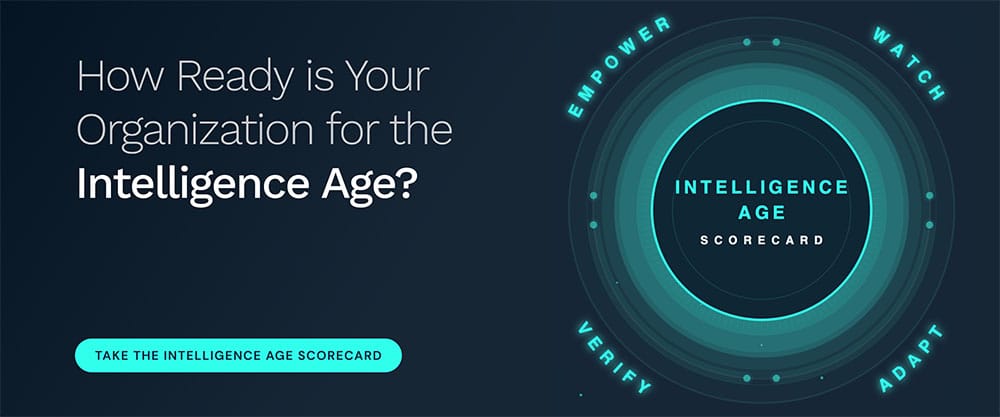
Intelligence has fallen to three cents a task, so it will be integrated everywhere, and the scarce asset becomes the judgment to wield it, exactly as the junior roles that grow judgment are being cut. The WAVE Framework, Watch, Adapt, Verify, Empower, puts this at Empower: the work is building the people and judgment AI cannot replace.
Benchmark your readiness for the next two quarters, and the next five years, with the Intelligence Age Scorecard. Or read the public Intelligence Age Scorecard of Verizon, Accenture, IBM, Visa, Qantas, Woolworths, Telstra or Commonwealth Bank first.
If this newsletter was forwarded to you, you can sign up here.
Thank you.
Mark
Frequently asked questions
Why is judgment becoming more valuable than knowledge in the AI era?
When AI can answer questions for a few cents, knowledge itself stops being a competitive edge because machines can look up whatever is needed. What remains scarce is judgment: deciding which problem matters, whether an AI's answer is true, and what decisions a machine must never be allowed to make alone. The market already pays more for roles that require weighing AI output.
Link to this questionHow much cheaper is the newest AI model compared to the leading US model?
A capable AI model can complete a task for about three cents, compared with over three dollars, specifically three dollars and fifteen cents, charged by the leading US model for the same work. This price collapse means intelligence is becoming nearly free and will be integrated almost everywhere, shifting competitive advantage away from raw access to knowledge.
Link to this questionWhat is happening to entry-level jobs because of AI?
A payroll study from Stanford found that workers aged 22 to 25 in the most AI-exposed jobs are shrinking by nearly four percent a year, driven by a hiring collapse rather than layoffs. At the same time, roles where AI sharpens expert judgment are growing twice as fast and paying more, according to PwC's analysis of a billion job ads.
Link to this questionWhat risk do companies face by cutting junior roles to save costs?
Judgment is grown through experience, not downloaded from a model, and it develops on the junior rungs that firms are now automating away to cut costs. By eliminating entry-level positions, organizations risk destroying the very pipeline that trains the senior judgment they will need later, since no book or AI system yet holds that kind of learned discernment.
Link to this question
Dr Mark van Rijmenam
Dr. Mark van Rijmenam, widely known as The Digital Speaker, isn’t just a #1-ranked global futurist; he’s an Architect of Tomorrow who fuses visionary ideas with real-world ROI. As a global keynote speaker, Global Speaking Fellow, recognized Global Guru Futurist, and 5-time author, he ignites Fortune 500 leaders and governments worldwide to harness emerging tech for tangible growth.
Recognized by Salesforce as one of 16 must-know AI influencers , Dr. Mark brings a balanced, optimistic-dystopian edge to his insights—pushing boundaries without losing sight of ethical innovation. From pioneering the use of a digital twin to spearheading his next-gen media platform Futurwise, he doesn’t just talk about AI and the future—he lives it, inspiring audiences to take bold action. You can reach his digital twin via WhatsApp at: +1 (830) 463-6967.