Synthetic Minds | Building Medicine Got Easy. Proving It Safe Did Not
Synthetic Minds | Building Medicine Got Easy. Proving It Safe Did Not
The Synthetic Minds newsletter offers short daily insights to get you thinking. If you enjoy it, please forward. All signals are powered by Futurwise. If you need more insights, subscribe to Futurwise and get 25% off for the first three months!
I built the Intelligence Age Scorecard! It will help you understand how ready your organization is for the Intelligence Age.
Today’s topic: Health
Who Still Certifies Medicine Moving This Fast?
A child has died in a gene-editing trial that a hospital was allowed to run without a regulator's sign-off. The country that built medicine's fastest engine has started pulling the brakes.
The hardest problem in medicine is no longer building the therapy. It is proving the therapy is safe, and the people paid to prove it are stretched thin.
China built that engine by letting hospitals start trials without its regulator's approval. It has begun tightening the pathway, even as US officials study how to copy the speed.
The price surfaced first. A second child has died in one such gene-editing study, and the company behind it went quiet for more than a year.
The American gatekeeper has been swinging hard both ways. It refused a promising cancer drug over how the drug is manufactured.
It cleared another on an early signal alone, benefit still unproven, after rejecting it twice.
And the ethics boards that clear human trials are, in one ethicist's words, an honor system, paid by the companies they oversee.
That's the speed story. Here is the signal.
For a decade the hard question has been whether we could build the therapy.
Edit the gene. Engineer the virus. Aim the radiation. That question is mostly answered.
The hard question has become who certifies that what we built is safe, and how fast they can do it. That layer, the regulators, the ethics boards, the manufacturing inspectors, has become the real constraint. It is bending in plain sight.
China has proved the point twice over. The pathway that made it the fastest engine in medicine is the same one that let a child die untracked. Beijing has started to rein in the very system Washington wants to import.
The American side is failing from the opposite direction. Ethics boards get paid by the companies they oversee, and get rewarded for turnaround rather than for protecting the person in the bed. The federal office meant to watch the watchers has lost half its staff.
The argument that medicine wired the machine before it wired the judgment named the instrument. This is the instrument breaking.
Here is what the headlines miss. The harm has moved.
It is no longer only a needle in the wrong place. It is data, privacy, consent, the things the old rules never imagined, arriving as the guardians are let go.
So the question a board should carry is not whether its science works. It is whether anyone left in the system can prove it is safe fast enough, and who absorbs the loss when they cannot.
The cost of building has collapsed. The cost of trust has not. Someone is about to learn what that gap is worth, in a currency no discovery can pay.
The Intelligence Age Scorecard
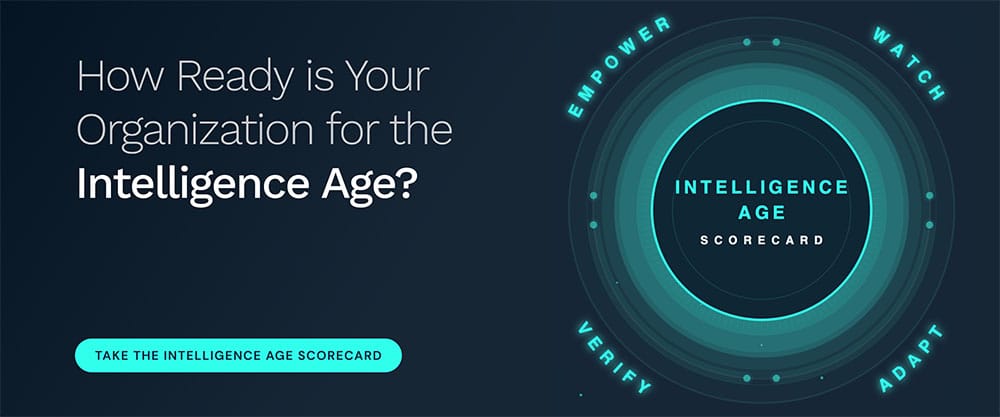
The constraint in advanced medicine has moved from building the therapy to proving it safe, and the regulators, ethics boards, and inspectors doing the proving are stretched thin across two continents. Under the WAVE Framework (Watch, Adapt, Verify, Empower), this is a Verify moment: pressure-test the oversight behind any trial, gene-editing, or novel-modality bet before you fund it, not after.
Benchmark your readiness for the next two quarters, and the next five years, with the Intelligence Age Scorecard. Or read the public Intelligence Age Scorecard of Verizon, Accenture, IBM, Visa, Qantas, Woolworths, Telstra or Commonwealth Bank first.
If this newsletter was forwarded to you, you can sign up here.
Thank you.
Mark

Dr Mark van Rijmenam
Dr. Mark van Rijmenam, widely known as The Digital Speaker, isn’t just a #1-ranked global futurist; he’s an Architect of Tomorrow who fuses visionary ideas with real-world ROI. As a global keynote speaker, Global Speaking Fellow, recognized Global Guru Futurist, and 5-time author, he ignites Fortune 500 leaders and governments worldwide to harness emerging tech for tangible growth.
Recognized by Salesforce as one of 16 must-know AI influencers , Dr. Mark brings a balanced, optimistic-dystopian edge to his insights—pushing boundaries without losing sight of ethical innovation. From pioneering the use of a digital twin to spearheading his next-gen media platform Futurwise, he doesn’t just talk about AI and the future—he lives it, inspiring audiences to take bold action. You can reach his digital twin via WhatsApp at: +1 (830) 463-6967.