Synthetic Minds | Clean Power Becomes Software. Who Holds The Switch?
Synthetic Minds | Clean Power Becomes Software. Who Holds The Switch?
The Synthetic Minds newsletter offers short daily insights to get you thinking. If you enjoy it, please forward. All signals are powered by Futurwise. If you need more insights, subscribe to Futurwise and get 25% off for the first three months!
I have just launched the Intelligence Age Scorecard! It will help you understand how ready your organization is for the Intelligence Age.
Today’s topic: Climate & Energy
The Off-Switch to Your Grid Has Moved
A European ceramics maker has stopped buying batteries the way it once bought boilers. Its fifteen plants run on an AI platform that decides, minute by minute, when each site charges, holds or sells power.
On their own, the headlines read like storage and drilling news. Read together, they reveal something quieter: clean power is growing a brain, and that brain belongs to whoever wrote the software.
Start with that ceramics group. Turbo Energy and HiTHIUM have wired 366 megawatt-hours of batteries across its fifteen sites into one system, where a single platform orchestrates generation, storage and use in real time.
The same logic is reaching underground. Fervo, NVIDIA and Pacific Northwest National Laboratory are building a digital twin of geothermal rock, a working software model that will run the reservoir, as Fervo drives its 400-megawatt Cape Station project toward first power.
It is reaching the grid as well. Google and Energy Dome have agreed to create a carbon-dioxide battery in Ireland that stores 200 megawatt-hours of wind and releases it on command under a ten-year contract, while rPlus has switched on Utah's largest solar-and-battery plant, 400 megawatts of sun wired to four hours of storage and built to dispatch on demand, not on weather.
That is the storage story. Here is the signal.
For a decade, clean energy was sold by the megawatt, and the winner was whoever built the most of them. These announcements quietly change the prize. The real contest is the right to decide when the power flows, and that right lives in software.
Look at what each deal transfers. The ceramics group still owns its batteries, but an outside platform decides how they behave; Fervo still owns its wells, but a model will tell them how to run.
Firmness, a.k.a. power on demand, has detached from the steel and become something you license.
AI had taken the operating seat inside the climate stack. When one optimization platform, a single compute stack and a few hyperscaler-funded storage fleets decide how clean power dispatches, grid reliability rests on code that no energy regulator audits and no operator can fully switch off.
It arrives wearing the friendly face of efficiency. A factory trims its energy bill and a utility smooths its wind, so the dependency stays invisible until the day the platform changes its price, its owner, or its mind.
So the question for your board is not how many megawatts you own. It is who holds the off-switch to the software that decides when they run.
Clean power spent its first decade learning to generate. It has started learning to obey. The question that compounds is simple: whose command does it answer to?
The Intelligence Age Scorecard
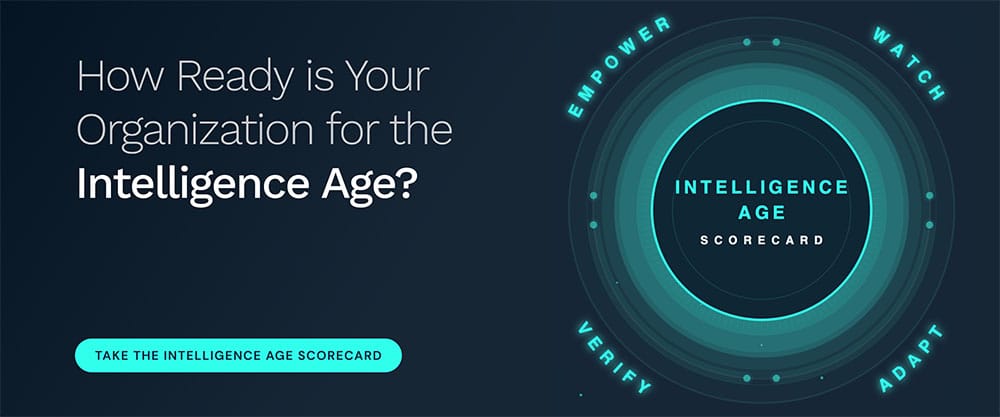
The control layer of clean power has moved into the asset itself, an AI platform running a storage fleet, a digital twin running a geothermal reservoir, or a hyperscaler-funded firmness running on a grid contract. WAVE — Watch, Adapt, Verify, Empower — is the question this pattern puts to every leadership team: are you still watching which megawatts you own, or already adapting to the fact that someone else's software decides when they flow?
Take the Intelligence Age Scorecard to benchmark your readiness for the next two quarters, and the next five years. Or read the public Intelligence Age Scorecard of IBM, Visa, Qantas, Woolworths, Telstra or Commonwealth Bank first.
If this newsletter was forwarded to you, you can sign up here.
Thank you.
Mark
Frequently asked questions
How is a European ceramics maker using AI to manage its energy?
A European ceramics group has wired 366 megawatt-hours of batteries across its fifteen plants into one AI platform, built with Turbo Energy and HiTHIUM, that decides minute by minute when each site charges, holds or sells power, orchestrating generation, storage and use in real time rather than relying on manually managed equipment.
Link to this questionWhat is the digital twin project happening in geothermal energy?
Fervo, NVIDIA and Pacific Northwest National Laboratory are building a digital twin of geothermal rock, a software model that will run the reservoir, as Fervo advances its 400-megawatt Cape Station project toward first power. This shows software increasingly taking over operational decisions in energy infrastructure that were once handled directly by asset owners.
Link to this questionWhy does control over clean energy software matter more than owning megawatts?
For a decade clean energy was judged by megawatts built, but the real contest has shifted to who decides when power flows, and that decision now lives in software. Deals like the ceramics group's batteries or Fervo's wells show owners still hold the hardware, but outside platforms and models dictate behavior, meaning firmness, or power on demand, has become something licensed rather than owned outright.risks
Link to this questionWhat is the main risk of AI controlling clean power dispatch?
When a single optimization platform, compute stack or a few hyperscaler-funded storage fleets decide how clean power dispatches, grid reliability depends on code that no energy regulator audits and no operator can fully switch off. This dependency stays hidden behind the appearance of efficiency until the platform changes its price, ownership, or behavior, leaving leadership without control over their own energy assets.
Link to this question
Dr. Mark van Rijmenam
Dr. Mark van Rijmenam is The Digital Speaker, a world-leading futurist and global AI keynote speaker who helps leaders decide what AI, and the technologies that follow it, mean for their business. He speaks to leadership teams at their retreats and to conference audiences worldwide, and his WAVE framework gives them a way of deciding that they keep using long after he has left the room. His Intelligence Age Scorecard measures how ready an organization is across the four WAVE pillars.
He holds a PhD from the University of Technology Sydney, is a Certified Speaking Professional and Global Speaking Fellow, and ranks among the world’s top futurists on the Global Gurus list (#1 in 2025, #3 in 2026). Salesforce named him one of its 16 leading AI voices. He has written six books, most recently Now What? How to Ride the Tsunami of Change, writes the Synthetic Minds newsletter on Substack, and founded Futurwise. Talk to his digital twin on WhatsApp: +1 (830) 463-6967.