Synthetic Minds | The Token Is Becoming the Only Copy of What You Own
Synthetic Minds | The Token Is Becoming the Only Copy of What You Own
The Synthetic Minds newsletter offers short daily insights to get you thinking. If you enjoy it, please forward. All signals are powered by Futurwise. If you need more insights, subscribe to Futurwise and get 25% off for the first three months!
I have just launched the Intelligence Age Scorecard! It will help you understand how ready your organization is for the Intelligence Age.
Today’s topic: Tokenization
When Your Ownership Record Has No Backup
A custodian that keeps the books on $8.6 trillion of assets has begun issuing funds whose only proof of ownership is a token on a ledger. There is no paper twin left to check it against.
Read four announcements together and a system appears: the record of who owns what is moving onto the ledger itself, and the second copy that used to verify it is being removed.
A custodian has built a blockchain register for funds issued natively as tokens, with BlackRock and Baillie Gifford among the first names. The token becomes the ownership itself, no conventional share left to reconcile against.
Ten European banks have launched a shared, neutral chain, Cecabank, Crédit Mutuel, DZ Bank and Standard Chartered's venture arm among them, timed for the moment central-bank money begins settling on-chain.
Aviva Investors has put a cash fund on a public ledger, but only as a mirror of the paper share, reconciled daily and unable to move. The old model showing its ceiling.
Circle, the issuer of a 70 billion digital dollar, has won bank-like charters, state and federal, making it the regulated entity of record for the cash that settles all of it.
That's the tokenization story. Here is the signal.
For a century, every share you owned existed twice. Once on the company's register, once in your broker's books.
The two were checked against each other, day after day. That second copy was never redundancy. It was the audit. How an error got caught and a fraud got found.
Native issuance deletes it. When the token is the ownership, there is no other book to reconcile against. The efficiency is real, and so is the loss: the check disappears with the copy.
The argument that money arrived on rails whose trust layer was already breaking named the price feed and the issuer key as the weak points. This is the next turn of that screw. The record of ownership has joined them on the same private infrastructure, and shed its backup in the move.
Concentration follows. A handful of custodians, bank cooperatives and stablecoin issuers are becoming the single source of truth for trillions in funds and cash. Whoever holds the only copy holds a power the old registers never granted anyone.
The last time one ledger became the sole proof of who owned what, it was the medieval land roll, and whoever controlled the parchment controlled the estate.
So the board question has changed. Not whether to tokenize. When your ownership record has no second copy, who do you trust to keep the only one, and what is your recourse when it is wrong?
Tokenization has stopped copying the old system and started replacing it. When ownership has only one copy, the question is no longer how to move it, but who you trust to hold it.
The Intelligence Age Scorecard
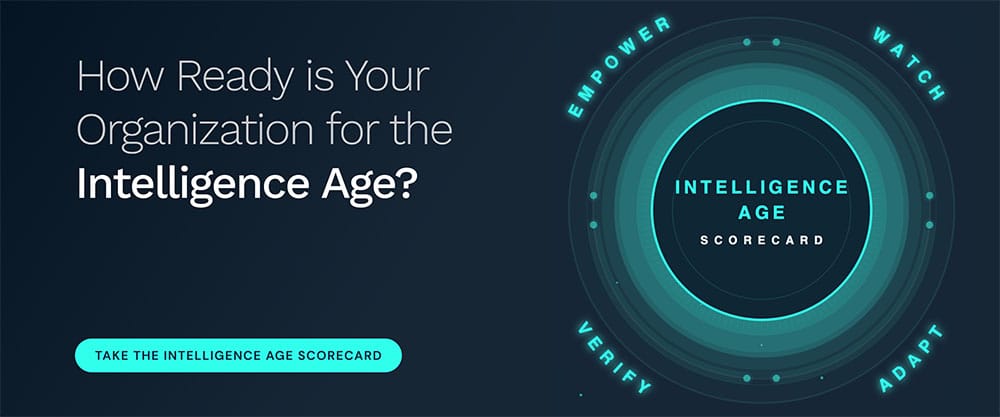
Fund ownership has begun moving on-chain as the token itself, and the reconciled second copy that used to verify it is being removed as the money arrives. The WAVE Framework, Watch, Adapt, Verify, Empower, asks which move this demands, and here it is Verify: before you tokenize, pressure-test who holds the only record of what you own and what your recourse is when it is wrong.
Benchmark your readiness for the next two quarters with the Intelligence Age Scorecard. Or read the public Intelligence Age Scorecard of Verizon, Accenture, IBM, Visa, Qantas, Woolworths, Telstra or Commonwealth Bank first.
If this newsletter was forwarded to you, you can sign up here.
Thank you.
Mark
Frequently asked questions
What does it mean for a token to become the only copy of ownership?
Historically, every share existed twice: once on a company's register and once in a broker's books, and the two were checked against each other daily. With native issuance, the token itself becomes the ownership record, so there is no separate paper or ledger copy left to reconcile against, removing the second record entirely.
Link to this questionWhy was having a second copy of an ownership record important?
The second copy was never just redundancy, it functioned as the audit mechanism. By checking one record against another day after day, errors could be caught and fraud could be found. Removing that second copy eliminates this built-in check, even though it makes the system more efficient.
Link to this questionWhat is the main risk of removing the second ownership record?
The main risk is concentration of power: a small number of custodians, bank cooperatives, and stablecoin issuers become the single source of truth for trillions in funds and cash. Whoever holds that only copy gains a level of control over ownership records that the old dual-register system never granted anyone.
Link to this questionHow does Aviva Investors' tokenized fund differ from natively issued tokens?
Aviva Investors put a cash fund on a public ledger, but only as a mirror of the existing paper share. It is reconciled daily against that paper share and cannot move independently, showing the ceiling of the old model, unlike native issuance where the token itself becomes the sole ownership record with nothing left to check it against.
Link to this question
Dr Mark van Rijmenam
Dr. Mark van Rijmenam, widely known as The Digital Speaker, isn’t just a #1-ranked global futurist; he’s an Architect of Tomorrow who fuses visionary ideas with real-world ROI. As a global keynote speaker, Global Speaking Fellow, recognized Global Guru Futurist, and 5-time author, he ignites Fortune 500 leaders and governments worldwide to harness emerging tech for tangible growth.
Recognized by Salesforce as one of 16 must-know AI influencers , Dr. Mark brings a balanced, optimistic-dystopian edge to his insights—pushing boundaries without losing sight of ethical innovation. From pioneering the use of a digital twin to spearheading his next-gen media platform Futurwise, he doesn’t just talk about AI and the future—he lives it, inspiring audiences to take bold action. You can reach his digital twin via WhatsApp at: +1 (830) 463-6967.