Synthetic Minds | Who Issues Your Machines a Name and a Spending Limit

Synthetic Minds | Who Issues Your Machines a Name and a Spending Limit
The Synthetic Minds newsletter offers short daily insights to get you thinking. If you enjoy it, please forward. All signals are powered by Futurwise. If you need more insights, subscribe to Futurwise and get 25% off for the first three months!
I have just launched the Intelligence Age Scorecard! It will help you understand how ready your organization is for the Intelligence Age.
Today’s topic: Agents & Tokenization
Who Holds the Off-Switch for Your Agents?
Three companies have handed AI agents a wallet, and all three sell the same promise: you set the spending limit. Read the fine print. Someone else enforces it.
The contested prize has moved off the payment rail and up one floor, to who issues a machine its identity, vouches for the data it acts on, and holds its permission to spend.
At the network edge, Cloudflare has given agents an identity and a wallet, a checkable name tied to their owner, plus per-agent caps and approved-merchant lists.
A wallet maker has gone further: MetaMask has shipped a self-custodial agent wallet that lets an agent act inside your own keys and your own rules, with a default mode that demands approval for anything out of policy.
Underneath, a licensed Hong Kong exchange has built the settlement layer. OSL routes an agent's stablecoin (digital-cash) payments across currencies and chains through one door.
The same company issuing those AI identities has warned that machine traffic could run a 1000 times human traffic within five years, with humans becoming a rounding error online.
One thread runs through all four: a machine cannot act until it is named, vouched for, and capped.
That's the payments story. Here is the signal.
The rails were the old fight, and it is settled. The pipes are laid, so the advantage has moved upstairs, to who vouches for a machine and the data it acts on.
An agent needs three things to transact: a name you can verify, a wallet, and a limit. Hand those out, and you hold its passport and its credit line at once.
The pitch is safety. You set the cap, you keep the keys. All true. Read it again.
You set the limit; someone else enforces it. Whoever enforces it can freeze the agent, throttle it, or switch it off. The off-switch has changed hands, and no one voted on it.
Identity is only half of it. If machine traffic runs a thousand times human traffic, proving that a request, and the data behind it, is real becomes the plumbing the internet lacks.
Cryptographic proof, the tamper-evident ledger, is the obvious candidate. This runs deeper than tokenizing assets; it is about the veracity of data itself.
The Know Your Agent problem named the first gap. Identity built for software, not people. Enforcement and veracity are the next two, with no liability rule and no portability.
The last time a private gatekeeper decided who was trusted online, control of that trust became control of the web.
So the question is not whether to let your agents transact. It is who you allow to issue your machines their name and vouch for their data, and your recourse the day that party says no.
Whoever hands the machines their name holds a quiet veto over the machine economy. The question worth carrying upstairs is plain: whose permission, and whose proof, will your agents be living on?
The Intelligence Age Scorecard
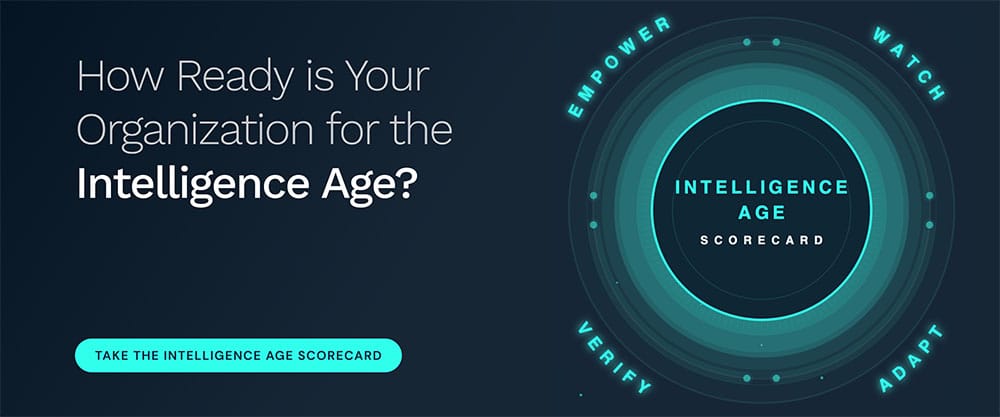
The layer that issues an AI agent its identity and its spending limit has been staked out across cloud, wallet and exchange in a single stretch, and the party enforcing the limit holds the off-switch. The WAVE Framework, Watch, Adapt, Verify, Empower, asks which move this demands, and here it is Verify: pressure-test who would issue and enforce your agents' spending authority before you delegate it.
Benchmark your readiness for the next two quarters, and the next five years, with the Intelligence Age Scorecard. Or read the public Intelligence Age Scorecard of Verizon, Accenture, IBM, Visa, Qantas, Woolworths, Telstra or Commonwealth Bank first.
If this newsletter was forwarded to you, you can sign up here.
Thank you.
Mark
Frequently asked questions
What three things does an AI agent need to transact?
An agent needs a verifiable name, a wallet, and a spending limit. Whoever hands out these three elements effectively holds both the agent's passport and its credit line, giving that party significant control over how and whether the agent can act.
Link to this questionWho actually controls an AI agent's spending limit?
Although you set the spending cap for your agent, someone else enforces it. That enforcing party can freeze, throttle, or switch off the agent at will. This means the off-switch has effectively changed hands to the company providing identity and wallet infrastructure, without any formal vote or agreement on the shift.
Link to this questionWhy does machine identity matter more than payment rails now?
The payment rails themselves are already built and settled as infrastructure. The real contest has moved up a level to who issues a machine its identity, vouches for the data it acts on, and holds its permission to spend. Controlling that layer means controlling trust in the emerging machine economy.
Link to this questionWhat is the Know Your Agent problem?
The Know Your Agent problem names the first gap in machine identity: current systems were built for verifying people, not software agents. Beyond this identity gap, two further gaps exist, enforcement and data veracity, and neither has an established liability rule or portability mechanism yet.
Link to this question
Dr Mark van Rijmenam
Dr. Mark van Rijmenam, widely known as The Digital Speaker, isn’t just a #1-ranked global futurist; he’s an Architect of Tomorrow who fuses visionary ideas with real-world ROI. As a global keynote speaker, Global Speaking Fellow, recognized Global Guru Futurist, and 5-time author, he ignites Fortune 500 leaders and governments worldwide to harness emerging tech for tangible growth.
Recognized by Salesforce as one of 16 must-know AI influencers , Dr. Mark brings a balanced, optimistic-dystopian edge to his insights—pushing boundaries without losing sight of ethical innovation. From pioneering the use of a digital twin to spearheading his next-gen media platform Futurwise, he doesn’t just talk about AI and the future—he lives it, inspiring audiences to take bold action. You can reach his digital twin via WhatsApp at: +1 (830) 463-6967.