Synthetic Minds | Which Country Will Host Your Tokenized Assets
Synthetic Minds | Which Country Will Host Your Tokenized Assets
The Synthetic Minds newsletter offers short daily insights to get you thinking. If you enjoy it, please forward. All signals are powered by Futurwise. If you need more insights, subscribe to Futurwise and get 25% off for the first three months!
I built the Intelligence Age Scorecard! It will help you understand how ready your organization is for the Intelligence Age.
Today’s topic: Tokenization
The World Stopped Renting Wall Street's Financial Rails
Four financial centers on four continents have moved a piece of their home market onto a blockchain, and not one of them asked New York for permission. The map of who owns finance has quietly redrawn itself.
This is not a crypto story. It is a geography story: the rails that carry tokenized assets are no longer built in one place and rented to everyone else.
In the Gulf, a US exchange has won a license from Abu Dhabi's regulator to put global stocks on-chain as real securities, with voting and dividend rights, registered under local oversight rather than American.
In Brazil, the largest bank in Latin America has begun testing tokenized bonds and funds inside its own regulator's sandbox, built on the rails of the country's digital-currency work.
In Tokyo, the biggest Japanese bank has started settling government-bond loans on a shared institutional chain, aiming to turn a three-day process into round-the-clock finality.
And an African development lender has sold a 431 million dollar digital bond straight onto a Swiss exchange, the first of its kind from the continent.
Four venues. Four regulators. One direction of travel.
That's the tokenization story. Here is the signal.
Tokenization has stopped being a Wall Street story. It has become a map.
The rails are no longer built in one place and rented to everyone else. Each region has begun laying its own, blessed by its own regulator and kept inside its own perimeter.
That perimeter is the whole point. A tokenized market that a national authority has approved keeps its issuers, its settlement fees, its data, and its bargaining power at home. For a bank, an exchange, or a finance ministry, this is a chance to own the plumbing of the next capital market instead of leasing it from someone else's balance sheet.
The argument that a handful of US custodians were becoming the single source of truth for global assets has found its counter-move, and the rest of the world has started making it. One issuer has already priced a live bond to prove the path works, not in a demo, but with real money and a real coupon.
The shadow is fragmentation. Twenty on-chain markets built to twenty rulebooks do not automatically speak to each other, and the value leaks to whoever controls the bridges between them.
The last time banks built a shared network to connect national systems, SWIFT became a lever of statecraft, and losing access to it has punished whole economies, not any single bank.
So the question your board should weigh is not whether to tokenize. It is which market's rails your assets will live on, and who you are willing to let hold the connections between them.
The first movers are not waiting for a global standard. They are building the market they want to live in, and inviting everyone else to come settle on their terms.
The Intelligence Age Scorecard
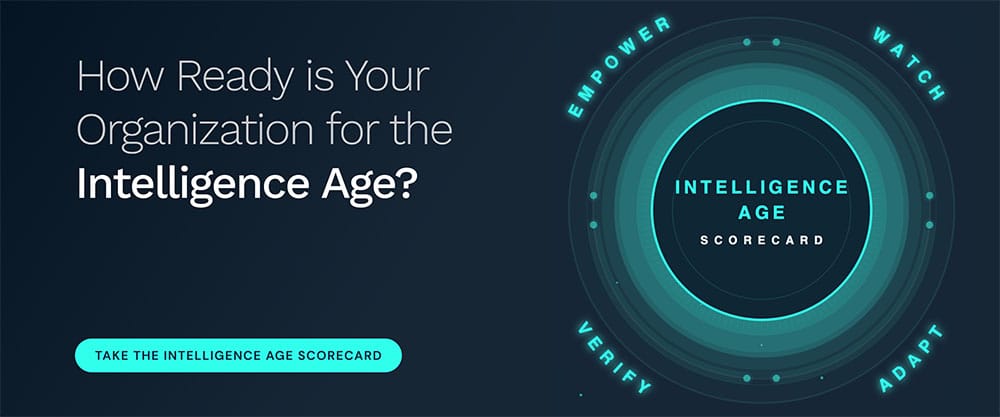
Four regulators on four continents have each blessed a home-grown on-chain market for stocks, bonds, or sovereign debt, and the prize has shifted to which jurisdiction hosts your assets. The WAVE Framework, Watch, Adapt, Verify, Empower, asks which move this demands, and here it is Adapt: decide which market's rails your tokenized assets will live on before the choice is made for you.
Benchmark your readiness for the next two quarters, and the next five years, with the Intelligence Age Scorecard. Or read the public Intelligence Age Scorecard of Verizon, Accenture, IBM, Visa, Qantas, Woolworths, Telstra or Commonwealth Bank first.
If this newsletter was forwarded to you, you can sign up here.
Thank you.
Mark
Frequently asked questions
What are the four examples of tokenization mentioned globally?
A US exchange won a license from Abu Dhabi's regulator to put global stocks on-chain as real securities. The largest bank in Latin America is testing tokenized bonds and funds inside Brazil's regulator sandbox. The biggest Japanese bank is settling government-bond loans on a shared institutional chain in Tokyo. An African development lender sold a 431 million dollar digital bond directly onto a Swiss exchange.
Link to this questionWhy does it matter that tokenization is spreading beyond Wall Street?
Tokenization has shifted from being controlled from one place and rented out to everyone else, into a map where each region builds its own rails under its own regulator. This lets a bank, exchange, or finance ministry keep issuers, settlement fees, data, and bargaining power at home, rather than leasing the plumbing of capital markets from someone else's balance sheet.
Link to this questionWhat is the risk of countries building separate tokenized asset markets?
The shadow risk is fragmentation. Twenty on-chain markets built to twenty different rulebooks do not automatically connect with each other, and value leaks to whoever controls the bridges between them. This echoes how SWIFT became a lever of statecraft, where losing access punished entire economies rather than a single bank.
Link to this questionWhat decision should businesses make about tokenized assets now?
The key question is not whether to tokenize, but which market's rails your assets will live on and who you are willing to let control the connections between those rails. Following the WAVE Framework's Adapt principle, organizations should decide which jurisdiction's tokenized market to use before that choice gets made for them by first movers already building markets on their own terms.
Link to this question
Dr Mark van Rijmenam
Dr. Mark van Rijmenam, widely known as The Digital Speaker, isn’t just a #1-ranked global futurist; he’s an Architect of Tomorrow who fuses visionary ideas with real-world ROI. As a global keynote speaker, Global Speaking Fellow, recognized Global Guru Futurist, and 5-time author, he ignites Fortune 500 leaders and governments worldwide to harness emerging tech for tangible growth.
Recognized by Salesforce as one of 16 must-know AI influencers , Dr. Mark brings a balanced, optimistic-dystopian edge to his insights—pushing boundaries without losing sight of ethical innovation. From pioneering the use of a digital twin to spearheading his next-gen media platform Futurwise, he doesn’t just talk about AI and the future—he lives it, inspiring audiences to take bold action. You can reach his digital twin via WhatsApp at: +1 (830) 463-6967.